Ciara Moloney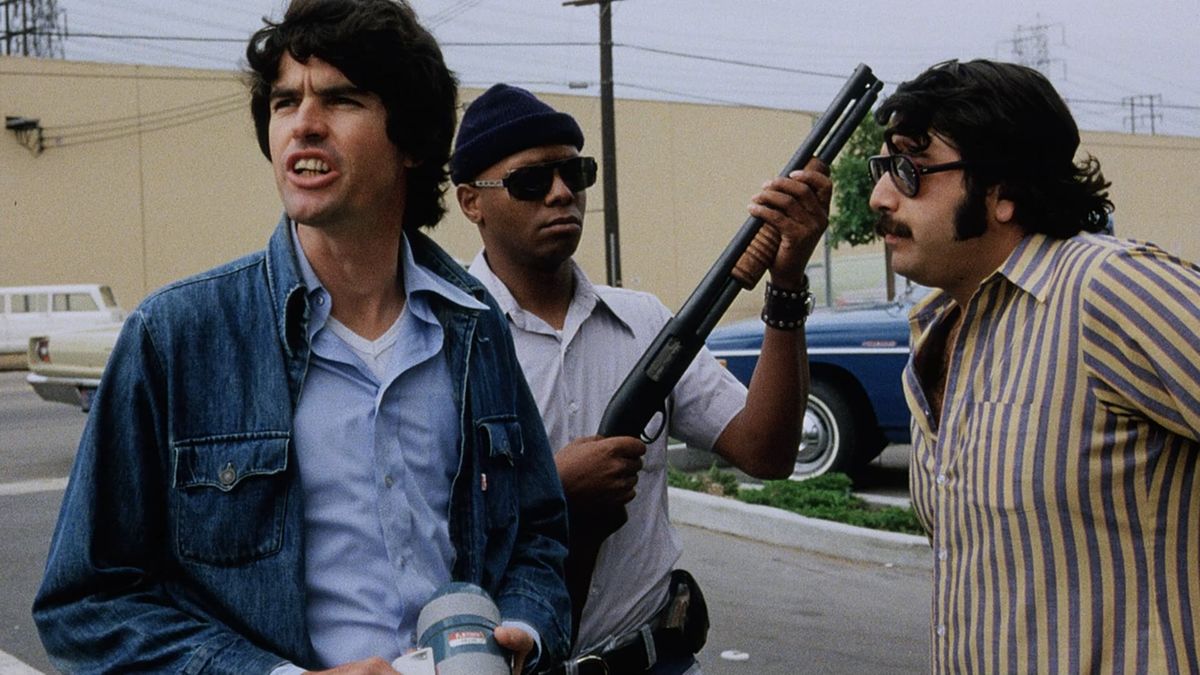
The original 1974 Gone in 60 Seconds is a gonzo car stunt showcase. Almost half the movie is a single car chase through six California cities,from Long Beach to Carson; during its filming, ninety-three cars were destroyed. Writer-director, producer and star HB Halicki was a stuntman with a dream, and he powered that dream to reality buying cars at a city auction for 200 bucks and convincing his friends and family to play roles on-screen. It’s an improbable success story that ended in tragedy, when he was killed by a falling telephone pole on the set of Gone in 60 Seconds 2 in 1989.
I’m not going to talk about any of that.
The first half of Gone in 60 Seconds, before it turns into an insane car chase, is what a curmudgeon might call “boring” and “badly made.” The car theft ring at the story’s center has a contract to steal forty-eight specific cars and deliver them to the docks by Friday, and a lot of screentime is spent on logistical meetings. Much of the dialogue in these scenes is dubbed over footage where you can’t see the actors’ mouths or even faces, shot without a script and cobbled together by editor Warner E. Leighton. They’re some of the best, most realistic scenes in film history.
The meetings in Gone in 60 Seconds have a kind of attentive, even transcendent eye for mundanity that you get in some Italian neorealist cinema, or the religious dramas of Robert Bresson. As a director, Bresson would have his actors repeat the same actions again and again until any quality of “performance” was gone, becoming, as Shmuel Ben-gad writes, “like people we meet in life, more or less opaque creatures who speak, move, and gesture.” The non-professional actors (non-acting actors, really) of Gone in 60 Seconds, too, are like people we meet in life. Most movies – and action movies especially – do not take place in the real world so much as in Movie Land, an approximation of reality built on top of a century of previous approximations of reality. Not so Gone in 60 Seconds. It is this willingness to attend to utter tedium that makes the shift into car action extravaganza so explosive.
Meetings (either one-on-one or in groups) happen in every organisation, meaning “vast amounts of employee time, salaries, and other organizational resources are invested in meetings every single day.” Yet meetings in movies do not meaningfully resemble this everyday experience. Even in non-fiction film, meetings are rarely depicted at all and rarely depicted accurately: the documentaries of Fredrick Wiseman being a rare exception. But in fiction films, meetings are places where characters make impassioned speeches, have revelations about their life priorities, and do evil schemes. In heist movies in particular, the meetings are as thrilling as the robbery itself. In Ocean’s Eleven, the distinction between planning and executing the heist is thoroughly blurred as Danny Ocean runs through the plan in a custom-built life-size replica of the casino vault. But what Gone in 60 Seconds realises is: meetings about things that are exciting are, in the end, meetings.
Before becoming a director, Halicki owned and operated an impound and towing business – that is to say, was a guy with a regular job who had to go to meetings. Meetings have specific conventions that regulate conversation – producing what linguistics scholar Jan Svennevig calls “meeting talk.” Gone in 60 Seconds captures “meeting talk” not in tongue-in-cheek deployment of corporate jargon – circling back on mission-critical synergy and so forth – but in something more fundamental, capturing not a particular moment or trend but a basic, tedious alienation.
Meetings are essentially a creature of management, with direct reports often passive participants, or indeed receptacles. All the real decisions are made at the meeting before the meeting anyway. (In Gone in 60 Seconds, the meeting before the meeting is telling a guy he can’t take time off because they need to hit their target by the end of week.) Not seeing characters’ faces when they speak breaks the voyeuristic intimacy of the screen. The audience is neither a godlike observer nor part of the conversation, but stands awkwardly at the edge of the group. The characters on screen are as opaque as real people in a meeting for a company you don’t work for. Even as the plan is explained, it’s hard to fully grasp it: we’re given a task list, not a scheme.
“You’ll have to redo this so we can read it. But just go down the line here and code name them. I want all of them listed this way…” Halicki tells an employee, “Also, uh, let me see, what was it, oh, I want you to get both undercover cars serviced and ready to go.” I still can’t really explain why it was important for the cars to be insured. But everyone’s had jobs where they weren’t sure why they were meant to do what they were doing, or what contribution (if any) it made to some larger goal. That’s what most jobs are like. Even robbing cars.
“Gone in 60 Seconds” is streaming on several ad-supported services.