Sean Burns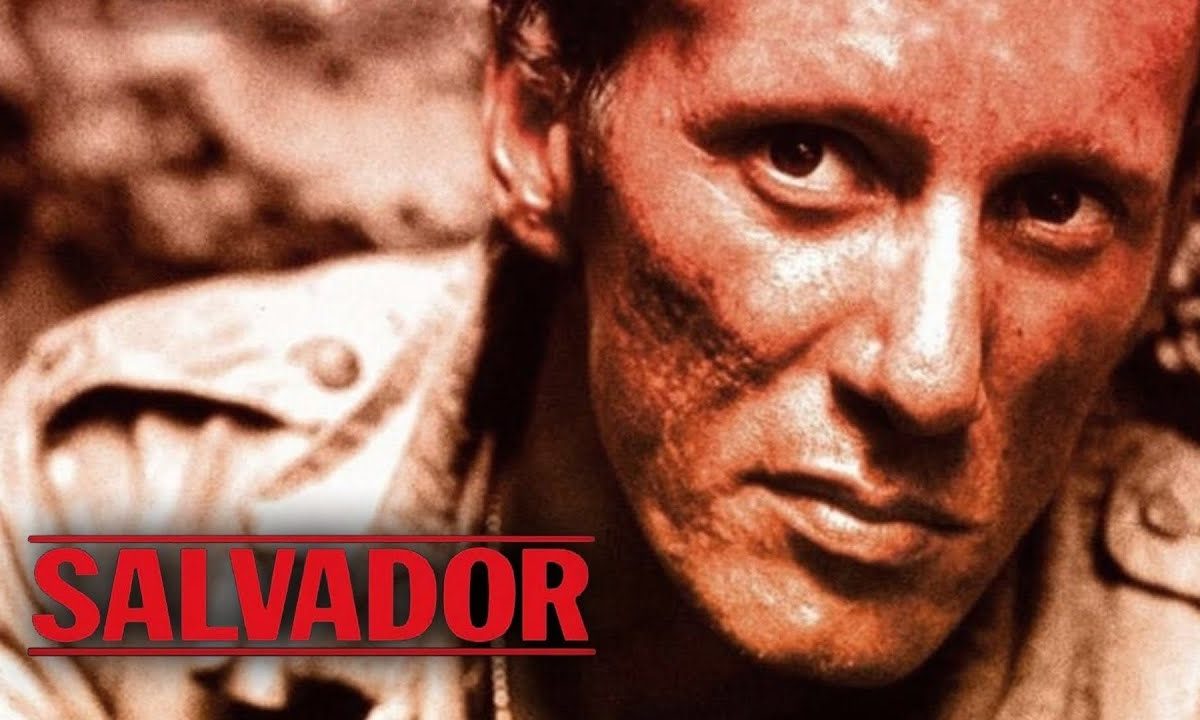
“I love America,” insists Richard Boyle, the swaggering dirtbag reporter played by James Woods in Oliver Stone’s electrifying Salvador. He’s giving a what-for to a cartoonishly blonde-coiffed CIA agent and a mustachioed, cigar-smoking colonel, unloading for a full five minutes about how the U.S. is once again interfering in a legitimate peasant revolution, backing a fascist militia strongman under the guise of fighting communism. “So that’s why you guys are here?” he sputters, “Looking for some kind of post-Vietnam experience, like you need a rerun or something?”
Every movie was a ”post-Vietnam experience” for Stone, who had famously enlisted to fight in a war that violently ripped away every illusion this child of privilege had held about his country. His subsequent political awakening was expressed in a prolific run of ferocious, shockingly successful films that reclaimed patriotism for an audience who felt betrayed and disappointed by their country. From 1986’s Salvador to 1995’s Nixon, Stone directed a string of incendiary pop entertainments made by and for people who loved America enough to know that it could do better.
Salvador is the crudest and most propulsive of the bunch, a fireworks factory of jaded idealism loosely based on the real-life Boyle’s misadventures in Central America. Stone was an Oscar-winning screenwriter but his directorial career had been a non-starter, with the failure of his risible horror film The Hand leaving him on the outs with the studios. Salvador was a run-and-gun independent production. Stone believed it was his last chance and poured everything he had into it. As Pauline Kael noted in her review: “He writes and directs as if someone had put a gun to the back of his neck and yelled ‘Go!’ and didn’t take it away until he’d finished.”
Half-Graham Greene, half-Hunter S. Thompson, the movie begins with the wiry, Hawaiian-shirted Boyle and his bloated, disc jockey drug buddy Doctor Rock (James Belushi) speeding to Central America in a beat-up red convertible loaded with booze and a bevy of controlled substances. They’re both single again, broke again and Boyle figures he might be able to sell some photos of the civil war that’s been popping off in the region. It’s Fear and Loathing in El Salvador, with caveman Woods convincing Belushi to come along for the ride by claiming that down there “you can get a virgin to sit on your face for seven bucks. Two for twelve.”
Most of the dialogue is that rancid, often riotously so. Stone tries to knock the earnest, do-gooder halo off the social issue drama by making his lead characters lowlifes. As a yammering asshole who thrives on chaos, Woods has never been better. He’s the most abrasive of actors — as Kael said, hostility oozes from his pores – but Woods also projects a whip-smart intelligence. Boyle’s the kind of savvy operator who keeps his car glove compartment full of knockoff watches he can take off his wrist to hand out as bribes. He goes through a lot of watches in this picture.
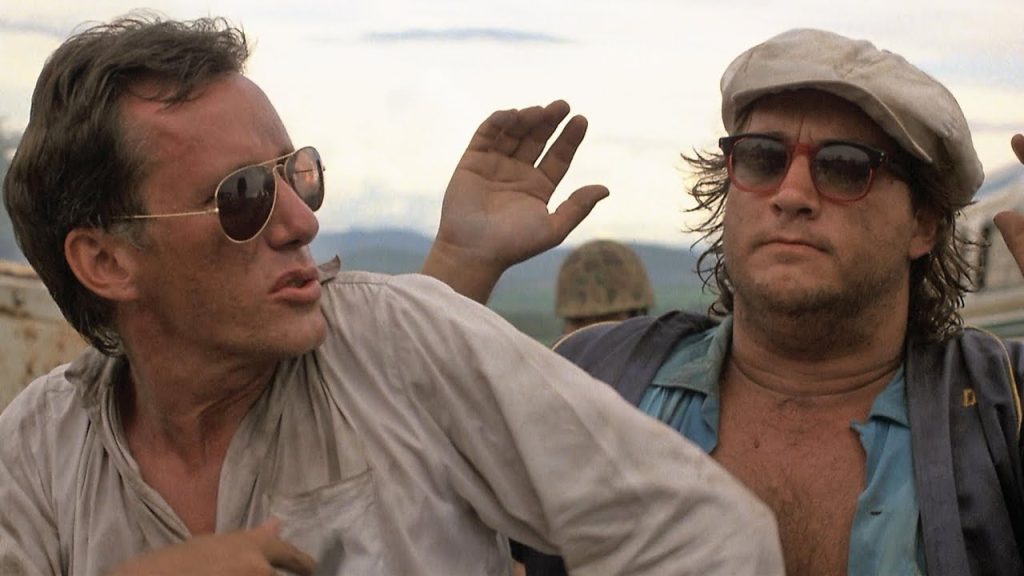
One of the throughlines is that Boyle’s hustling to get the appropriate papers so his angelic girlfriend can leave the country. She’s played by Elpidia Carrillo as an abstract trigger for his redemption. The women in Stone’s films tend to be more motivational forces than people, but the director is able to whip up enough sturm und drang around the star-crossed couple that we buy Boyle’s declarations of love without any onscreen evidence. Woods has much better chemistry with Belushi, who serves as our addled audience surrogate with his endearing, “Can you believe this fucking guy?” reactions to the messes his friend keeps dragging him into. Much like Michael Mann’s Thief and Kristen Stewart’s The Chronology of Water, Salvador serves as a reminder of what a superb character actor Belushi can be when he’s playing it straight.
As always, the filmmaker’s blunt-force, tabloid storytelling plays fast and loose with history, to sometimes outrageous ends. He puts Woods and Carrillo at the communion rail in the same pew as Archbishop Romero’s assassin, and stages a thrilling horseback battle at Santa Ana that never happened. In his delightfully candid memoir Chasing the Light, Stone admits he made it up because he figured Salvador would be his last movie, and he really wanted to film a horse charge. Who can blame him? It’s a rousing scene with a bitter aftertaste, as Boyle looks on in horror as his idealized revolutionaries immediately begin executing their vanquished enemies in cold blood. Meet the new boss.
But Salvador isn’t particularly interested in the nuances of Central American politics. It’s more about Stone’s ideal of a macho, alpha-male liberalism. Boyle is drinking, drugging, and whoring harder than anyone else, while standing up to pious, ineffectual weenies like Michael Murphy’s Carter-appointed ambassador – who we meet here in the process of being shoved out the door by Reagan’s lantern-jawed goon squad. (Nobody was better than Murphy at embodying 1970s spinelessness in a suit.) The only person in the movie Boyle respects is a brilliant combat photographer played by John Savage, probably because he’s the one guy who takes even crazier risks than he does.
Despite some now-obvious political differences with the character, Woods was so perfectly cast that Stone let him write his own dialogue for the film’s funniest and most famous scene, in which lapsed Catholic Boyle goes to confession for the first time in 30 years and tries to fast-talk the priest into carving out certain exemptions for his salvation. In Stone: The Controversies, Excesses and Exploits of a Radical Film Director, Woods told biographer James Riordan that the director said: “I don’t want to give you the lines. I want you to just look into that dark, murky soul of yours, into that weasel soul of yours, and come up with whatever you want.”
Boyle keeps telling anyone who will listen that he stayed in Cambodia longer than journalist Sydney Schanberg. One could read that as the director’s dig at The Killing Fields, a tasteful, Oscar-winning production that plays “Imagine” on the soundtrack, as opposed to Stone’s leering close-ups of drooling death squad savages raping nuns. Salvador is a lurid, disreputable picture, and quite deliberately so. Stone’s saying that if a selfish, disgusting lout like Boyle can be outraged about what his country is doing in his name, then you decent people have no excuse.
“Salvador” is streaming on Hoopla, Amazon Prime Video, and several other ad-supported streamers.