Josh Bell
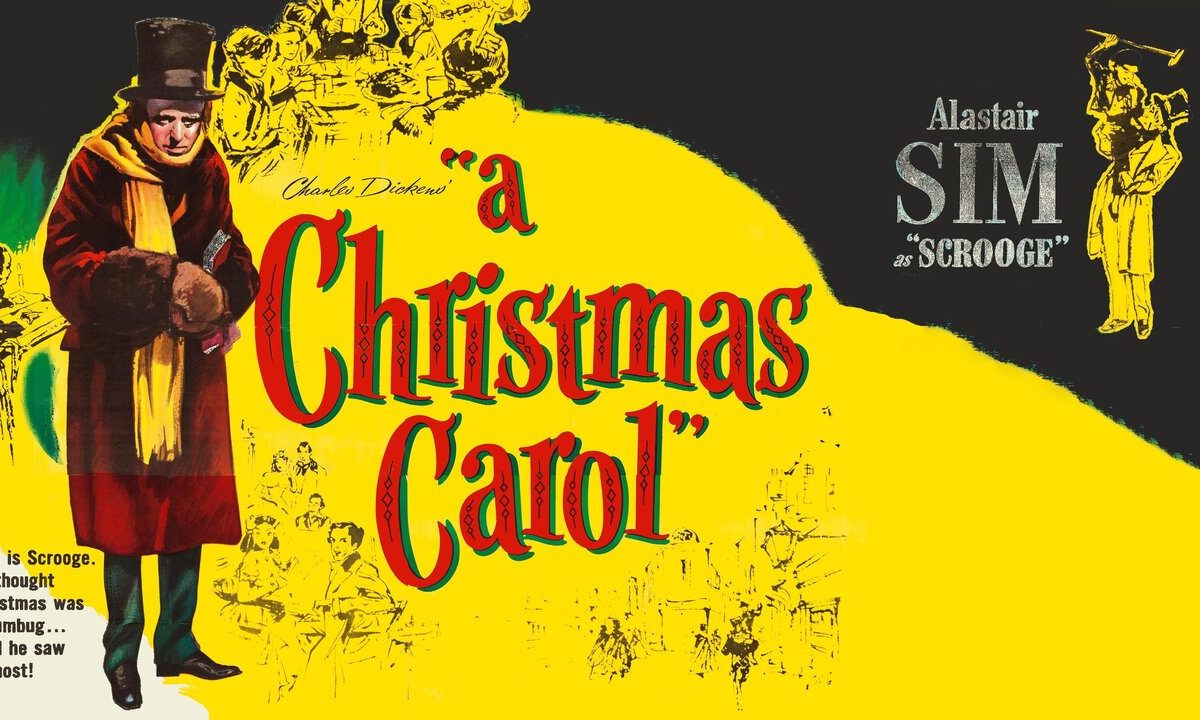
October 31, 1951, marked the U.K. premiere of a movie about a miserable man spending a harrowing night being tortured by multiple ghosts, who put him through an ordeal that ends with him collapsing atop his own grave. That movie, of course, is director Brian Desmond Hurst’s adaptation of Charles Dickens’ perennial holiday favorite A Christmas Carol (released in the U.K. as Scrooge and in the U.S. under Dickens’ original title). It’s unlikely that producers intended for the premiere to be a Halloween celebration, but Hurst’s version of the frequently adapted novel is appropriate for both spooky season and yuletide season, emphasizing the grim, bleak aspects of Dickens’ inspirational story.
That sense of stark humanism also makes Hurst’s film the best cinematic take on A Christmas Carol, anchored by a fantastic performance from Alastair Sim as Ebenezer Scrooge. While actors often take a cartoonish approach to the famous miser, Sim treats him seriously, playing him as a weary, haunted man full of regrets, both before and after his iconic Christmas Eve transformation. Many screen Scrooges take perverse delight in their disdain for the working class and dismissal of human kindness, but Sim’s Scrooge is as dejected as the impoverished people he denigrates.
From its opening moments, A Christmas Carol mixes the ominous with the festive. A disembodied hand reaches for a leatherbound tome from a shelf, accompanied by a portentous orchestral score. Then that shifts into Christmas carol “Hark! The Herald Angels Sing,” and the book opens to Dickens’ familiar prose. Even the choral music often sounds threatening, though, and the London that Scrooge inhabits is a city of dingy, cramped spaces and streets that are either excessively crowded or entirely desolate. “Good afternoon,” Scrooge says huffily to the people he meets as he goes about his business, under such thick gloom that it’s hard to believe afternoon has ever existed here.
Every space has a patina of dust, including both Scrooge’s office, where he works with his kind-hearted clerk Bob Cratchit (Mervyn Johns), and his home, which is sparse and threadbare despite his obvious wealth. Hurst and cinematographer C. M. Pennington-Richards add expressionist flair to these glum spaces, with long shadows cast across every room. The city itself reflects Scrooge’s inner torment, and his pessimism seems like an entirely natural reaction to his surroundings.
Into this forbidding world enter the ghosts who will teach Scrooge to appreciate life, each with their own horrors. Hurst uses simple optical effects for these spectral presences, starting with the face of Scrooge’s late business partner Jacob Marley (Michael Hordern) superimposed on his doorknocker. As Scrooge dozes in front of his meager fire, loud bells begin to ring even though none of the bells in the room are moving. There’s the snarling sound of a dog or wolf outside the door before Marley enters, dragging his chains, to tell Scrooge about the three ghosts that will visit him that night.
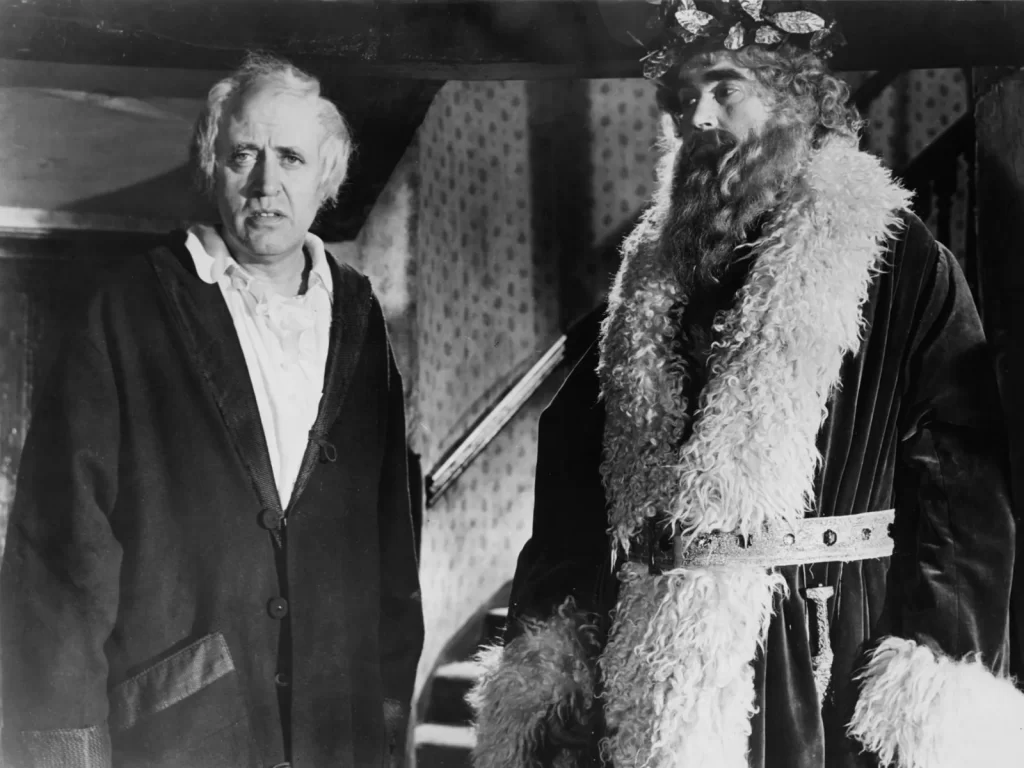
The final apparition, the Ghost of Christmas Yet to Come (Czesław Konarski), is typically depicted as a terrifying shrouded presence, but even the jovial Ghost of Christmas Present (Francis de Wolff) has a sinister bearing here, with his maniacal laughter reaching Scrooge through the bedroom door before he’s revealed onscreen. “Are you afraid?” asks the Ghost of Christmas Past (Michael J. Dolan) when he invites Scrooge to join him in leaping out a window, and that question applies to the entire experience.
Hurst and screenwriter Noel Langley expand on Dickens’ story in ways that make Scrooge both more hardened and more despondent, especially in the lengthy Ghost of Christmas Past section. Here, Scrooge and Marley engage in a hostile takeover in order to launch their company, covering up the financial crimes of their former boss in the process. Scrooge’s resentment of his nephew Fred (Brian Worth) stems from his despair over the death of his sister, Fan (Carol Marsh), following Fred’s birth. In the same manner, Scrooge’s father blames him for the death of his own mother during childbirth. The family cycle of emotional abuse perpetuates itself.
“I’m too old — I’m beyond hope!” Scrooge wails to the Ghost of Christmas Present, already judging himself as beyond redemption even as he begins to understand the harm he’s caused. Sim’s Scrooge doesn’t so much learn his lesson as acknowledge what he’s always known: that he’s been punishing himself in the same way he punishes others, as a way of inflicting his anguish upon the world. When he wakes up the next day rejuvenated with love for his fellow man, Sim plays it as a kind of mania, and there’s a sense that Scrooge hasn’t actually changed, just redirected his internal energy. “I don’t deserve to be so happy,” he mutters to himself, that old self-loathing still just below the surface.
Following its Halloween U.K. premiere, A Christmas Carol opened in New York City the following month, originally scheduled to play at Radio City Music Hall. It was rejected as inappropriate for family holiday fare at Radio City, but that’s exactly the reason it’s endured. Rather than cuddly entertainment for the whole family, it’s a harsh look at the greed and cruelty of human nature. Just the right movie for a cold Halloween night.
“A Christmas Carol” is streaming on Tubi, Plex, and Kanopy.