Craig J. Clark
It’s instructive to compare the openings of Stuart Gordon’s first two features. Re-Animator and From Beyond are both adaptations of works by H.P. Lovecraft, which Gordon and his collaborators updated to the present day. Set within the milieu of academia and scientific inquiry, the films depict unorthodox experiments gone awry, carried out by a pair of scientists, with the elder winding up a mangled corpse that the younger (played in both cases by Jeffrey Combs) has to explain on the spot. In the former, he’s the haughty Herbert West, who insists he gave his mentor “life” and somehow avoids any legal entanglements. In From Beyond, the nervous Crawford Tillinghast isn’t as lucky, as he’s arrested for murder and placed in a mental hospital. All things considered, he might have preferred to stay there.
Unlike Re-Animator, which had the six-part serialized story “Herbert West—Reanimator” to draw material from, From Beyond’s prologue just about exhausted Lovecraft’s original (written in 1920, but not published until 1934). Accordingly, Gordon, producer Brian Yuzna, and screenwriter Dennis Paoli had to get creative when fleshing it out. Lovecraft gave them plenty to go on, though, and the suggestive nature of the opening gave them something to top over the ensuing 75 minutes. (That’s another thing From Beyond has in common with its predecessor: brevity.)
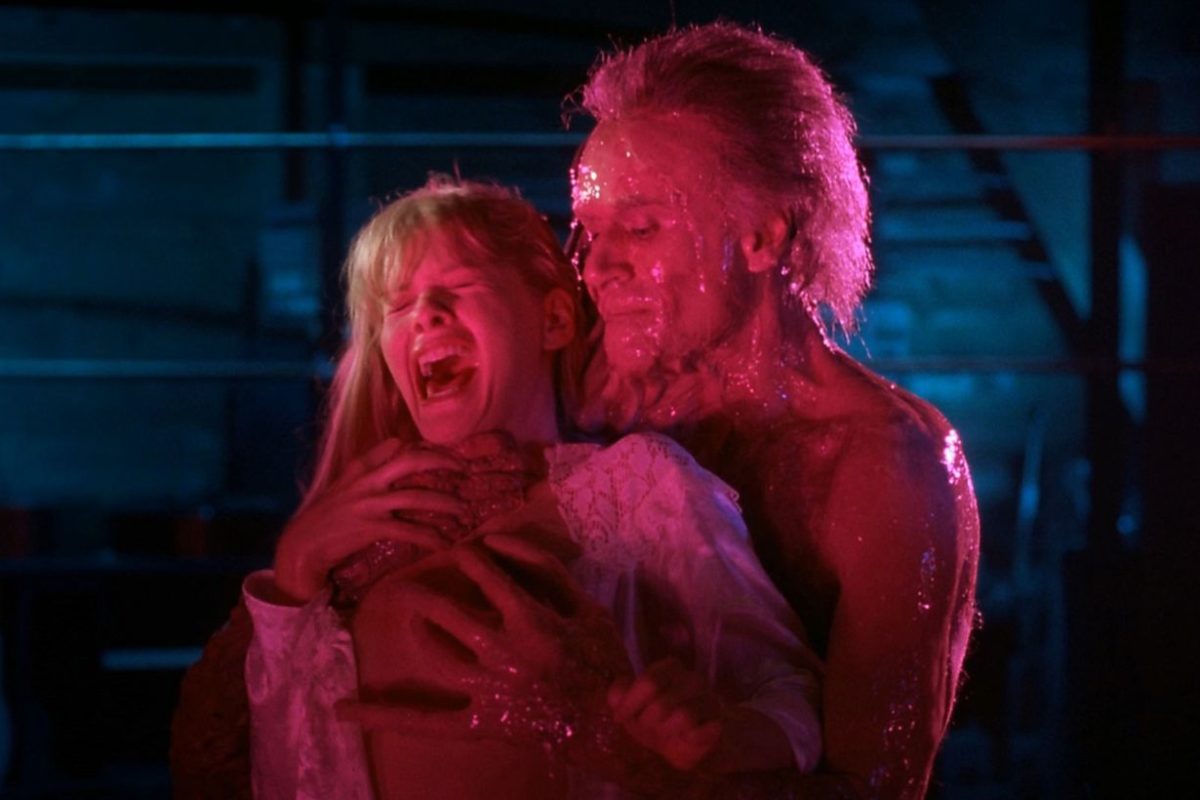
The device that drives the plot – the Resonator – goes unnamed and undescribed by Lovecraft, but since its function is to stimulate the pineal gland, Gordon and company use that as an excuse to inject eroticism into the proceedings since it’s said to regulate the sex drive. That appears to have been the main goal of Dr. Edward Pretorius (Ted Sorel), a hedonist and sexual deviant whose desire to see “more than any man has seen” leads directly to his demise – in our dimension, at least. “He was a genius,” Crawford says. “It’s just that the five senses weren’t enough for him. He needed more.” Regardless of what Dr. Pretorius needs, what he gets is a visit from a slimy creature that bites off his head “like a gingerbread man.”
As for Crawford, he’s visited by Dr. Katherine McMichaels (Combs’s Re-Animator co-star Barbara Crampton), who’s seeking a cure for schizophrenia and believes Dr. Pretorius’s research may hold the key. To that end, she gets Crawford released into her custody (over the objection of Carolyn Purdy-Gordon’s officious Dr. Bloch) and, accompanied by police detective Bubba Brownlee (Ken Foree, the film’s MVP), takes him back to the Pretorius Institute to recreate the experiment. Their initial success – and Crawford’s apparent exoneration – is short-lived, however, since the Resonator turns out to have something of a mind of its own, and Dr. Pretorius is an even more dangerous adversary than they could imagine.
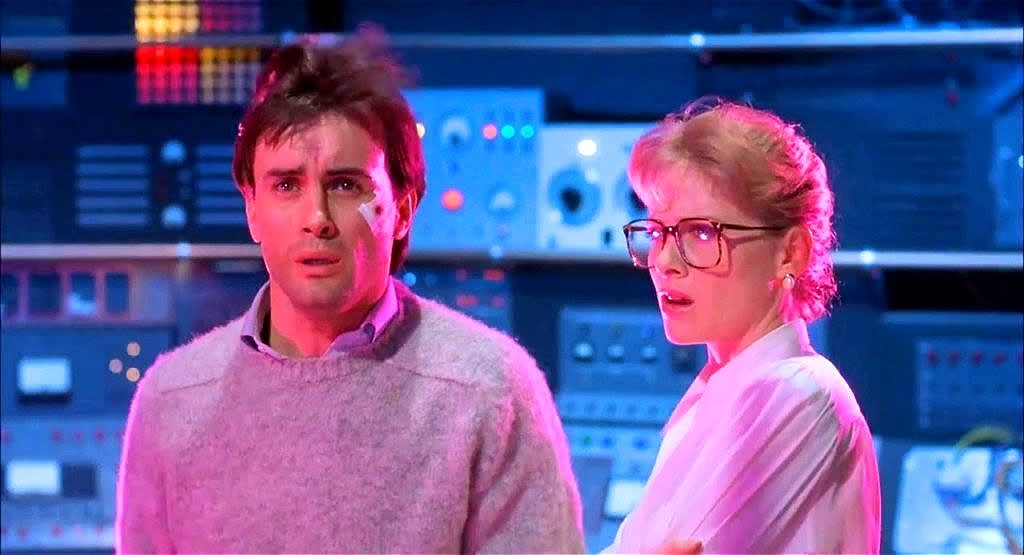
Coming close on the heels of Re-Animator, it’s interesting to note that Combs and Crampton essentially swap roles in From Beyond. This time she’s the scientist who loses her objectivity and continues with an experiment long past the point where a reasonable person would stop. (Katherine’s choice of wardrobe is also decidedly different from West’s.) As for Foree’s Bubba, he’s the story’s voice of reason and sanity, which is why he has to be taken out of it first – and the film misses his jovial skepticism when he’s gone.
In addition to Combs and Crampton, the “keeping the band together” aspect of the production extends to the crew, chief among them editor Lee Percy, cinematographer Mac Ahlberg, and composer Richard Band (whose score is less indebted to Bernard Herrmann this time out). Ahlberg’s contribution is especially important considering how much emphasis is placed on the color and quality of the light whenever the Resonator is activated. The film also had a small army of special effects technicians at its disposal who used every trick in the Necronomicon to bring the various inhuman entities to slimy, slithery life. Working in Italy on his second film in a row (Dolls was shot first, but released second owing to its extended post-production phase), Gordon made the most of the budget he had by limiting the number of characters and locations to get maximum bang for Empire Pictures’s buck.
That bang was somewhat muted when From Beyond was first released, thanks to the trimming of a few of its more graphic moments courtesy of the MPAA. Thankfully, these have since been reinstated on home video, so viewers can experience the film as Gordon intended. As fun as his work often is, he didn’t soft-pedal the violence in it, and sought to get visceral reactions out of audiences. As Katherine McMichael says, echoing Dr. Pretorius’s credo, “There’s always more to see.” Gordon might have added, “There’s always more to feel.”
“From Beyond” can be viewed on a number of services without the need of a Resonator. It is also available on 4K from Vinegar Syndrome.