Jason Bailey
Every Tuesday, discriminating viewers are confronted with a flurry of choices: new releases on disc and on demand, vintage and original movies on any number of streaming platforms, catalogue titles making a splash on Blu-ray or 4K. This twice-monthly column sifts through all of those choices to pluck out the movies most worth your time, no matter how you’re watching.
PICK OF THE WEEK:
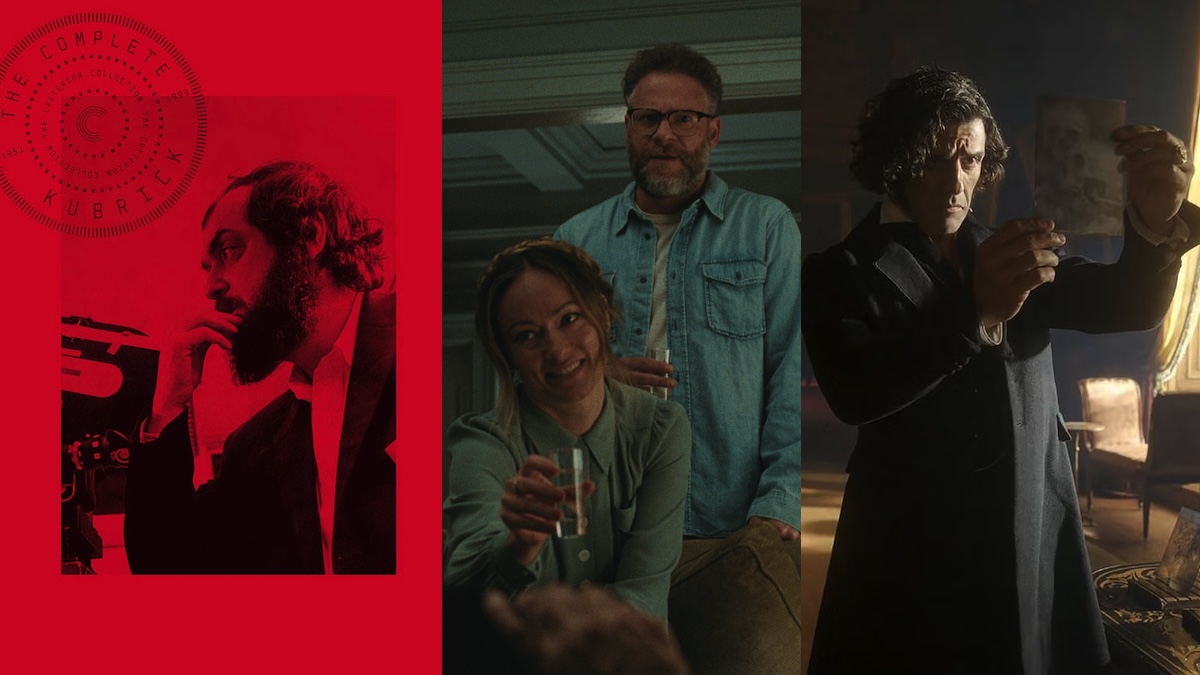
The Complete Kubrick: When Criterion announced its exhaustively comprehensive Stanley Kubrick box set a few months back, there was some grumbling among physical media cheapskates (hello) that it was an awfully hefty price tag for a collection comprised mostly of movies that had already been released, by Criterion and others, as stand-alone 4K UHD releases. And it’s not that spending time with the object itself has rendered that criticism moot. But there is undeniable value in taking in the full body of the master filmmaker’s work — thirteen features (Fear and Desire, Killer’s Kiss, The Killing, Paths of Glory, Spartacus, Lolita, Dr. Strangelove, 2001: A Space Odyssey, A Clockwork Orange, Barry Lyndon, The Shining, Full Metal Jacket, and Eyes Wide Shut), three shorts, and various odds and ends — and watching his evolution from a still photographer, struggling in the transition between mediums, to one of the most exacting and confident directors in history. There are also a fair number of valuable and hard-to-find bonuses, including the frankly revelatory international cut of The Shining (which Kubrick preferred to the U.S. version, and this viewer concurs). And it must also be said that as a totemic object, as a physical media genie bottle, it’s breathtaking — the most impressive 4K release in recent memory. (Includes audio commentaries, documentaries, featurettes, The Shining international version, new and archival interviews, Lolita screen tests, archival materials, and essay by Nathaniel Rich.)
ON HBO MAX:
The Invite: This story of two couples at a dinner party is a wickedly smart, quietly knowing, and frequently quotable exploration of marital ennui, sexual desire, and keeping up appearances. The four speaking roles are played by director Olivia Wilde, Seth Rogen, Penelope Cruz, and Edward Norton, and all four shine; Norton gets to call on his unsung gifts as a comic actor, Rogen gets to a point where everything he says is funny, Cruz has several line readings that will live in your head rent-free. Wilde may have the most difficult role, and she nails it, without sacrificing the quality of her direction — the tonal turns are gingerly navigated, except when they’re jarring on purpose. It starts out like Who’s Afraid of Virginia Woolf, turns into Bob & Carol & Ted & Alice, and earns comparison with both.
ON 4K / BLU-RAY / DVD / VOD:
Frankenstein: The Creature of Dr. Victor Frankenstein doesn’t show up until nearly an hour into Guillermo del Toro’s take on Mary Shelley’s tale (a new addition to the Criterion Collection), and that’s exactly how it should be; unlike the simplest adaptations of this chestnut, he’s no mere monster, and Dr. Frankenstein isn’t simply a scientist, but a man motivated by his own demons and darkness. del Toro immediately frames the Creature as a sympathetic figure, and Jacob Elordi does much of that work with only his eyes, a potential disadvantage that the gifted actor turns into an affecting tool. There are moments of black humor and unexpected eroticism, and don’t worry, gore hounds — it gets good and grisly in the home stretch. Some of the CGI is a lil’ janky, and del Toro’s script can be too on-the-nose with the themes (William’s dying words to his brother are “You are the monster”). But overall, it’s a gorgeous, delicate work, making an oft-told tale into something fresh and distinct. (Also streaming on Netflix.) (Includes extended “reborn” cut, audio commentary, featurettes, interviews, Q&As, trailer, and essay by Christopher Frayling.)
ON 4K UHD:
The Silence of the Lambs: Jonathan Demme’s 1991 grand-slam Oscar winner is a home video perennial — Criterion’s 4K upgrade follows KL Studio Classics’ 4K edition just five years ago, which itself followed Criterion’s Blu-ray re-release by a mere four years – but I’ll always welcome the opportunity to revisit it. The memorable quotes and moments have become such pop-culture shorthand that we often forget the complexity of what surrounds them; Silence boasts not only the serial-killer procedural element but a complicated portrait of women in the workplace, a thoughtful exploration of the challenges of transcending class, and a thrillingly unconventional deployment of the subjective camera. Plus, y’know, “fava beans” and “an old friend for dinner” and all that. It remains a high watermark for all involved, and the 4K presentation richly replicates the original theatrical presentation’s blown-out lights and terrifying darkness. (Includes audio commentary, deleted scenes, interviews, documentaries, featurettes, storyboards, trailer, and essays by Thomas Harris, Amy Taubin, Caden Mark Gardner, and Willow Catelyn Maclay.)
Christiane F.: Long all-but-impossible to see legally, at least on these shores, this 1981 drug drama from director Uli Edel finally got a proper restoration and re-release last year, and now gets a glorious 4K (also from Criterion). It was worth the wait. Christiane F. is a jaw-dropper, detailing in often uncomfortable detail the slow descent and seemingly impossible rehabilitation of the title character, a German good-time girl who we first meet at the tender age of 13. Its impact and influence on drug cinema is tough to overstate – the pitch-black portraiture of addiction presages Requiem for a Dream, while Edel’s musical motifs and gonzo energy were clearly key to Trainspotting – but it has an unforgiving bleakness and vérité craft all its own. (Includes interviews, screen tests, and essay by Hester Baer.)
The Frighteners: Peter Jackson’s first American studio picture (following the international success of Heavenly Creatures) was sold less on his name than that of executive producer Robert Zemeckis, whose presence alongside star Michael J. Fox hinted at more fun in the Back to the Future mold. The premise is juicy, with Fox as a huckster who can, in fact, see ghosts, but employs them to manufacture hauntings that he can then collect a hefty fee for cleaning up. Jackson doesn’t quite make it work, taking the fundamentally comic premise more seriously the deeper he goes, mixing the elements uneasily before a somewhat desperate infusion of action in the third act. But Fox is having fun, Trini Alvarado brings her A-game opposite him, and Jeffrey Combs makes the admirable choice to go absolutely nutso as the primary antagonist. Arrow Video’s 4K restoration shows effects that have held up quite well, preserving the enjoyable mixture of throwback (borderline corny) ghost effects with impressive, then-recent advancements in CGI. (Includes audio commentary, archival introductions, documentaries, interviews, and trailer.)
ON BLU-RAY:
Jewel Robbery: One of Warner Archives’ most admirable ongoing projects has been their attention to the filmography of Pre-Code queen Kay Francis, following up last summer’s release of The Keyhole with this sparkling jewel of a caper comedy from 1932. (Would it be too much to hope for Guilty Hands next?) Francis brings her stunning beauty, smoky charm, and sly line delivery to the role of society woman Teri, who finds her marriage of convenience challenged by her immediate attraction to a gentleman jewel thief, played with winking delight by Francis’s frequent co-star William Powell. Their chemistry is electric enough to power a Manhattan skyscraper, all loaded double entendres and barely-contained lust, and the line from this picture to something like Out of Sight is so short and direct, it’s barely perceptible. (Includes cartoons and trailer.)
The Blackboard Jungle: It’s easy to dismiss this 1955 social drama from director Richard Brooks as either a typical scare-mongering ‘50s juvenile delinquent picture or an early example of the kind of trite “inspirational teacher” movie that’s still a cliché. And neither of those critiques are meritless; the story unfolds in the broadest possible strokes, and Glenn Ford comes across as such a leaden square for most of the picture that much of the narrative feels like checking boxes. But it stands out for two reasons: the historical importance of the “Rock Around the Clock” opening, a thrilling and immediate recalibration of what movie music was and could be, and the showcase supporting role for Sidney Poitier, who similarly hinted at the kind of movie star that was waiting around the corner. (Includes audio commentary, cartoon, and trailer.)
The First Films of Samuel Fuller: Criterion continues, admirably, to simultaneously add new sets to their Eclipse collection while going back to upgrade some of the most notable DVD-only editions. This is certainly worth the bump, compiling the first three films the great Fuller directed (I Shot Jesse James,The Baron of Arizona, and The Steel Helmet) between 1949 and 1951, after more than a decade of screenwriting. James is a fine example of the sort of psychologically rich, morally nuanced Western that directors like Mann and Boetticher were making in the run-up to the revisionist period; it’s also entertaining to watch now as the blueprint for Andrew Dominick’s The Assassination of Jesse James by the Coward Robert Ford, which follows it almost beat for beat. Baron is centered by a delightfully atypical Vincent Price turn as the title character, a kind of pre-Daniel Plainview type, capable of both squalid bloodlust and refined sophistication. (And James Wong Howe’s cinematography is gorgeous.) And The Steel Helmet’s influence on later classics is even more obvious, thanks to the presence of an Asian kid sidekick nicknamed “Short Round”; set during the then-current Korean War, its rah-rah conclusion (and egregious stock footage) are forgivable in light of the knotty scenes that come earlier, in which the American GI’s North Korean P.O.W. asks pointed questions of the company’s Black and Japanese grunts. Those are the scenes that make it special, and that are most indicative of Fuller’s considerable gifts. (Includes essay by Nick Pinkerton.)
The Shout: A wildly eccentric movie, even by the standards of director Jerzy Skolimowski, as the arrivals of a menacing Alan Bates and an ingratiating Tim Curry set the residents of an English village — particularly a lusty Susannah York and her cuckolded husband John Hurt — on their collective ear. Skolimowski, adapting Robert Graves’s s short story, doesn’t use the title lightly; this is among his most sophisticated uses of sound design, with the most chilling scenes and dialogue barely delivered above a whisper, until the title lament comes around and turns your speakers into dust. I’m still not sure what I thought of this one, but I certainly haven’t stopped thinking about it. (Includes interviews, featurette, festival appearance, and essay by Leo Goldsmith.)
Welcome II the Terrordome: One more new addition to the Criterion Collection, and one of the most obscure, a 1995 British production from writer/director Ngozi Onwurah (the first Black woman to helm a theatrically-distributed British feature). An Afro-futurist portrait of life in a “dirty, rancid, stinking shithole” of segregation and crime, it uses its genre trappings to encase its social commentary, using powerful imagery and historical touchstones to make its points about the present. It’s a fine companion piece to the earlier Criterion releases Born in Flames and Fresh Kill — films that use their low budgets, grimy aesthetics, and nothing-to-lose urgency to do the work of post-apocalyptic table setting and storytelling. (Includes audio commentary, interview, three Onwurah short films, and essay by Kadish Morris.)