Josh Bell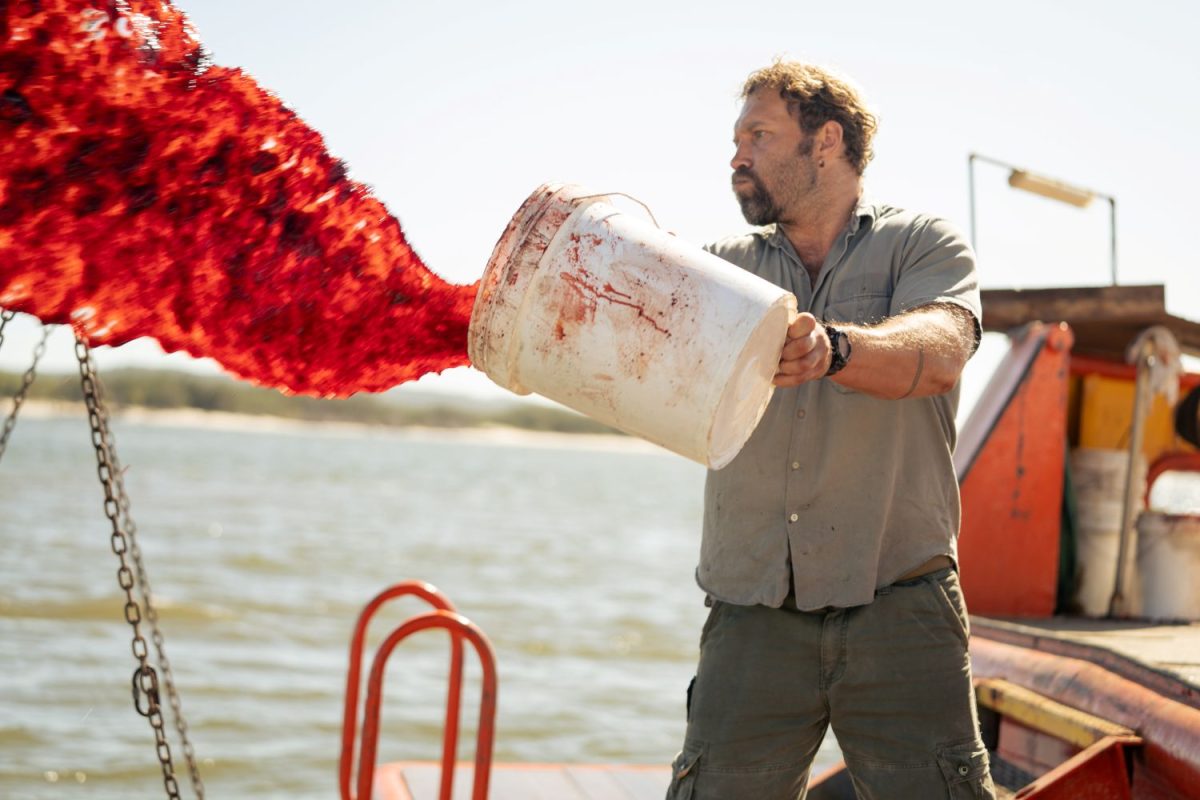
The 50th-anniversary celebrations for Steven Spielberg’s Jaws went on for seemingly half of 2025, and justifiably so: Spielberg’s 1975 thriller is one of the most accomplished and influential films ever made, and it holds up brilliantly after five decades. Its legacy also includes the less flattering distinction of inspiring the much-maligned cinematic subgenre of sharksploitation.
While audiences were busy celebrating Jaws in 2025, at least 10 other shark movies made their way to U.S. screens, some even playing in theaters, albeit in a brief, limited capacity. It would be fair to assume that these films weren’t worth seeing, since the history of post-Jaws shark movies is dominated by cheap, poorly made productions that exist solely to lure viewers in with lurid promises — often directly in the title — that they can’t possibly keep.
Every so often, though, movies like The Shallows or 47 Meters Down defy expectations for their disreputable niche, delivering genuine suspense, well-drawn characters, and effective set pieces. This was an uncommonly strong year for such movies, thanks to three Australian imports that deserve to take their place in the shark-movie pantheon. With modest ambitions, Sean Byrne’s Dangerous Animals, Matthew Holmes’ Fear Below, and Kiah Roache-Turner’s Beast of War prove that there’s still plenty of life left in pitting humans against deadly sharks onscreen.
Those three films are even more impressive in contrast to the bargain-basement shark movies that were also released in 2025, including efforts from mockbuster factory The Asylum and the producers of Winnie-the-Pooh: Blood and Honey. Filmmaker Brett Bentman, who’s directed more than 50 movies in the past decade, put out three installments in his Lone Star Shark series in 2025 alone, although the running time of the entire rushed, listless trilogy adds up to less than the length of Avatar: Fire and Ash.
The Asylum’s Great White Waters, from Sharknado franchise director Anthony C. Ferrante, and Christian Sesma’s Into the Deep even have essentially the same forgettable plot. Both involve criminals forcing divers to plunge into shark-infested ocean waters to retrieve caches of smuggled drugs that were lost at sea. Into the Deep manages to recruit Jaws’ Richard Dreyfuss to play the main character’s marine biologist grandfather, who offers her sage advice and wisely remains on land. Great White Waters has no such star power, but that doesn’t make much difference, since the acting in both movies is as weak as the special effects for the nonthreatening sharks.
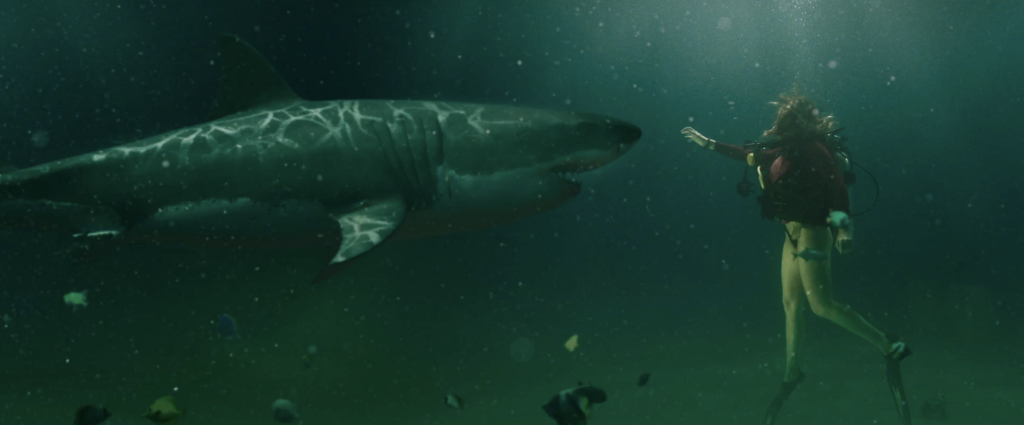
The Asylum is also behind Shark Terror, which features Michael Paré as the captain of a decommissioned military ship on a promotional final voyage. He mostly stands around and barks orders into a radio as a pair of dumbass young people are stranded on a rapidly shrinking sandbar after falling overboard. Yelling “Damn sharks, why can’t you just leave us alone?!” is about the best defense that they can muster.
That’s brilliant dialogue compared to the ridiculousness of British production Bikini Shark, which should be a lot more entertaining given its bonkers premise. Although it’s disappointingly not about a shark wearing a bikini, it does involve sharks that mutate after consuming discarded bikinis tainted with toxins. The sharks can sort of slither around on land and now have an insatiable hunger for ladies in bikinis. Director EJ Marshall fails to render anything amusing from the incoherent concept, which only gets more nonsensical as the movie goes along.
Japanese would-be cult film Hot Spring Shark Attack does a much better job of following through on its craziness, with just as much absurdity as Bikini Shark but a much sharper sense of humor about itself. It built up enough of an international reputation following its Japanese release to warrant special-event theatrical showings across the U.S. in addition to a VOD premiere. It’s the kind of campy movie that would be fun to watch with a packed crowd, laughing at the knowing nods to the clichés of shark B-movies. Writer-director Morihito Inoue has so much enthusiasm for shark-movie silliness that it’s hard not to get swept up by his upbeat energy.
As amusing as Hot Spring Shark Attack is, however, the best way to make a successful shark movie is to treat the creatures seriously, to show both the characters and the audience that these animals should be feared and respected. That’s the attitude of serial killer Tucker (Jai Courtney) in Dangerous Animals, and while he’s not exactly trustworthy, he knows his sharks. As he explains to his targets, sharks aren’t inherently violent toward humans, and he has to deliberately provoke them in order to get them to devour the women he kidnaps and videotapes as they’re being dismembered.
Byrne and screenwriter Nick Lepard are smartly economical with their shark action, a lesson that the best shark-movie filmmakers take from Spielberg and Jaws. The villain is Tucker, not the sharks, and Courtney makes the most of the role, digging into the character’s sleazy charm as he dances to classic rock, mockingly sings “Baby Shark,” and gleefully stages his victims’ final moments. Hassie Harrison is solid as the indomitable woman who finally provides Tucker with a worthy opponent, but this is Courtney’s movie all the way. He even outshines the sleek-looking sharks.
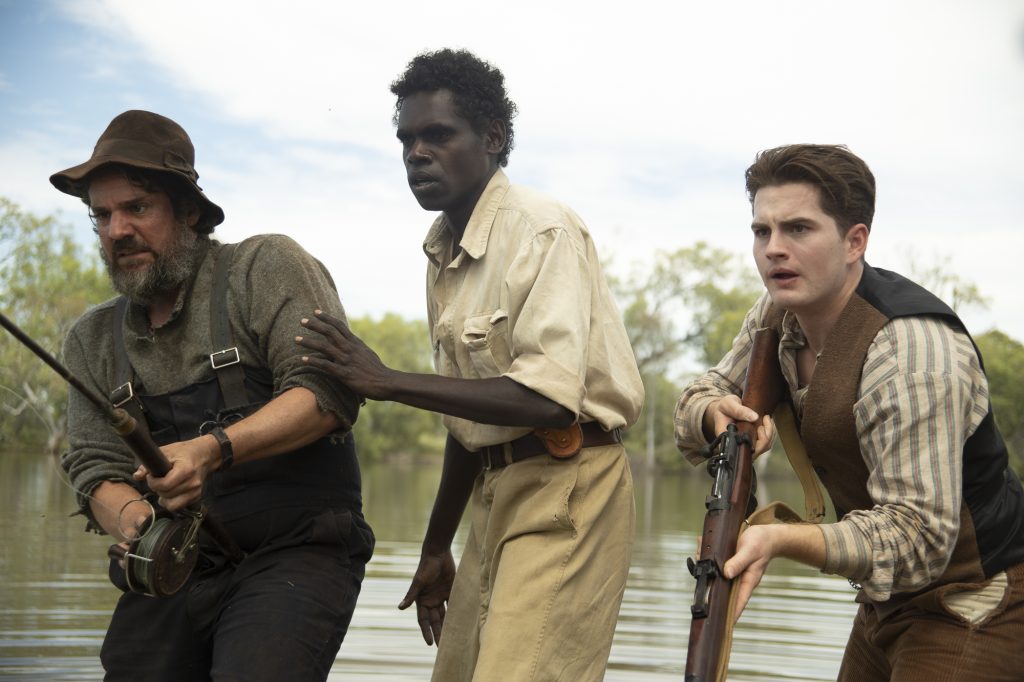
There are no similarly dominant personalities in Fear Below or Beast of War, but they’re both well-acted, character-driven stories that first get viewers invested in the central humans so that the danger they face from sharks is more meaningful. Both are historical dramas, set in the 1940s during and after World War II. The setting is more than just window dressing, and the filmmakers take their time establishing the details of the time period, which inform the way the characters deal with the shark-attack threat.
Hermione Corfield gives a sharp, measured performance in Fear Below as the only woman working for a scrappy diving company in post-World War II Australia, hired by mobsters to salvage their illicitly acquired gold from a car that plummeted to the bottom of a river. Although they’re easily able to get in and out of the water, the divers are in constant danger merely by being submerged, since they’re using old-fashioned equipment with helmets and hoses. Holmes generates as much suspense from their rickety gear as he does from the bull shark that menaces them while they’re underwater.
Indigenous diver Jimmy (Jacob Junior Nayinggul) faces racist taunts from the company’s mobster clients, and Beast of War’s Indigenous protagonist Leo (Mark Coles Smith) receives the same treatment from many of his fellow soldiers in the Australian army during World War II. Like Jimmy, though, he has diving experience going back to childhood, which proves invaluable when he and his squadron are stranded at sea after the Japanese destroy their ship.
Inspired as much by Robert Shaw’s USS Indianapolis monologue in Jaws as by a real-life Australian incident, Beast of War features impressive practical effects as Leo and his dwindling compatriots are circled by a great white shark while clinging to a small floating piece of debris. Roache-Turner surrounds the makeshift raft with thick fog, and the desperation and paranoia is nearly as terrifying as the eventual brutal shark attacks.
That’s the case in Jaws, too, and anyone seeing Spielberg’s film for the first time will remember the interactions among Shaw, Dreyfuss, and Roy Scheider as much as the aquatic maulings. Too many shark movies forget that part, just marking time between their meager, sensationalistic attack scenes. Dangerous Animals, Fear Below, and Beast of War succeed because they approach the humans and the sharks with equal care. They do Jaws’ legacy justice.