Chelsea Spear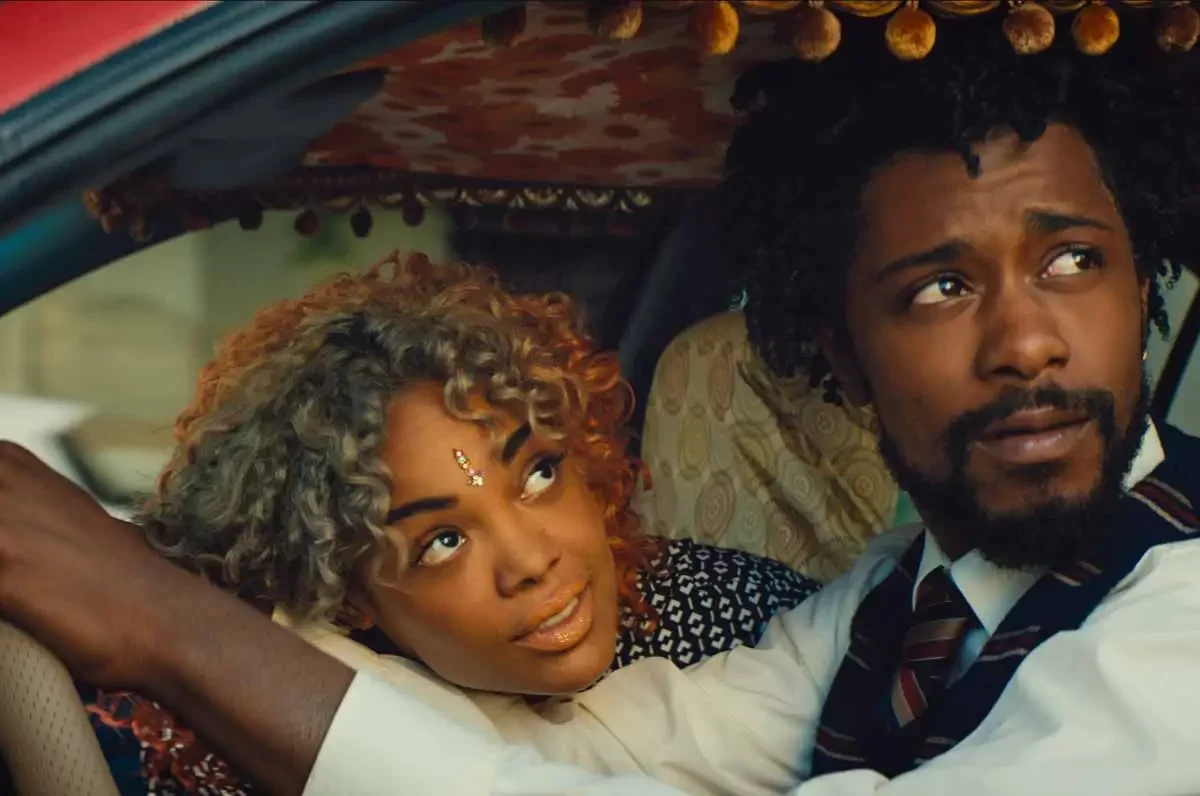
The music of Merrill Garbus can’t help but pull focus. As the creative force behind the indie band Tune-Yards, her blend of Afrobeat-influenced rhythms and clear-eyed feminist lyrics brought a socially conscious dance party to the bloggy indie scene of the early 2010s. Tune-Yards’ live shows, which showcased Garbus’s wailing vocal style and marionette-like dance movements, became an unexpected showstopper at major music festivals.
The very aspects of Garbus’s music that made her a standout in the Obama era also made her seem like a counterintuitive choice for scoring films. But Garbus has always had a skill for subverting expectations. After scoring an evening of Buster Keaton shorts at the San Francisco Film Festival, she and her Tune-Yards cohort Nate Brenner began a long-term collaboration with the polymathic Bay Area filmmaker and musician Boots Riley.
By the time Garbus met Boots Riley, both artists had established impressive careers within their respective underground/indie scenes. Riley was already 20 years into his work as a compelling and provocative MC and lyricist who wrote and co-produced seven albums, while Garbus had just completed the album cycle for w h o k i l l, which had placed at number one on the Pazz and Jop poll in 2011. Garbus could see similarities between her cultural background and political upbringing and that of Riley, who had been involved with political organizing since high school. “My grandparents kind of hovered around the communism of New York Jews in the ’40s and ’50s,” Garbus told KQED in 2023, “and I have a background in a lot of the stuff that I was hearing in the music.”
When Riley began writing the script for Sorry to Bother You, he asked Garbus and Brenner to score the film, at first as his soundtrack for writing the screenplay. Tune-Yards’ songs had appeared in a handful of TV shows at that point, and Garbus observed that “when people say they want Tune-Yards to score something, they mean they want us to write ‘Bizness’ over again, or they want us to write ‘Water Fountain’ over again. But with Boots, I had a feeling he was like, ‘No, I want all the weird of you.’”

It’s hard to imagine Boots Riley not wanting to draw out the most eccentric sides of his collaborators, especially for something like Sorry to Bother You. The dark comedy explores the experiences of Cash Green (Lakeith Stanfield), a struggling Oakland resident who takes a job as a telemarketer at a sketchy call center. He experiences great success when he taps into his white voice (David Cross), only to learn about the call center’s connection with the slave labor apartment firm WorryFree. Riley was able to bring the maximalist sensibility and Jonathan Swift-worthy satire to the big screen; his use of saturated primary colors and tableau staging heightens the surrealistic tone and allows Riley’s corrosive satire to land in a more humorous way.
The tension between the lived experiences of Black characters like Cash and his girlfriend Detroit (Tessa Thompson) and their use of “white voice” in offices and art galleries flipped the perceptions of Merrill Garbus at that point in her career. She grew up in Connecticut, graduated from Smith College, toured with a puppetry troupe, and released two albums where she played original music on the ukulele. On w h o k i l l, her band’s breakout album, she began experimenting with Fela Kuti-inspired polyrhythms and Ghanaian highlife-style guitar arrangements while writing about witnessing acts of racism as a white woman and not knowing how to deal with what she’d seen. “I felt real responsibility as white people making music for a very Oakland film,” she told Stereogum in 2021. “What’s our responsibilities and accountability when it comes to making art while still respecting the ground that we stand on? It felt really great to make art in service of Boots’s art — to feel lifted up by him while also wanting to lift him up, and make music that took risks while putting ourselves all the way out there.”
Riley uses songs by The Coup and the Bay Area MC E-40 as a Greek chorus that comments on the story of Sorry to Bother You, and Garbus and Brenner’s score serve as a kind of ligament that helps connect Riley’s narrative into a more cohesive whole. Where the pop songs make a big musical impact, Garbus’s score leans into the surrealism with music box-like mbira melodies and minor-key ostinatos played on a synth with a violin setting. At times her use of distorted vocal harmonies sounds like church music, as in a scene at the end of the film when Cash liberates a group of equisapiens that WorryFree was pursuing. Riley abruptly cuts the cue as it reaches its climax, undercutting the expected moment of catharsis with a harsh observation from one of the equisapiens.
Sorry to Bother You was the sleeper hit of the summer of 2018, and its success has led to further collaborations between Boots Riley and Tune-Yards, including the score for this summer’s I Love Boosters. “Riley is incredible because he’s just so creative,” Garbus’s collaborator Nate Brenner told Relix in 2023. “Being around someone who’s constantly surprising us with his ideas made Merrill and I want to approach our songwriting with this sense of, ‘What’s gonna happen? Who knows?’ It helped us get out of the predictable nature—whether that means the song structures or instrumentation—and open up the music to where anything’s possible.”