Craig J. Clark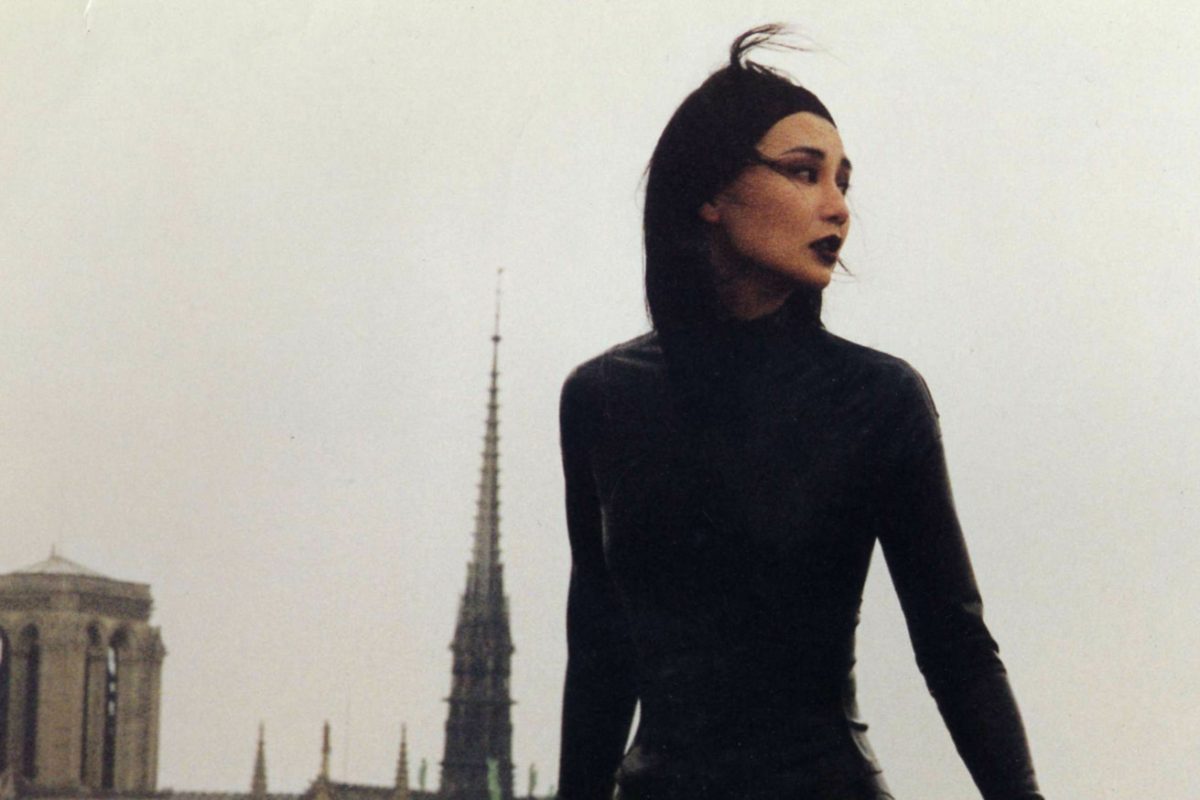
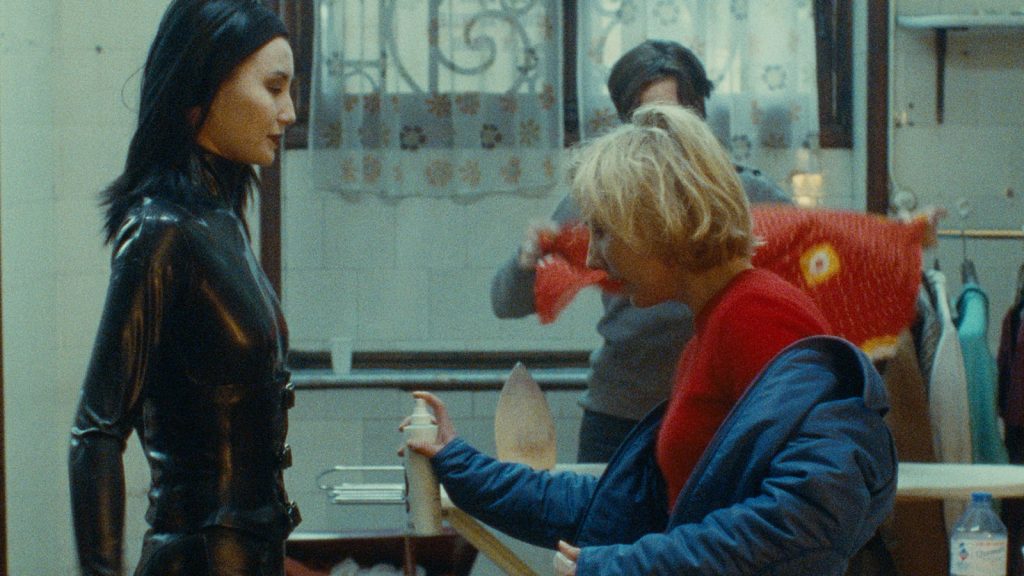
When Maggie Cheung arrives in Paris to star in a remake of Louis Feuillade’s silent crime serial Les Vampires, she’s three days late because the Hong Kong shoot she’s coming from ran over schedule. As a result, her integration into the production is less than smooth, exacerbated by the fact that she can only communicate with the members of the staff who speak English. This is no impediment to playing the role of Irma Vep, however, since the remake is being shot silent and in black and white to boot, which invites the question why it’s being done in the first place. True, Feuillade’s original doesn’t have Maggie Cheung sneaking around rooftops in a latex bondage suit, but right from the outset the remake is shaping up to be the Francophone Gus Van Sant’s Psycho.
“Why do we do what’s already been done? Why don’t we do more personal films?”
These questions, voiced by costume designer Zoé (Natalie Richard), are central to Olivier Assayas’s Irma Vep, which premiered in Cannes 30 years ago. The crisis of creativity diagnosed by Assayas isn’t limited to French cinema, of course, but he makes it specific by framing it around a has-been director’s insistence that he wants a “modern Irma Vep” while remaining beholden to the filmmaking techniques of the 1910s. The has-been in question is René Vidal, played by Jean-Pierre Léaud as a man who is past his prime and knows it, yet seeks to shake things up by focusing his remake on a Chinese actress he saw and was transfixed by in Johnnie To’s The Heroic Trio. Then again, it could also be he simply wants to see Maggie Cheung in black latex. Historically, there are much worse reasons to make movies.
When Assayas set out to make Irma Vep, he had been directing features for a decade. Before that, he was a writer for Cahiers du Cinéma and had collaborated with fellow critic Charles Tesson on a special edition of the magazine dedicated to Hong Kong cinema. While Cheung inspired the character of the actress in his script, he despaired of getting it to her until cinematographer Christopher Doyle arranged an introduction at the Venice Film Festival. Intrigued by the notion of playing herself, Cheung jumped in with both feet, relishing the opportunity to work on a smaller scale than she was used to – and with less need for special effects.
“A film character is born from your imagination, plus whoever the actor is; and ultimately, who the actor is matters more than whatever you wrote.” –Olivier Assayas in Cinema Today (2011)
As depicted in the film, the production of Les Vampires has a hastily thrown-together feel, exemplified by costume fittings in sex shops and contradictory directions from René, who doesn’t know how to coherently communicate his vision – if he even has one. Running parallel is the relationship between Maggie and Zoé, which starts with that awkward fitting and develops in spite of the language barrier between them as they spend time together off the set. Maggie is happy to see a friendly face every day, but Zoé nurses a crush she worries may not be reciprocated. Meanwhile, the character that begins to have the greatest hold on Maggie is Irma Vep, who asserts herself in surprising ways. The sequence where Maggie, clad in her skintight costume, prowls around her hotel and steals a fellow guest’s necklace is riveting from start to finish. Thirty years on, it remains one of the most exhilarating things Assayas has ever filmed.
Assayas explored a similar dynamic in Irma Vep, an eight-episode miniseries about a director named René Vidal (Vincent Macaigne, who’s served as his alter ego in a few projects, most recently Suspended Time) tasked with remaking his 1996 film of the same name. This time, it’s centered on casting an anxiety-prone American actress (Alicia Vikander, not playing herself) as the slinky criminal. With more time to expand his story’s scope, Assayas allows René to see his remake through to completion this time, and even incorporates dramatizations of the production of the original Les Vampires, with Macaigne playing Feuillade and Vikander as Musidora. This adds a whole other layer to the story, with each strand in dialogue with the others. It also serves as a fitting tribute to French cinema’s past without being a pale imitation.
“It’s just images about images. It’s totally worthless.”
When Jean-Pierre Léaud’s René laments his inability to spin nitrate out of Les Vampires, he sounds like he’s at the end of his rope, personally and professionally. (His world-weary performance may very well have inspired Bertrand Bonello to cast him as the washed-up porn director in 2001’s The Pornographer.) The opposite is true of Assayas, whose 2022 Irma Vep is the work of a still-vital director who has things to say about the industry (including the fact that so many name directors are turning to streaming series) and, crucially, the means to express them. It’s the rare remake that rises to the level of its predecessor and even enhances one’s enjoyment of it. Guess René Vidal got his modern Irma Vep after all.
“Irma Vep” is streaming on the Criterion Channel and HBO Max, where the “Irma Vep” limited series can also be found.