Steve Erickson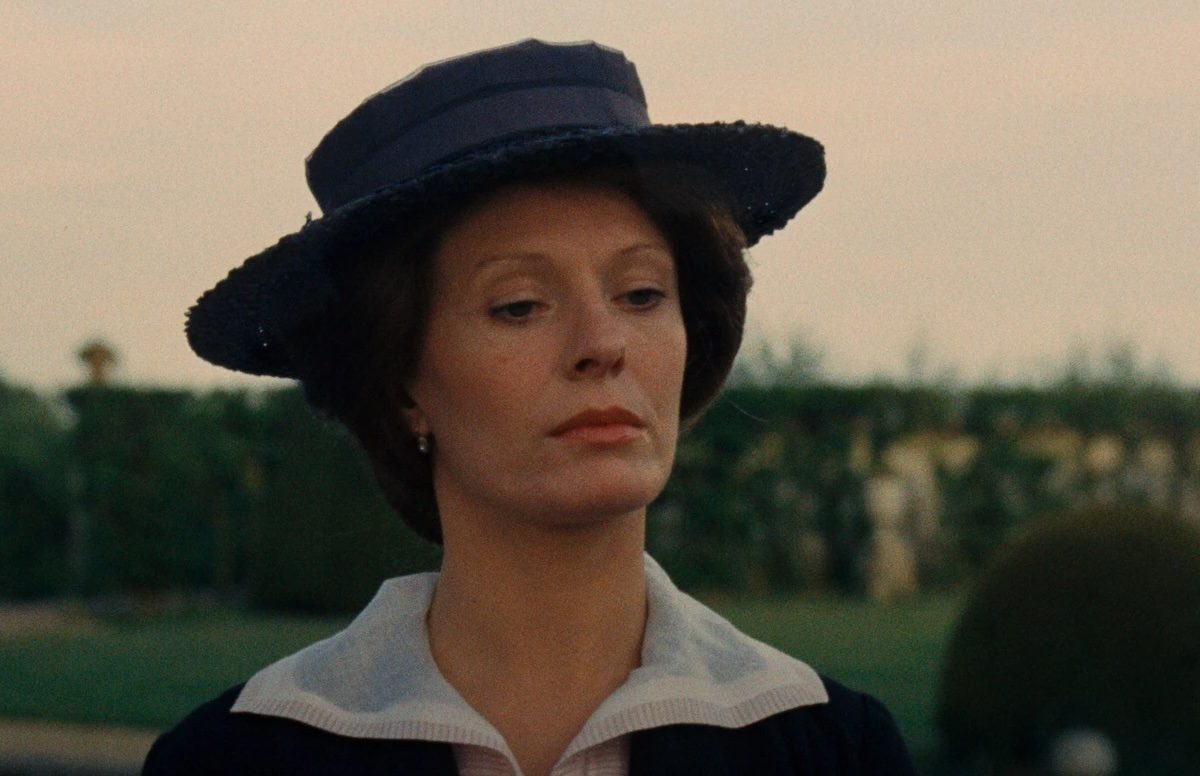
Rather than a standard period piece, Aloïse is a nightmare of suppressed female artistry. Director Liliane de Kermadec served a long apprenticeship in the French film industry, working on Agnes Varda’s Cleo From 5 To 7 and Alain Resnais’ Muriel as a set photographer. She launched her own body of work with the shorts Le Temps d’Emma and Qui donc a revé, made in 1964 and 1965. While she could’ve become a late participant in the Nouvelle Vague, she didn’t get the opportunity to direct her first feature, Home Sweet Home, until 1973. Even though it played at Cannes, it’s now lost media; not a single person has logged it on Letterboxd. While the lived experiences of de Kermadec and artist Aloïse Corbaz were far different, her film pulses with regret at what might have been.
Aloïse starts with an intertitle, written in red letters: “Aloïse’s mother has just died.” A music student, she is seen dashing out to buy sheet music of a Mozart composition. (As a young woman, she’s played by Isabelle Huppert.) She proves to be a talented singer and pianist, but her life doesn’t offer her a chance to show these skills. She leaves her home in Switzerland to take a job in Potsdam, Germany as a governess. (At this moment, Delphine Seyrig takes over the role.) World War I threatens this position, but when forced to leave, she refuses. Diagnosed as schizophrenic, she is institutionalized; within a mental hospital’s confines, she develops her interests further, taking up writing and drawing. As she remains deeply isolated for the rest of her life, years pass by, marked by changes in Seyrig’s wigs and makeup.
The 2023 restoration of Aloïse faithfully renders the cinematography’s contrast between pale and bright tones. Some of its most powerful scenes are shot from a stationary camera. Once Aloïse becomes institutionalized, the camera peers outside, as if it too were a patient. When her father arrives for a visit, he’s barred from coming inside. Long shots of him speaking outside appear to represent Aloïse’s point of view. Even the green spaces of the hospital’s garden tend to be glimpsed from a distance. Camera movements are sparse, as though there had to be a reason for each one.
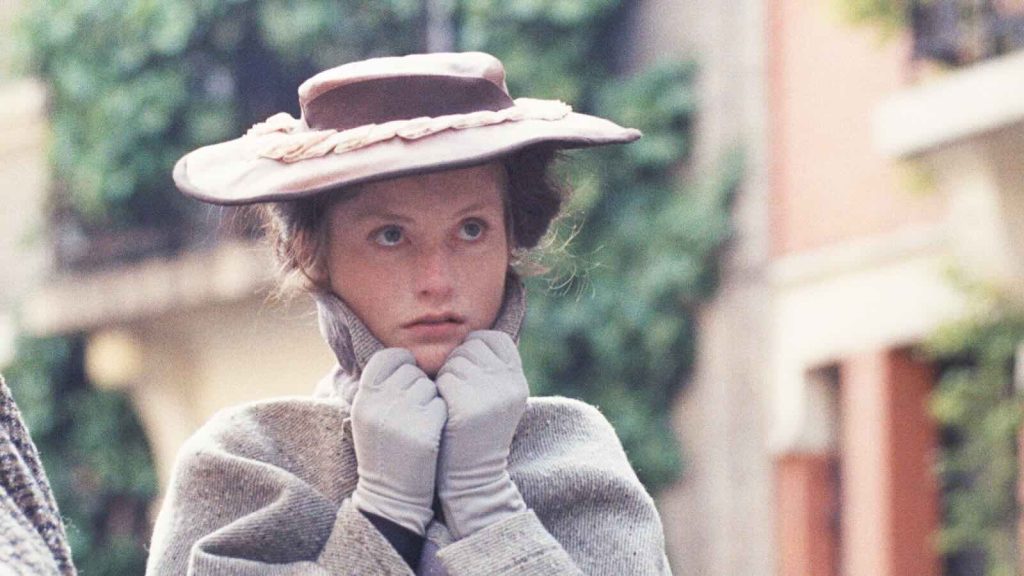
De Kermadec didn’t lack talented collaborators. André Téchiné co-wrote the script for Aloïse, while Paul Vecchiali produced, and it was a coup to get both Huppert and Seyrig to appear. One of the reasons for its obscurity may be that superficially, it resembles a traditional French biopic. Its radicalism is subtle: an ultimate rejection of naturalism and psychological conventions.
Aloïse isn’t shy about depicting the sexism that led its protagonist to be institutionalized. As a young woman, she pursues her muse without recognizing the barriers in her path. At church, she asks for permission to sing by herself. She sees herself as an individual artist, while the priest tells her she has to subjugate her voice to become part of a group calling out to God. Men repeatedly make patronizing remarks to her. (Her music teacher asks “You do have a body, do you?”) Once institutionalized, the staff takes it for granted that schizophrenics can’t be helped. The hospital drugs its patients, even putting them into insulin comas, instead of offering therapy that could really treat their conditions. The way its leader speaks about a newfound population of alcoholics stresses the theme of psychiatry as a form of social control akin to the carceral system.
Aloïse takes refuge in the women’s restroom to write. In a rather on-the-nose touch, the camera centers the “Femmes” sign on its door. Still, the film isn’t a simplistic tale of martyrdom. Hidden away from the world, Aloïse has time and space to create her work. Her drawings are achingly physical, showing women’s bodies (especially their breasts) in a delirium of color. In an implicitly sexual manner, she uses writing and visual art to fantasize. (Heading to a locked bathroom to do so enhances the connection.) The film pivots around the paradox of such isolation both oppressing Aloïse and giving her room to develop her art. It seems most tragic that once her work is recognized, she’s again patronized and ignored.
Seyrig’s performance refuses to sentimentalize Aloïse by granting the audience access to an inner life. Even as an old woman, she’s blank and unsocialized. It would be insensitive to make direct comparisons between the lives of Aloïse and her director. However, de Kermadec was tossed aside by the industry after producer Irene Silberman shut down her third feature Sophie and the Captain two weeks into the shoot. It was never finished. She managed to complete one more, The Telegraph Trail, in 1994. De Kermadec ended up making her own form of outsider art, directing documentaries on digital video. Aloïse holds so much promise that the fact that she couldn’t walk further down its path feels like an enormous loss.
The new restoration of “Aloïse” (accompanied by de Kermadec’s short film “Qui donc a rêvé?”) opens Friday at New York City’s Metrograph.