Craig J. Clark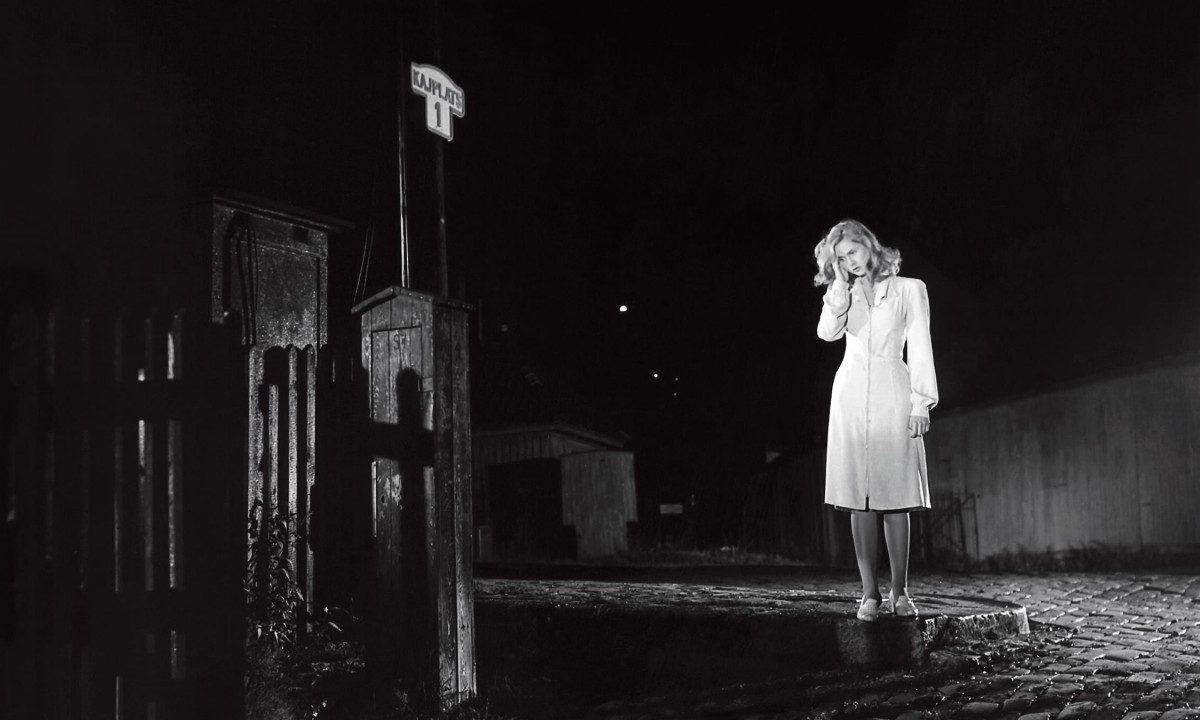
By his own reckoning, Ingmar Berman’s first feature Crisis was an unmitigated disaster. His accounts of its troubled production in his 1987 autobiography The Magic Lantern and 1990 memoir Images: My Life in Film detail how painful the experience was. A failure on its release (80 years ago this week), Crisis nearly halted his directing career in its tracks, forcing him to return to Svensk Filmindustri’s “slaveship,” his colorful term for the company’s script department. While he avoided that fate, he was still smarting from it in the late ’60s when he was interviewed by film journalists Stig Björkman, Torsten Manns, and Jonas Sima for a book on his career up to that point.
Early in their first conversation, Manns proposes going “back to Crisis, your début as a film director,” but Bergman shuts him down, calling it “lousy, through and through.” Bergman also declines to consider Manns’s assertion that Crisis was his attempt to “evoke an authentic small-town milieu,” but does single out one sequence that went well: “the bit in the beauty salon. About 200 meters.” (That accounts for seven minutes of the 93-minute film.) “The whole of that sequence has a sort of suggestive quality about it,” he says. “Suddenly the film gels.” Nothing else does, though. When Björkman asks if the actors are good, Bergman responds, “No. Nothing’s good.” (Quotes from the English translation of Bergman on Bergman, first published in 1973.)
In some respects, Bergman was a victim of his own success, since Crisis came about because of the positive reception of his first produced screenplay, Torment, which Alf Sjöberg directed in 1944. That project even gave Bergman his first taste of directing; he was tapped to do some reshoots when Sjöberg was unavailable. (Bergman’s original ending was deemed too dark, so he was tasked with writing a new one that sent his tortured protagonist out on a more hopeful note.)
When he lobbied for the chance to make his own film, the head of Svensk Filmindustri presented him with a Danish play called Moderdyret (“The Maternal Instinct”) and promised he would be allowed to direct the film if, as Bergman later wrote, “I could manage to wring a good script from this grandiose drivel.” With such unbridled enthusiasm for the material, how could he possibly go wrong?
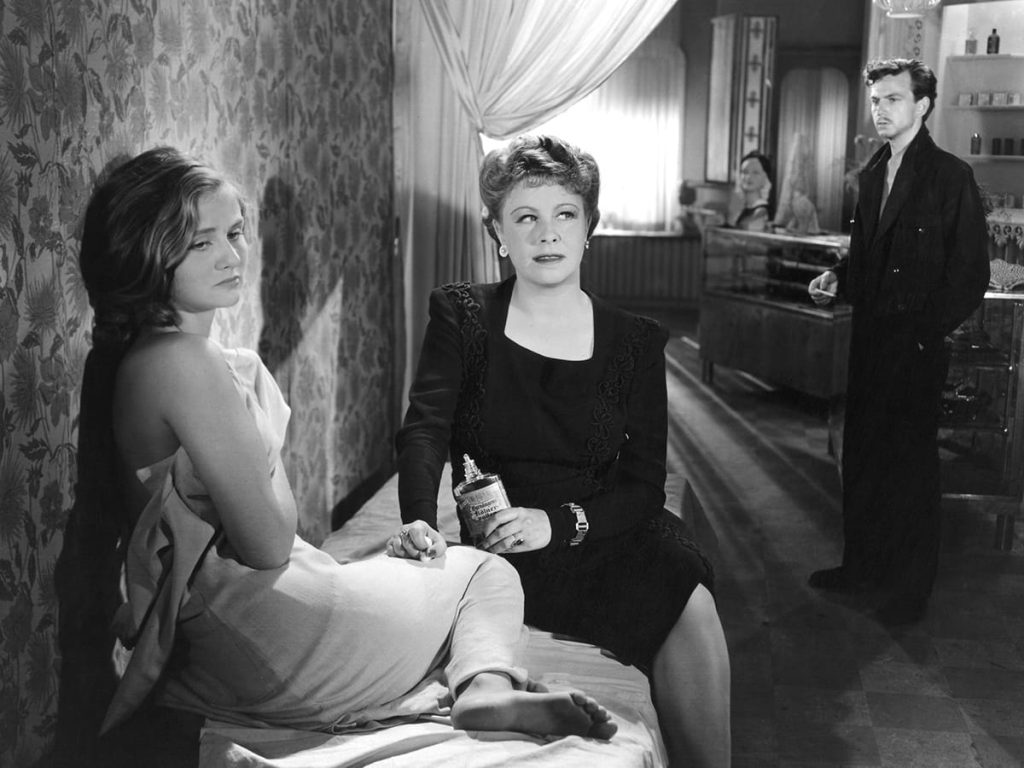
Considering Bergman was in his mid-20s at the time, it’s unsurprising that Torment and Crisis both revolve around young protagonists. The key difference is while the former is about a morose student who clashes with a sadistic Latin teacher and gets involved with a young woman of ill repute, the latter is focused on an impressionable 18-year-old girl who’s tired of small-town life and dreams of being whisked away to the big city. Hardly the stuff of high drama, as Bergman’s omniscient narrator confirms. “I wouldn’t call this a great or harrowing tale,” he says. “It really is just an everyday drama. Almost a comedy.” “Almost” is the operative word here, since Bergman’s idea of comedy is more ironic than laughter-inducing.
The main event in the first half of Crisis is the town ball, which Nelly (Inga Landgré) is fixated on. This coincides with the return of her birth mother Jenny (Marianne Löfgren), who left her in the care of piano teacher Ingeborg Johnson (Dagny Lind) so she wouldn’t be tied down. Ingeborg’s devotion to the girl is all-consuming, to the point where she scrimps, saves, and borrows to buy her a ball dress, not knowing “Aunt Jenny” has also sent her one. Since it’s fancier, that’s the one Nelly chooses. She also rejects the overtures of local veterinarian Ulf (Allan Bohlin), who’s admittedly a stiff compared to Jenny’s worldly boyfriend Jack (Stig Olin, father of Lena). When Jenny offers to take Nelly with her to Stockholm, the girl leaps at the chance, heedless of how much she’s hurting her foster mother. Life in the big city isn’t all it’s cracked up to be, though, and it’s not long before she’s back home where she belongs.
As debuts go, Crisis has its shortcomings, and Bergman the director wasn’t always helped by Bergman the writer’s clunky dialogue and thin characterizations. (He does give the town’s mayor a classic Bergman line when he opens the ball by saying, “I hope you’ll all enjoy yourselves insofar as anyone can enjoy themselves.”) While he had plenty of experience directing actors for the stage, eliciting an effective performance for the camera required a skillset the 27-year-old Bergman had yet to acquire, and his habit of losing his temper alienated his crew.
Fortunately, Bergman had the support of mentor Victor Sjöström, whose sage advice he repaid with the lead role in 1957’s Wild Strawberries, and he was taken under the wing of Lorens Marmstedt, who produced his next three films. That kept him going until Svensk Filmindustri was prepared to give him a second chance. There were more stumbles to come, but as he gained experience on set, Bergman found himself on surer footing. Crisis overcome.
“Crisis” is streaming on the Criterion Channel along with a few dozen of Bergman’s best-known works.