Josh Bell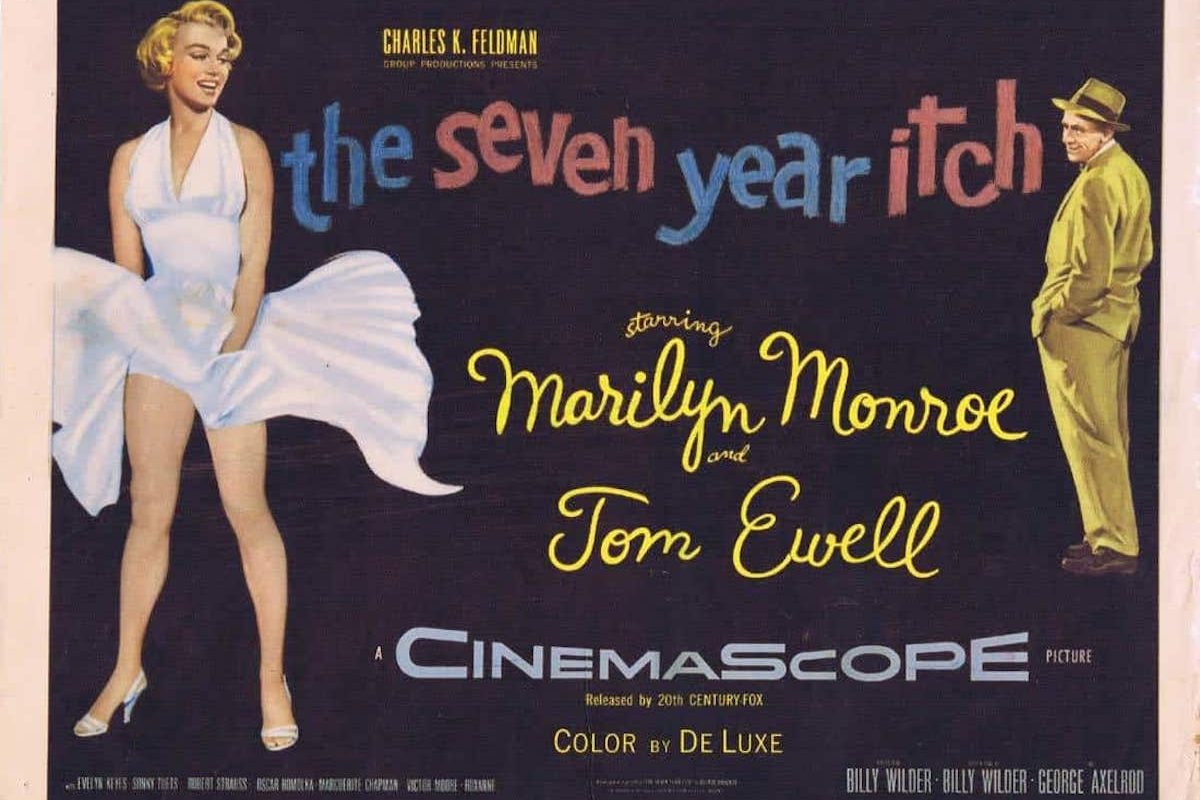
When Billy Wilder adapted George Axelrod’s 1952 stage play The Seven Year Itch for the screen in 1955, he bypassed the sex and adultery in order to conform to the stringent Hollywood Production Code. For Wilder and Axelrod (who share the screenplay credit), the film was a watered-down compromise, and in later years Wilder expressed regret at having made it at all. But like so many movies produced during the Production Code era, The Seven Year Itch (released 70 years ago this week) finds ingenious ways to imply what can’t be overtly stated, using its restrictions to tell a story that is often more creative and subversive than if it were completely explicit.
The film version of The Seven Year Itch is no longer a story about a middle-aged married man who has an affair with his younger female neighbor while his wife and son are away for the summer. Instead, it’s a story about a neurotic husband who’s so terrified of even the slightest hint of impropriety with the attractive woman who’s moved in upstairs that he works himself into a frenzy, while his ostensible temptress sits back, sips a cocktail, and luxuriates in the air conditioning. If some darkness or edge has been lost in translation between stage and screen, it’s replaced by a sly puncturing of the male ego, in which the main character’s sexist assumptions have little to do with his real-life prospects.
Not that book editor Richard Sherman (Tom Ewell) is some kind of vile misogynist or lothario. He fancies himself an upstanding husband, who’s never even considering straying from Helen (Evelyn Keyes), his wife of seven years. But Helen and their irritating young son Ricky (Tom Nolan) have barely been gone an hour before he starts fantasizing about the possibilities of being, as his building’s janitor calls it, a “summer bachelor.” Like many businessmen in New York City, Richard has stayed behind to work, and he now has the apartment to himself, free to carouse all he likes.
Even Richard’s fantasies involve his wife scoffing at him, though. He envisions scenarios in which his secretary, a nurse, and his wife’s best friend all find him irresistible, but he also envisions Helen, sitting in the chair across from him and mocking his assertions of manhood. This guy couldn’t enjoy having an affair if he tried.
He does try, but only with a wary sense of obligation, once he meets the unnamed young woman (Marilyn Monroe) subletting the apartment above him. The Girl (as she’s listed in the credits) is a 22-year-old spokesmodel who looks like, well, Marilyn Monroe, and Richard spends more time convincing himself that a fling is inevitable than he does actually interacting with her. He plays out the entire exaggerated drama of cheating and being discovered while she’s offscreen, completely unaware of his existential crisis.
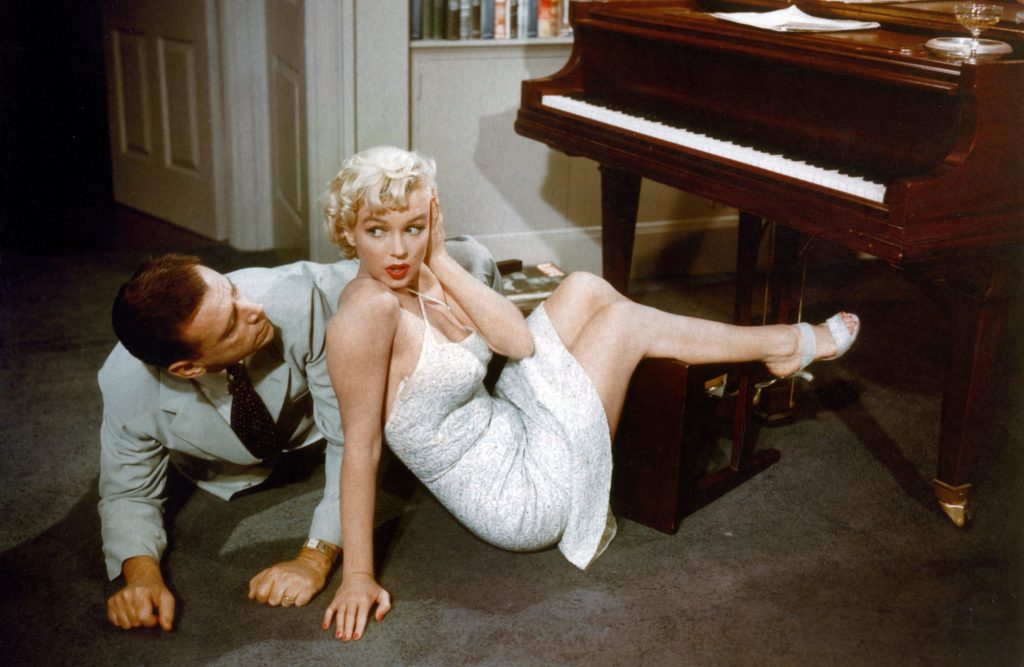
Monroe plays up the Girl’s apparent naïveté, but she’s not as ditzy as she seems. Acting innocent and oblivious is one way to negate potential sexual advances, and Richard is far too self-conscious to press himself on someone who appears not to even understand what he’s desperately insinuating. Without the looming specter of a full-on sexual encounter, their interactions take on a sort of comic-strip wholesomeness, despite the lusty undercurrent.
Richard is so besotted that he might as well be a cartoon wolf with his tongue lolling and his eyes popping out of his head, and that’s about as naughty as anything in the movie ever gets. Even the iconic shot of Monroe’s dress billowing up over a subway grate is tamer than its pop-culture reputation.
“I have this appalling imagination,” Richard tells the Girl, and part of her appeal is that, as she says, she has no imagination at all. She’s exactly who she says she is, and she takes others at the same face value. If Richard says that he’s married and would never cheat on his wife, that’s all she needs to hear. She wears a fancy dress not to lure him in, but because she reasons that it only makes sense to dress up when drinking champagne — then she uses the champagne as potato-chip dip. While Richard is babbling about the nature of the subconscious, she’s working out whether she can return the weak fan she bought for one that’s more effective at cooling her apartment.
Wilder presents this farce with the energy of a Looney Tunes short, and while the majority of the movie is set within Richard’s apartment, it never feels stagebound. Wilder frequently cuts away to Richard’s compulsive daydreams, which have the heightened quality of the pulp-fiction book covers he oversees at work.
At Richard’s job, a new edition of Little Women is sold under the tagline “the secrets of a girls’ dormitory,” but of course the text inside is the same old-fashioned Louisa May Alcott novel. Likewise, Wilder lures the audience in with the promise of something lurid, then delivers a bitingly funny comedy about a man who can’t handle two days away from his beloved wife.
“The Seven Year Itch” is streaming on Amazon Prime, Tubi, and Pluto TV.