Jason Bailey
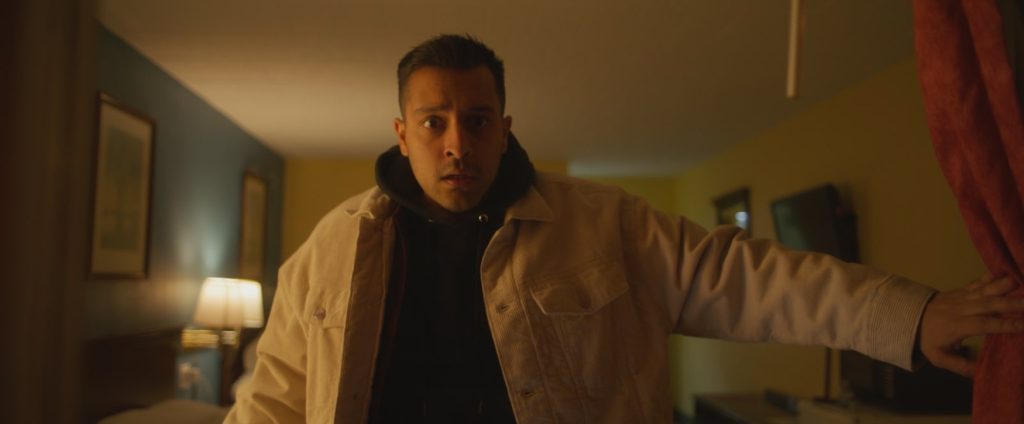
You might think, from the pre-title sequence of Aneil Karia’s Hamlet, that you’ve wandered into the wrong theater. A dead body lays on a slab; burial rituals are in progress around it, with Hindi prayers murmured and tears shed. The corpse is then placed in a coffin and sent into the fires of cremation, the metal door slamming behind it as the title comes up in cold, hard letters.
It’s a hell of an opening salvo, and not just one of those lame “this ain’t your daddy’s Hamlet” provocations that college and community theaters have been laying down since time immemorial. Make no mistake, if you live long enough on this earth, you’ll see enough interpretations of Hamlet that you can start to make little spreadsheets in your head as you watch a new one, checking off the similarities and noting the differences. Karia’s new modern-dress version, with Riz Ahmed starring as the melancholy (no longer) Dane, is one of the boldest I’ve seen.
It runs 112 minutes, less than half of the typical four-hour running time of the unexpurgated text, and it probably uses even less than that (there’s a fair amount of dialogue-free transitional and interpretive scenes). Characters are tossed by the handful — there’s no Horatio, or Rosencrantz and Guildenstern, to pinpoint the most obvious examples — dialogue is freely rearranged and reassigned (Hamlet says the “There are more things in heaven and earth” line to Ophelia), and while I will cede to greater experts on the point, it’s likely the first Hamlet adaptation to feature the title character doing bumps in a nightclub. Yet it totally makes sense as the incitement for his conversation with his father’s ghost, and is a fine example of director Karia and screenwriter Michael Lesslie’s intentions. They’re not just doing this stuff to be clever — they’re heightening, and even strengthening, the text.
This Hamlet most recalls Michael Almereyda’s 2000 take with Ethan Hawke, particularly in its shifting of the family at its center from literal royalty to business royalty, and if there isn’t any futzing with Shakespeare that’s quite as clever as the Blockbuster Video “to be or not to be” or the “get thee to a nunnery” tirade as answering machine messages, Lesslie makes one major, inspired shift that, blasphemous as it sounds, may well improve on the text. He rejiggers the timeline, folding the wedding of Hamlet’s mother Gertrude and uncle Claudius into the narrative, rather than having it precede the events therein. This allows us to see Hamlet’s first reaction to the union (a priceless take by Ahmed), turns his curtain speech for the damning play into a cringe wedding toast, and twists the play itself into a wedding performance. They’re all smart shifts that crank up the urgency and immediacy of the narrative, and allow us to consider the events anew.

Karia also makes some smart choices in the supporting cast. Timothy Spall has just the right read on Polonius – a smiling, unapologetic, status-starved sycophant, a specific type of weasel that seems culturally omnipresent these days. Joe Alwyn (who, amusingly, co-starred in last fall’s Hamnet, not to mention the “Fate of Ophelia” of it all) is not exactly an exciting actor, but he’s firm and sturdy and a fine Laertes. Art Malik mines the contradictions of Claudius, seemingly supportive and loving, but able to shift into a sociopath on a moment’s notice. Sheeba Chaddha as Gertrude bears the brunt of some of the extensive cutting, but she nails the “thou hast thou father much offended” scene as well as any actor I’ve seen. And Morfydd Clark, such a revelation in Saint Maud, is a spectacular Ophelia, conveying the kindness and fragility of the character, all while hinting at the unsteadiness underneath. Despite the quicksilver pacing of the picture, it lingers lovingly on the intimacy and longing of her relationship with Hamlet — so that when he turns on her, it cuts like a knife. Her astonished reactions, first to “I loved you once” and then to “I loved you not,” are staggering; he shatters her, in an instant.
As with any experimentally-minded update, some of the transpositions don’t quite work; the references to “the king” don’t really make sense, making the murder of Polonius a deliberate choice (albeit one borne out of self defense) is less potent than Hamlet mistaking him for Claudius, and the business of turning the character of Fortinbras into an Occupy-style movement is better in theory than execution. And they whiff big on “to be or not to be” (probably the one thing you’d least want to whiff big on), turning it into a furious rant behind the wheel of a speeding car — a choice at odds with the lost, searching nature of the speech, and of this performance’s best moments. (And having Hamlet play chicken with the other cars makes the subtext into text, in a less-than-insightful way.)
But Ahmed plays the character as the jittery neurotic he’s always been, and it proves an ideal vehicle for the burning intensity this actor conveys so deftly. This is an extraordinary performance, not just in the big moments (though he delivers on most of those) but in the quiet way he spins his line readings, making some of the most familiar dialogue in the English language into something fresh and spontaneous. That goes double for this Hamlet, which taps into the raw, emotional core of the play, and strips it to the marrow.
“Hamlet” is in theaters Friday.