Kimber Myers
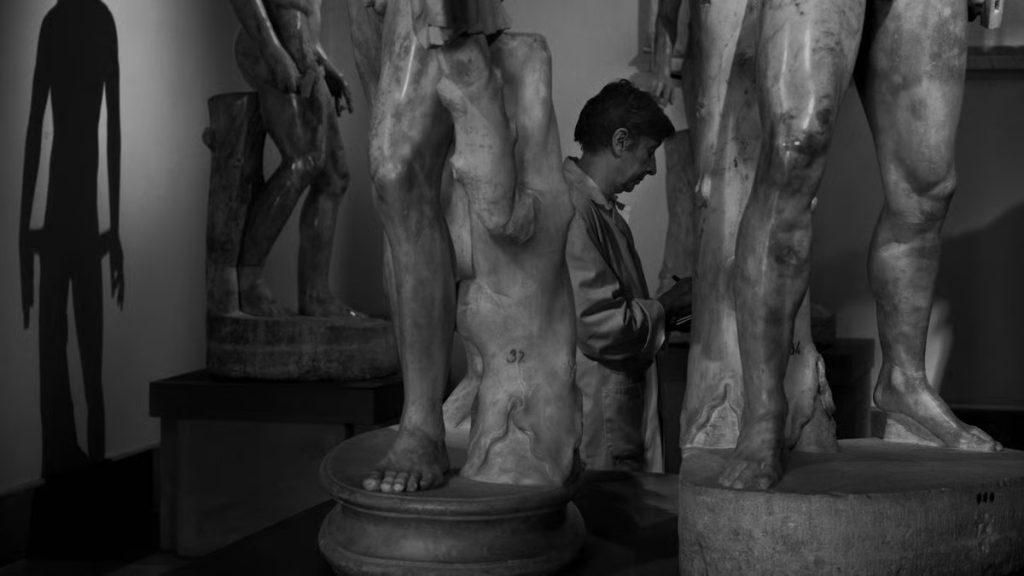
Set in the shadow of Mount Vesuvius, Pompei: Below the Clouds features neither narration nor narrative. The early scenes of this Italian black-and-white documentary initially seem unconnected: steam billowing from the earth, a volcano documentary projected on a theater screen, a train chugging along a track, a person walking amidst statues stored underground, firefighters working in a tunnel. It explores life near the volcano at a leisurely pace, revealing both the everyday nature of Neapolitan existence as well as what it means to live in a place where that existence could end at any time without any warning—just as it did for Pompeii in 79 A.D.
Pompei: Below the Clouds opens with a quote from Jean Cocteau — “Vesuvius makes all of the clouds of the world” — but it isn’t just fitting because of the match in its subject matter. Cocteau worked across disciplines as an artist, but he thought of himself first as a poet. Pompei: Below the Clouds bears far more in common with poetry than prose in its approach; it wafts along gentle rhythms, and it relies on feeling rather than on a clear storyline. Cocteau’s La Belle et la Bete also feels like a visual influence on Pompei: Below the Clouds. The Cocteau classic was striking in its use of chiaroscuro, with shadows, light, and smoke creating one of the most beautiful black-and-white films of all time.
In Pompei: Below the Clouds, that smoke is replaced by steam rising from the fissures on the face of Vesuvius and the surrounding ground. In underground scenes, a flashlight illuminates the smooth surfaces of a marble bust amidst the shadows. The windows of a train show both their view and a reflection of other angles. It’s stunning work from director and cinematographer Gianfranco Rosi, who previously made the Oscar-nominated 2016 doc Fire at Sea. His latest is essentially the photo negative version of Fire of Love, and just as visually arresting; that 2022 documentary captured the majesty and fury of volcanic eruptions, while this evokes the stark quality of their absence.
Yet Pompei: Below the Clouds isn’t just about the beauty of this volatile landscape; it’s about what living near it does to the residents. They go about their daily lives, but fear rests just beneath the surface. Earthquakes are frequent, and they send people into a panic each time, worrying that they will befall the same fate of Pompeii and Herculaneum almost two millennia ago. The most dramatic scenes in the largely quiet film are ones featuring emergency calls; you hear the terror in Neapolitans’ voices as they worry about themselves and their families when they connect with dispatchers to see if it was an earthquake they felt or something more portentous. Even absent tremors, reminders of the danger are omnipresent, as ruins sit amidst modern buildings. Radio broadcasts highlight the rise in crime, as unease underpins the region’s denizens. It’s all presented by Rosi without comment, leaving the audience to absorb what life must be like in this state of purgatory.
The director has made a movie that is at once mesmerizing and slightly somnolent. Terror could be unleashed upon the city at any moment, but Pompei: Below the Clouds is quiet and often calming. The juxtaposition is fascinating, but the lack of traditional narrative may be off-putting or sleep-inducing to some viewers more accustomed to the Netflix style of documentaries and their sensational subjects. There are no reenactments, direct-to-camera interviews, or quick cuts. Luckily, Pompei: Below the Clouds is bound for Mubi, but it feels like it would be best seen on a big screen to let the beauty of the images wash over you. I cannot imagine a more stunning documentary will be released this year.
B+
“Pompei: Below the Clouds” is out Friday in limited release. It streams on MUBI beginning March 27th.