Virginia Yapp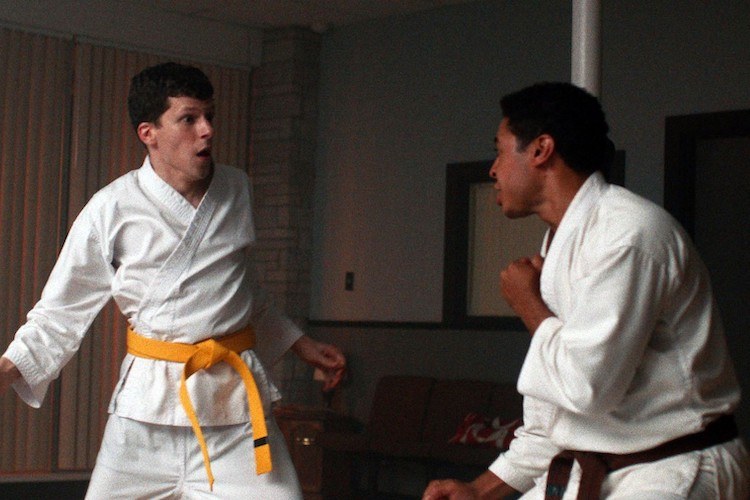
What do you get when you cross Napoleon Dynamite with Fight Club and maybe a touch of Yorgos Lanthimos? Writer-director Riley Stearns (previously known for 2014’s Faults, along with a string of shorts) apparently knew there was no good answer to this age-old cinematic riddle, so he got to work making and mastering The Art of Self-Defense. Appealingly offbeat but a bit uneven, the highly stylized film offers up a no-holds-barred takedown of toxic masculinity that’s not exactly subtle (I mean, not that subtle is what it was going for).
Stearns apparently likes his comedy as pitch-black as the film’s protagonist, Casey Davies (Jesse Eisenberg in a role he was born to play), likes his go-to coffee order — after he begins to transform himself from meek, soft-spoken accountant caricature into an uber-masculine blood-thirsty warrior caricature, that is. Formerly a Francophile with a love of chai tea lattes, Casey becomes fully obsessed with the idea of “manning up” after he’s beaten into a bloody pulp by a gang of masked motorcycle bandits while walking to the pet store to buy some food for his super-sweet (but not super-macho) pet dachshund.
Tired of being a human punching bag at the office and after hours, Casey (“a girl’s name”) struggles at first to decide whether he’s better off mimicking a certain all-American brand of masculinity by buying a gun or by taking up martial arts. After applying for a firearm license, he stumbles upon a local dojo, where he’s taken by the ritualistic nature of the classes taught by the deceptively zen-seeming Sensei (Alessandro Nivolo) and the out-and-out aggro Anna (Imogen Poots). Casey also happens to be quite suggestible, so when he sees a sign on the dojo wall bashing gun owners, he immediately decides to go with karate rather join the NRA.
There’s a rigidity to karate’s system of levels and belt colors that appeals to him on a primal level, and he doesn’t mind the whole “break you down to build you back up” kinda system that’s been the backbone of male-oriented groups like fraternities, the military, and even street gangs since, well, basically forever. When Sensei tells him he needs to quit learning French (so feminine!) and get into German (a man’s language!), become an ardent fan of heavy metal, and trade his dachshund in for a German shepherd, Casey not only jumps — he asks how high.
It isn’t until he goes to the dojo’s whispered-about night classes, however, that he finds out what’s really happening behind the scenes under Sensei, who rules his studio with an iron fist. Suddenly, the ideals Casey has been slavishly absorbing are called into question. The whole thing plays out like a graphic novel come to life (much like the 2017 adaptation of Daniel Clowes’ Wilson), moving abruptly from episode to episode and focusing in on rather cartoonish characters who always say exactly what they mean and exist in a Repo Man–like universe where everything is store brand. Unfortunately, the story itself seems more suited to comic book length, as Stearns’ general concept — and deadpan tone — wears out its welcome well before the film reaches its rather obvious conclusion. There’s a strong backbone to The Art of Self-Defense — Stearns could probably just do with a little more self-discipline next time around.