Jason Bailey
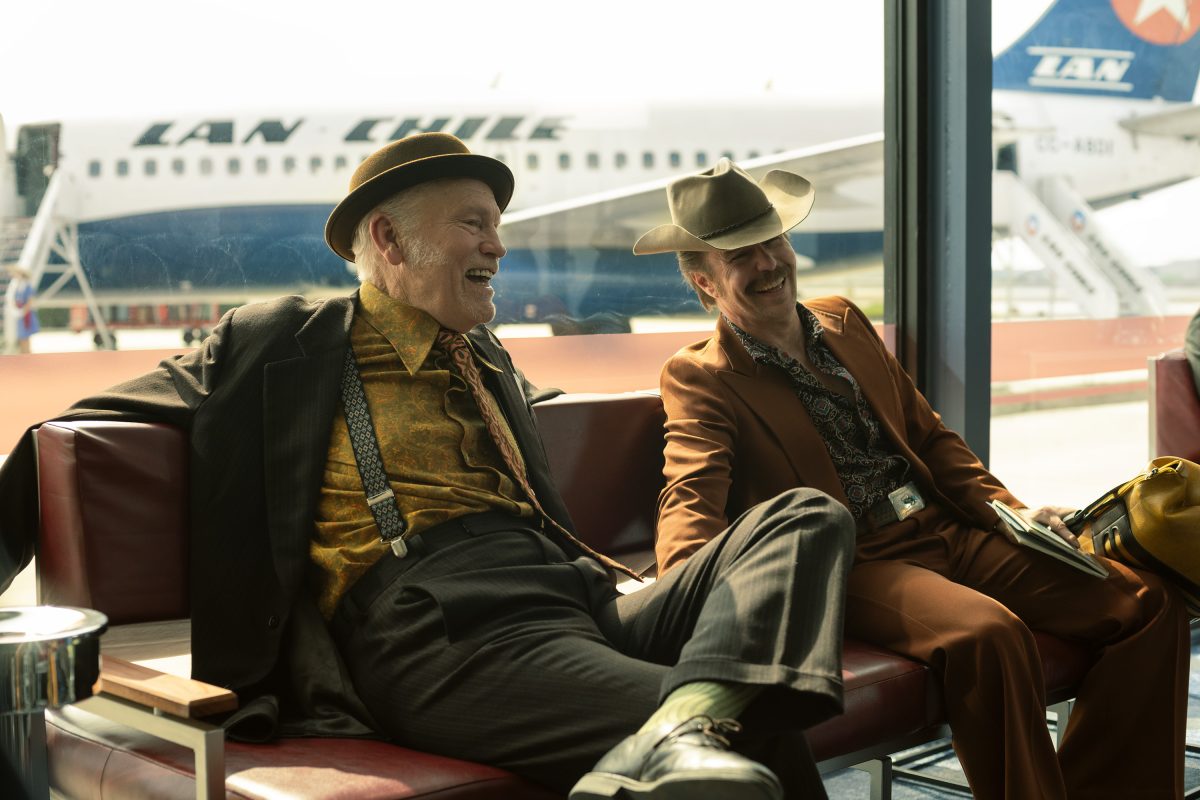
“Do you like your work?” Lee (Sam Rockwell) asks Chris (John Malkovich) in the opening scene of Martin McDoangh’s Wild Horse Nine, to which Chris replies, “I used to.” It’s a goof anyway, Lee trying out his new home movie camera by conducting a faux-interview with his partner and friend; he knows the question before he asks it, though Chris seems to still enjoy his work. You see, Lee and Chris are CIA agents, stationed in Santiago, Chile in 1973, not long before their agency will help orchestrate the September coup to remove Allende from power. “Enjoy him while you can, ladies!” Chris crows at a couple of leftists students in the airport.
Our “heroes” are heading to Easter Island for a weeklong trip, though through the early passages of the picture, it’s unclear as to exactly why. Are they there for a job? Is it just a vacation? Or is there something more sinister? It’s hard to tell with Chris, who is clearly losing his marbles, forgetting things all the time and spilling intelligence information to, say, students in airports. He’s a veteran of Guatemala, Congo, and the Bay of Pigs (among others); “I’ve killed people in countries you can’t even spell!” he boasts to Lee. But once they’ve settled in, he finds two notes in his own pocket:
- “Remember that you’re dying.”
- “Don’t trust Lee!”
And that is where the synopsis shall conclude, as one of the many pleasures of Wild Horse Nine is the careful yet clear manner in which McDonagh handles his exposition, the clever way he unpeels the onion and lets us know what’s happening only when we need to, without ever seeming to hold anything back. He mostly does so using the magician’s standby of misdirection, dazzling us with his (by now) signature vernacular speech, giving Malkovich and Rockwell line after line of quotable dialogue to chew on, swish around, and spit out, often at each other.
He’s a master of the two-hander, and in its broad strokes, his new film is plotted and structured like his first, In Bruges, another story of somewhat mismatched colleagues on a working vacation. But more importantly, the shagginess of the narrative allows him to indulge in comedic cul-de-sacs in his dialogue, uproariously funny explorations of the kinds of countries that export the best cheese, or whether there are dinosaurs in heaven. It helps, of course, to have as eccentric an actor as Malkovich acting as the motor of such scenes; he can make even the most banal dialogue seem like an alien language, so you genuinely believe these are the kinds of questions and hypotheses he might formulate.
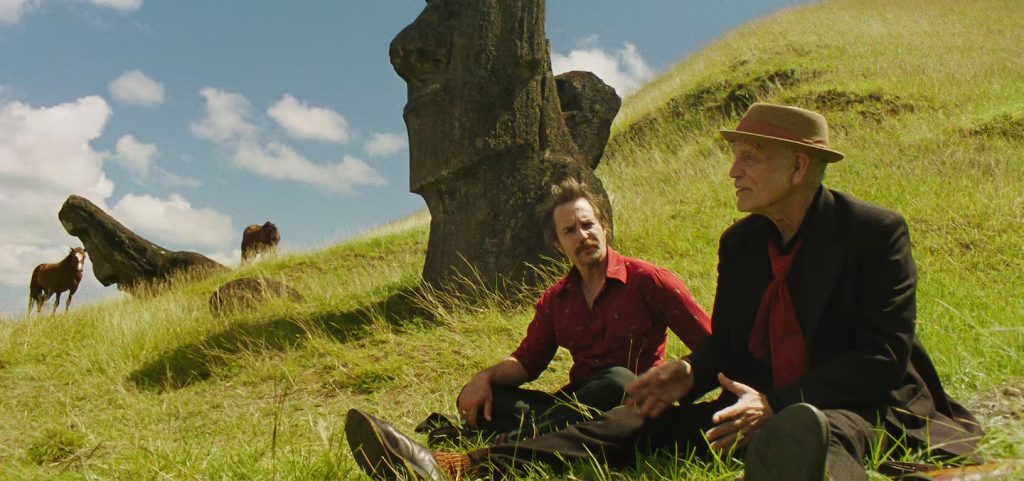
His work has generated a fair amount of buzz on the fall festival circuit, understandably, since he’s terrific (as he always is). But it’s the show-off role, and I found myself drawn to the reactive presence of Rockwell. Chris is who he is from the beginning to the end, but Lee goes on the journey, and Rockwell is up to the task. He is, by now, an old hand with McDonagh’s dialogue (and it probably doesn’t hurt that, not long before shooting this, he was doing American Buffalo on Broadway eight times a week), and he and Malkovich fall into a spiky but comfortable back-and-forth. He also gets a good rhythm going with Parker Posey as his miserable wife; it’s a delight to watch these two fine actors spitting absolute bile at each other, but then their sparring gives way, unexpectedly, to a humanity and honesty that’s frankly astonishing. (There’s not enough Parker Posey, but you can say that for pretty much every movie, even the ones she’s not in at all.)
Steve Buscemi is a hoot as their humorless, hardass boss, a very different kind of role for him. But the heart of the picture is Mariana Di Girólamo, whose character goes from a one-note throwaway (she’s one of those students at the airport) to one of genuine complexity and texture. The writing and playing of her later scenes with Malkovich is delicate and thorny, and she brings a startling freshness to the entire picture.
But that, again, is this filmmaker’s gift: how deftly he orchestrates the wild tonal shifts, the way he can go from raucous laughter to pin-drop silence in a blink. I frankly wasn’t expecting so much tenderness by the end of this pitch-black comedy about amoral spooks, but hey, that’s McDonagh for you.
A-
“Wild Horse Nine” is in theaters Friday.