Daniel Carlson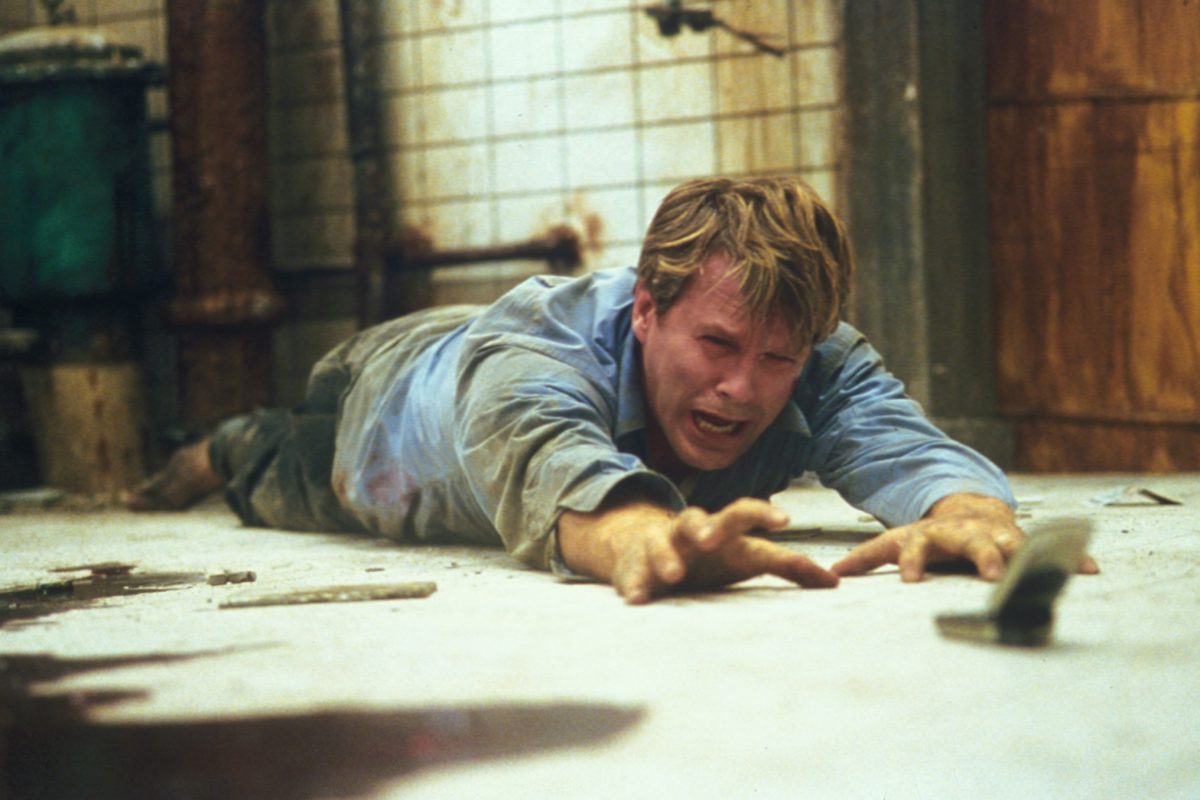
In the last week of October every year from 2004 to 2010, a Saw movie was released in theaters. The total production costs of these seven movies was about $64 million; worldwide, they collectively earned $885 million, more than 13 times that. Even allowing for the back-of-the-envelope math and Wikipedia, that is a staggering reception. A few years later, turning the piggy bank upside down and shaking it vigorously, there were three subsequent films in what could charitably be described as “the Saw extended universe”—a direct sequel (2017), a spinoff featuring no returning characters but, rather, characters who had heard of the original story because it happened in their city (2021), and a grafted-on sideshow set between the first two films that foolishly attempts to gin up backstory (2023)—but the series’ initial seven-film run is its essence, and the first film is the only one that’s really necessary to get the point. It exists at the nexus of brilliance and stupidity, of charm and tackiness, of creativity and ignorance. It contains a deft high-concept plot while also being built of cardboard. It has a generationally iconic villain alongside the absolute dumbest characters imaginable. It has moments that capture genuine terror, and it has line readings indistinguishable from parody or pornography. It was wildly influential even as its imitators seemed to regularly misunderstand what made the original work. It’s the perfect midnight drive-in movie for people born after they were all torn down. It is dumb, and it is beautiful, and it is each because it is the other.
///
There are really only a handful of horror stories:
- This House/Region Is Haunted
- Somebody Made a Deal With the Devil
- Killer on the Loose (Natural)
- Killer on the Loose (Supernatural)
- The Real Murderer Was Capitalism
- Cthulhu?
Saw is a haunted house movie at heart: a group of people are trapped in an abandoned warehouse and hunted by an evil entity, in this case the serial killer known as Jigsaw. The movie’s grimy genius is in its twist, which is that Jigsaw will allow the people to leave whenever they want. However, to do so, the would-be victims have to solve a riddle (difficulty: variable), the answer for which usually involves mutilating themselves in some way (difficulty: admittedly higher). As things start to go about as you’d expect from a movie called Saw, the string of increasingly baroque deaths that audiences come to these movies to see stretches out before the viewer in a cruel inversion of the genre’s norms: Saw, it turns out, is a self-slasher, a movie about people who have to choose whether to kill themselves or each other. It’s a great set-up.
And yet: while you can always make a bad movie from a good script, you can never make a good movie from a bad one, and Saw’s is pretty bad. The problem is that director James Wan and writer Leigh Whannell, who created the film together, had reverse-engineered the premise based on its low cost, meaning they weren’t trying to find a way to tell their story as cheaply as possible, but rather wondering what cheap story they could tell that would fit their limited resources. They didn’t have much more of a hook than “what if two guys were trapped in a room with a killer?” That’s less a pitch for a movie than it is an idea for a short film, which is what Wan and Whannell actually made first: they filmed the opening segment of the movie as a way to generate interest and secure funding for the feature. Saw is perfect as a short, a grimy and foreboding little jaunt, its brief length a perfect compliment to the tension of the story. Padded out to feature length, though, it is, well, padded. It shuffles between timelines and locations, constantly deflating the suspense it had just spent time building up, and quickly becomes lost in narrative ornamentations and double-crosses and triple-twists. The plot’s complications feel needless because they’re clearly just a way to kill time with something that looks like a movie until Wan and Whannell can get back to the gut-splattering stuff with Jigsaw. In an ironic twist, they got the budget for a movie they didn’t need to make, because the short that earned them that budget was the only story they could tell.
///
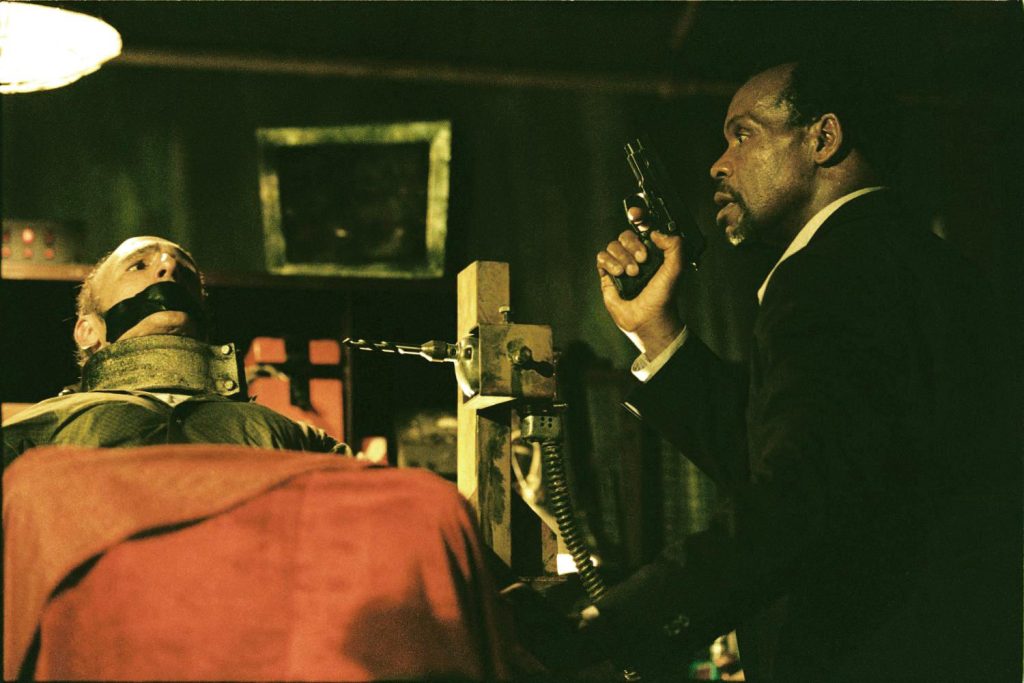
The film itself feels stapled together from disparate chunks: the haunted warehouse; a storyline about domestic suspense; a cop thriller where grizzled detectives chase down Jigsaw. One of those detectives is played by Danny Glover, who filmed all his scenes in two days and comes across on screen as someone who is about at the end of that second day and casually eyeballing the door. There’s a car chase where the cars don’t actually move but instead have a camera move past them on a dark soundstage, the final footage cut together with staggers and zooms and speed changes that do not at all succeed in disguising what is happening. Yet the little engine at the heart of it never dies, and the compelling horror of the premise—you have been kidnapped but can free yourself through an act of torture and self-revelation that will change you and your life forever—never wears off.
Saw also had the luck to be at the forefront of an oncoming wave of grisly, often quite unpleasant movies in a horror subgenre that would come to be known as torture-porn. These movies were about people in wet concrete rooms having their bodies mutilated for sport, and there was a period spanning both terms of the W. administration when they were just about impossible to avoid. Wan and Whannell beat the term to market but created the aesthetic, and it’s both accurate and fair to include Saw and its offspring in the torture-porn family tree.
Saw was able to cash in on the trend it helped spawn more successfully than any other comers (with the possible exception of Eli Roth’s Hostel movies, which helpfully cemented Roth as a both cruel and unserious filmmaker and allowed attention to move on) because it was the first, and also because it is self-consciously goofy in a way that imitators never seemed willing or able to recreate. Because Saw is the kind of movie where car chases happen with stationary cars and big imagination, and where people who get brain tumors decide to become supervillains, and where said supervillains take the time to make elaborate costumes and build little bike-riding puppets. It’s a cheeseball B-movie that knows it. It is not good, and it probably knows that, too. But it is honest, in its way, and that’s not nothing.