Julia Sirmons
There’s an anecdote about Russ Meyer, king of exploitation cinema. A woman dismissed his movies as outlets for his own fantasies; she called him “nothing but a breast man.” Meyer’s response was quick: “That’s only the half of it.” His reply captures both the unrepentant horndoggery and detached wit of his films.
This “nothing but” is unfair. Meyer’s cinema is permanently linked to the pneumatic silhouettes and tight outfits of his heroines, but these women are also compelling personalities. They range from the sassily self-sufficient to the outrageously perverse to the kind of tough chicks who like beating men up just because. It’s easy to make good art out of pedestrian sexual fantasies; Meyer was the rare bird who, through idiosyncratic creativity, superior craftmanship, and a genuine love of women, created bold feminine archetypes that transcend fetishism. These complex women are part and parcel of his great skill as a satirist. Many exploitation films parody or pastiche mainstream culture. Meyer went further: he took the sex, violence, and transgression endemic to exploitation flicks and used them to thumb his nose at cinematic convention and social mores in ways that still delight.
Meyer’s career took off when he pioneered the “nudie cutie” sexploitation genre with 1959’s The Immoral Mr. Teas. In it, a mild-mannered man has some truly gnarly dental surgery and is then able to see women beneath their clothes. But comic, innocent premises didn’t interest Meyer for long, and he moved into his “gothic” period. Mudhoney, from 1964, is an important transition film: it’s a sordid tale where sex is bound up in the taut atmosphere that surrounds people stuck in dead-end places. As a sadistic drunken lout terrorizes both his wife and the sex workers who he frequents, Meyer notes that feminine sexuality is often shaped by cruelty. The film may linger on these women’s breasts, but it leaves the viewer with real sympathy for them, and a hankering for harsher punishment.
The spectator’s thirst for female anger and vengeance would be slaked in one of Meyer’s best and best remembered films, 1965’s Faster Pussycat, Kill Kill! The titular pussycats (supposedly a dangerous “new breed’ of women) are a trio of go-go dancers. Their wolfpack is led by Varla, played with acidic bite and volcanic mean-girl rage by the wildly charismatic Tura Satana, in a T-shirt cut down-to-there, black driving gloves, and a perpetual sneer. The pussycats are thrill-seeking (they drive fast cars and play chicken in the desert) and also delightfully snide: their dialogue is dense with allusions and metaphors; they volley back and forth with bitchy élan.
After Varla karate-chops a man to death (mainly because he’s a cocky square), the pussycats flee and happen upon a Mud Honey-esque deserted ranch, populated by only by a bilious, reactionary old lecher in a wheelchair and his two dominated sons. The pussycats hang around once they learn that the old man has a pile of cash stashed somewhere on the ranch.
As the pussycats work on finding the cash (by both seduction and karate chops), the film becomes a showdown between a kind of perverse feminine greed and an altogether unsurprising male nastiness. Varla the femme fatale is also the manifestation of capitalist will to power. “Everybody wants, that’s what makes things run,” she tells one of the old man’s simpy sons. And Varla wants “everything, or as much as I can get.” Between the “so awful much” of Varla and the stingy greed of a would-be rapist who rants about the Democrats and women wearing pants, it’s hard not to root for the bad girl. But her inevitable comeuppance is blunted by Meyer’s ironic, over-the-top morality play scenes.

Following Pussycat, Meyer’s films grew more explicit. He cared less about sex in and of itself, and started experimenting with sex scenes as jokes, often juxtaposed with other elements of filmmaking. In Vixen, Meyer tests how unpleasant you can make a big-chested woman before she loses her sexual allure. Vixen (the pouty and annoying Erica Gavin) is a bored horny housewife in the Canadian “bush.” She has her way with everyone (including her brother) passing through her husband’s fishing lodge. Her seduction techniques are baffling: she bullies men into fucking her by challenging their virility. In a truly mind-boggling scene, she makes moves on a guy by go-go dancing with a freshly-caught fish: she stares at longingly, kisses it, and rubs it between her breasts.
But this goofball perversity is secondary to Meyer’s political interests, which focus on the character Niles (Harrison Page), a young black draft dodger who’s come to Canada in naïve pursuit of less racism. At times, the vocally racist Vixen dares Niles to rape her—a provocation that activates the stereotype of black men as sexually voracious and dangers to innocent white women. Meyer pushes that storyline but ultimately doesn’t go there, instead weirdly juxtaposing shots and sounds of Vixen and her brother going to town with scenes of an IRA member trying to get Niles to join the revolution in Cuba.
This back-and-forth between two perverse seductions is a satirical tool that Meyer returned to in his masterpiece, Beyond the Valley of the Dolls (1970). A send-up of the Hollywood coming-of-age story, which decries the excesses and exploitation of the entertainment industry, the film lets Meyer combine his love of busty, independent heroines, and his witty uses sexual imagery into a satire of Hollywood society. He nails the whole microcosm: the hippies and freaks, and the Hollyweird stars and suits who ape their style for cultural cachet and profit. In vibrant, swinging party scenes, colorful characters trot out snippets of hippie speak, while Meyer cuts to images of couples of all genders grinding on each other in every bed and bathroom. There’s a glorious array of kooky personalities and the polymorphously perverse, but it’s still clear that everyone’s on the make. “You’re a groovy boy, I’d like to strap you on some time,” is, after all, a phrase with many possible meanings.
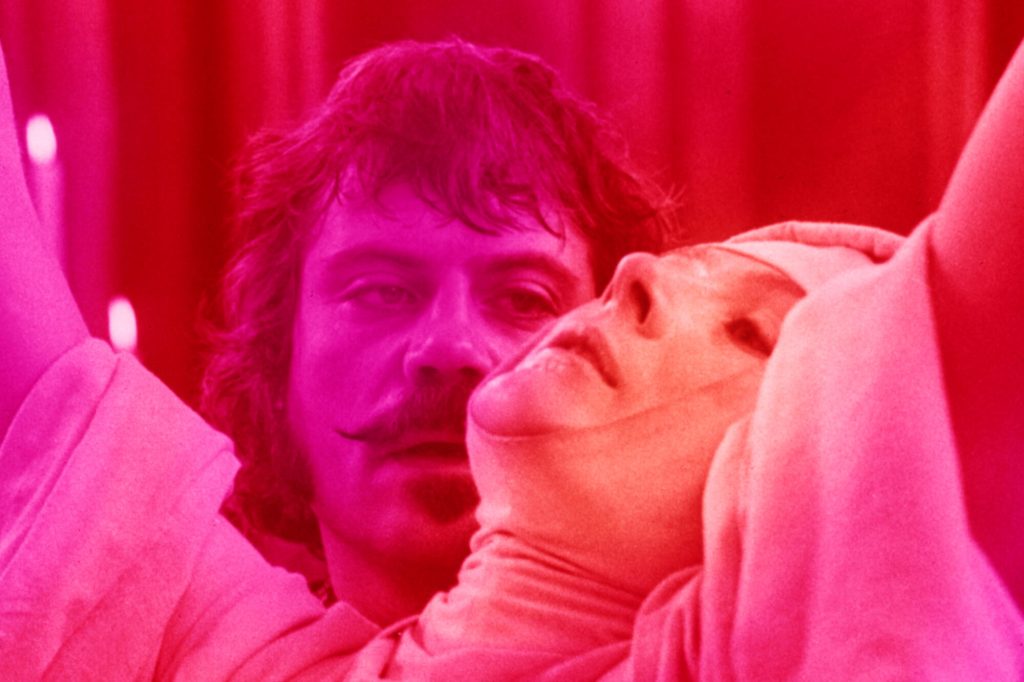
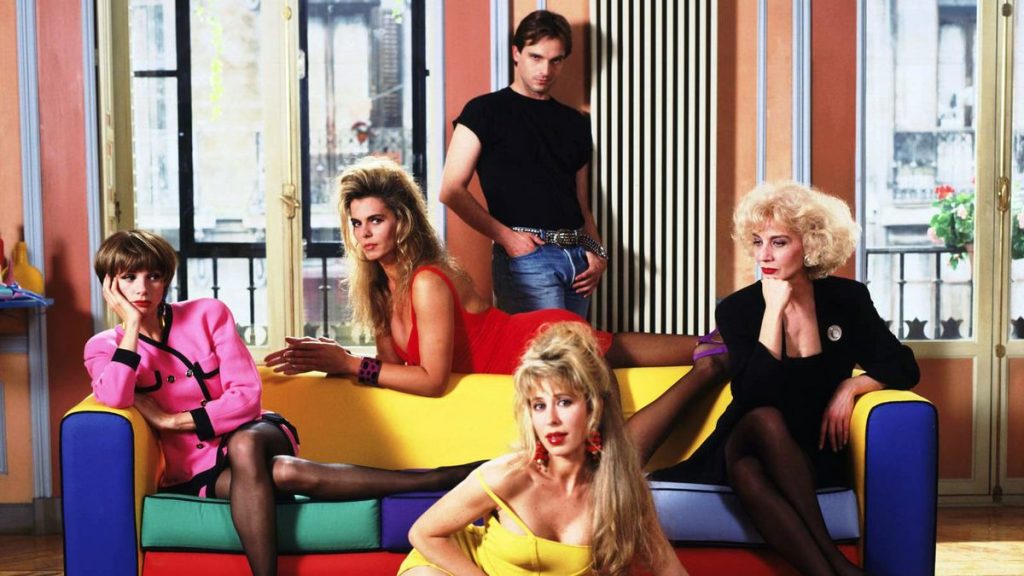
In Beyond, a girl band (all busty and sassy, naturally) comes to Hollywood in search of fame and fortune. They get it, thanks to a superstar producer named Z-Man. Z-Man is reminiscent of the notoriously eccentric and unstable Phil Spector, but in the hands of John LaZar, the character becomes his own entity: a bohemian, hyperliterate dandy who speaks in Shakespearean dialectic, uttering such memorable lines as “get thine ass in gear.” (Meyer wrote the screenplay with a young Roger Ebert.) In some sense, Z-Man represents Meyer himself, a wry commentator and a trickster who ironically frames the other characters’ sexual escapades, but also urges them on.
“Nothing is obscene,” Meyer said, “providing it is done in bad taste.” This credo is put to the test with Beyond’s mind-bogglingly schlocky ending, in which Z-Man hosts a druggy, witchy party, and then kills all his guests when he’s rejected by an Apollinian Hollywood hustler. (The revelation of Z-Man as a stereotypical crazed trans killer is what’s hardest to stomach today.) These circumstances are reminiscent of the murder of Sharon Tate and her friends by the Manson family—a crime that occurred a year before the film’s release. These murders caused a sea change in Hollywood’s relationship to the counterculture (the parties got a little less kooky), forced the industry to examine its own excesses, and made power players see themselves as potential victims.
Whether Meyer’s “bad taste” version of Hollywood murder –wherein a maniac beheads a man in a fit of jealousy while the 20th Century Fox fanfare plays in the background—can withstand the “obscenity” charge even to this day is certainly debatable. But Meyer’s use of the tools of trash cinema to explore something both so superficial and so deep as the industry’s understanding of itself is a mighty task few have done with such bracing cynicism, and such fun.