Sara Batkie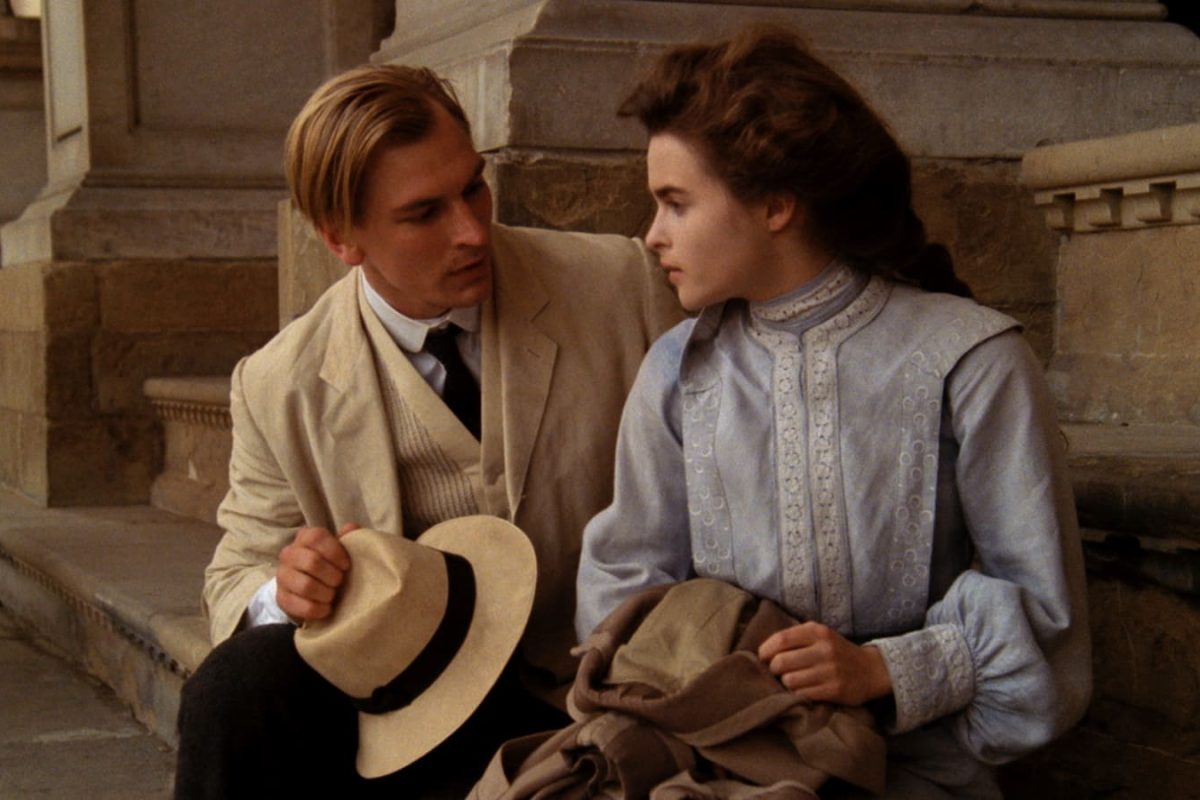
When thinking of auteur pairs, we often have two directors in mind, usually related: the Coen brothers, the Dardenne brothers, the Wachowski sisters. More rare is the director-writer partnership. Rarer still is the director-producer team that becomes a household name. But that’s exactly what happened with James Ivory and Ismail Merchant, who were often working alongside screenwriter Ruth Prawer Jhabvala (whose name was perhaps a bit too unwieldy to add to the mix). Though they’d been making films together since the early 60’s, it wasn’t until the release of 1986’s A Room With a View that their sumptuously meticulous historical reproductions became a recognizable brand.
Ivory and Merchant weren’t just professional partners but life-long romantic ones. Ivory was born in 1928 in Berkeley, California while Merchant, who was eight years younger, was raised in Bombay. They attended colleges on opposite coasts of the United States – Ivory at USC and Merchant at NYU – but their paths eventually crossed in 1959 at a screening of Ivory’s documentary The Sword and the Flute. They founded the Merchant Ivory Productions company two years later; Jhabvala’s first collaboration with them was in 1963 on an adaptation of her own novel, The Householder. “It is a strange marriage we have at Merchant Ivory,” Ismail once observed. “I am an Indian Muslim, Ruth is a German Jew, and Jim is a Protestant American. Someone once described us as a three-headed god. Maybe they should have called us a three-headed monster!”
Whether gods or monsters, their four decades together (until Merchant’s death in 2005) were fruitful ones. While earlier films like The Guru and Bombay Talkie were modestly budgeted originals, they soon turned their attention to literary adaptations. They had impeccable taste in books – authors they reinterpreted for the screen included Henry James, Jean Rhys, Evan S. Connell, Kazuo Ishiguro, and E.M. Forster, whose work they adapted three times. A Room With a View, Forster’s 1908 novel, was the first of these and became their biggest box office success at that point, eventually earning eight Oscar nominations and winning three awards, including one for Jhabvala’s script.
Though Forster considered it one of his lighter novels, it’s not difficult to discern its audience appeal. Inspired by a trip he took to Italy when he was twenty-two, Room is at once a deeply romantic story and a gently humorous critique of English societal norms in the early twentieth century. Studios were interested in the rights as early as the 1940s but Forster declined all offers, as he was dismissive of the cinematic medium. It wasn’t until ten years after his death in 1970 that the executors of his estate reached out to Ivory and Merchant and invited them to Cambridge to discuss the possibility of a film. Though initial investors thought Room “had no chance commercially,” it wound up grossing an estimated $60 million worldwide.
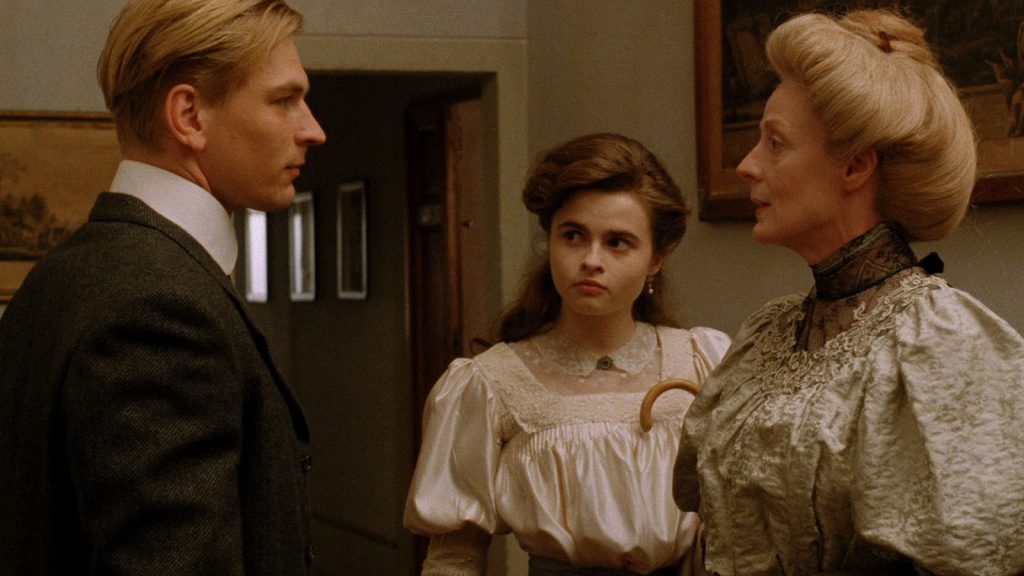
Much of the film’s first half was shot on location in Florence, which still retains its old world grandeur. Helena Bonham Carter, only eighteen at the time, stars as Lucy Honeychurch, an impressionable young woman with an extravagant pouf of pre-Raphelite hair. Ivory reportedly gave her the role despite her lack of experience because he found her “very quick, very smart, and very beautiful.” Lucy is traveling abroad with her spinster cousin Charlotte Bartlett (a gamely irksome Maggie Smith), and the two are disappointed to find their accommodations in the city aren’t as advertised. When their fellow guests Mr. Emerson and his son George (Denholm Elliott and Julian Sands, respectively) learn of their dilemma, they offer to switch rooms. “I don’t care what I see,” the elder Emerson insists to the ladies’ evident embarrassment. “My vision is within! Here is where the birds sing! Here is where the sky is blue!” So begins a comedy of errors as Lucy’s growing affection for the unsuitably bohemian George clashes against her inborn expectations of a proper life.
Following a clandestine kiss between George and Lucy in a field of wildflowers, she is whisked by Charlotte back to Surrey where she is soon proposed to by Cecil Vyse (Daniel Day-Lewis, who opted for the role over George, seeing it as the bigger challenge, and gives his character far more grace than is asked for). Cecil is a hopeless prig, and a poor fit for Lucy. But it isn’t until the Emersons unexpectedly come to stay in town that she begins to consider her true feelings and resolve to act on them.
It’s a simple setup, but one that Ivory, Merchant, and Jhabvala imbue with inordinate care. Lucy has been brought up to believe that intellect and passion are contradictory poles, but George knows that love in its purest form marries the two. His romantic conviction suffuses the film itself, the delicate light bathing the frame as soaring opera arias fill the soundtrack. The audience is carried away as much as the characters, and they continued coming back to Merchant Ivory productions seeking that same sweeping force.
The team’s output was remarkably consistent through the mid-90’s – Maurice was their next project; Howards End and Remains of the Day came in 1992 and 1993. But such uniformity also brought them criticism, especially once their flavor of tasteful period drama began falling out of fashion. Tarantino infamously put his own opinion of their work into a character’s mouth when Clarence decries the “safe, geriatric… Merchant Ivory clap-trap” in True Romance. Forty years on, though, at a time when both literary adaptations and female-led romances can feel rote and uninspired, A Room With a View remains ravishing because it’s the opposite of safe or geriatric. Forster was a publicly closeted gay man who channeled much of his thwarted yearning into his work, and Ivory, Merchant, and Jhabvala make that hunger palpable. The film indeed ends in a room with a view, but they know it’s the open window that really matters.
“Room With a View” is streaming on the Criterion Channel, HBO Max, Kanopy, and a handful of ad-based services.