Jason Bailey
George Sherman’s Big Jake – now streaming on Amazon Prime and a variety of other ad-supported services – opens in a style you might not expect from a John Wayne Western: like a documentary. Over archival photos, a deep-voiced narrator situates us in the time and place; it’s 1909, “the Edwardian Golden Age,” a time of rising sophistication and culture in the metropolises of the east. But “in the Western part of the United States,” we’re told, things were “not so refined.” It’s a clever bit of writing, but it’s more than simple scene-setting; screenwriters Harry Julian Fink and Rita M. Fink are laying out the themes of the picture, before we’ve even realized it.
The narration continues with a roll call of the members of “Fain’s Gang”, each one given a distinctive backstory: “A professional gunfighter, the last of his kind”; “A back-shooter. Considered a coward”; “Maybe the worst of them. An indiscriminate killer. Women and children.” Suddenly, we’re not watching a Western – we’re watching an episode of “Dragnet.”
This chicken soup of influences is typical of the trickiness of “traditional” Westerns of this period. An onslaught of revisionist takes in the 1960s – led by Leone and his Spaghetti Western brethren, and taken up by American mavericks like Sam Peckinpah and Monte Hellman – were making Wayne look like a bit of a fossil. His pictures still made money (the core oater audience was an older one, and one that thus leaned conservative, in its politics and its entertainment), but studios were moving into a decade where nothing was more embarrassing than seeming out of touch.
So Wayne attempted to strike a balance, embracing certain elements of these new Westerns while maintaining a tight grip on his well-established persona. His sense of humor and self-awareness helped him land an acting Oscar for 1969’s True Grit, for example, and surrounded himself with younger stars (including New Hollywood poster boy Bruce Dern) in The Cowboys in 1972. Between them came Big Jake, a film that mostly feels like 1971 in its graphic violence – particularly the nastiness and brutality of the opening sequence, in which Fain’s Gang invades the ranch of Martha McCandles (Maureen O’Hara), kills several people, wounds her son, and kidnaps her grandson.
“It is, I think, going to be a very harsh and unpleasant kind of business,” she declares, of paying the ransom. “And will, I think, require an extremely harsh and unpleasant kind of man to see to it.” And with that, Sherman cuts to John Wayne, squinting as he takes aim. It’s a perfect entrance, and a late one – we don’t meet the star of the movie until the 19-minute mark. But that’s the way to play this sort of thing; by 1971, you’re not making a movie with John Wayne the actor, or even John Wayne the movie star. You’re making one with John Wayne the icon, and you have to handle that accordingly.
It’s not just that the director treats him like an icon; the other characters do as well. His first dialogue scene includes this exchange:
“Just who in the hell do you think you are?”
“Jacob McCandles!”
“Oh, I uh, thought you were dead, Mr. McCandles.”
“Not hardly.”
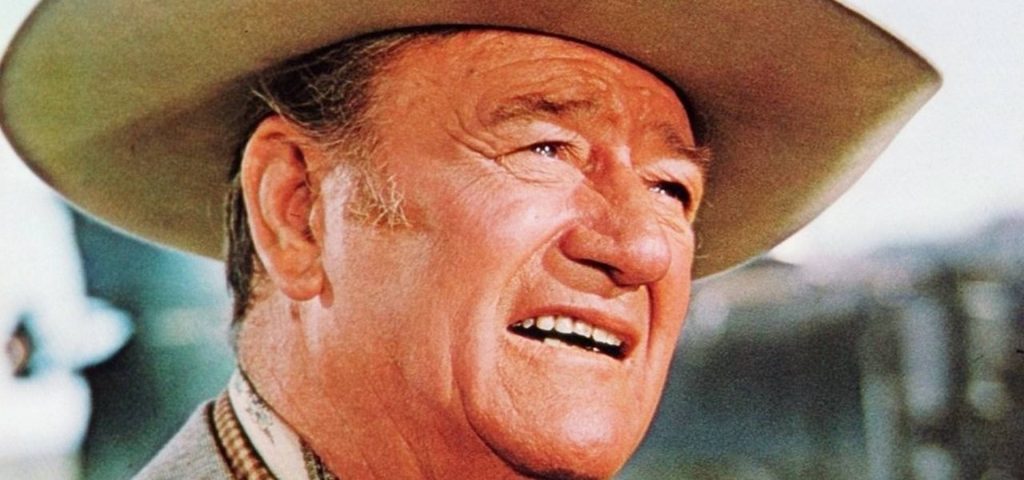
This becomes a running joke through the film, and a clear inspiration for a similar runner in noted John Wayne fan John Carpenter’s Escape from New York; in one instance, Wayne (not above an inside joke himself), responds to the remark “I thought you was dead for sure by now” by snorting “That’ll be the day,” his catchphrase from The Searchers.
Familiarity with his previous work also lends some extra weight to his loaded scene with O’Hara, with whom he’d shared the screen several times before (most memorably in The Quiet Man). Not that they don’t have plenty to play; when he’s first mentioned, she sneers, “I have no husband,” and he’s been estranged from his family so long, he barely recognizes his children. She just wants Jake to deliver the ransom, and not make trouble. Anyone who’s seen a John Wayne movie knows it won’t be that simple.
O’Hara isn’t the only familiar face; Big Jake was produced via Wayne’s own company, Batjac, and he makes it a family affair, casting his son Patrick as Jake’s son Jim, and his son Ethan as his grandson Little Jake. (Make of that math what you will.) And he also cast, as another of Jake’s sons, Christopher Mitchum – son of his pal (and El Dorado co-star) Robert Mitchum. Richard Boone is the villain, the second of his three collaborations with the Duke. And director Sherman was an old friend as well, directing Wayne in eight of his early, low-budget Westerns for Republic Pictures. This would turn out to be Sherman’s last film – it’s included in the recent “final films” episode of the Pure Cinema Podcast – and Wayne reportedly directed a few scenes when Sherman became ill.
But Sherman had been directing since 1937, and had clearly learned a thing or two. He lets Boone rip as the antagonist, and it’s a terrific performance; he’s terrifying but also weirdly charismatic, and you sort of had to be, at that point, to successfully go toe to toe with the Duke. Moreover, his credibility as a bad guy is necessary to pull off the carefully (and patiently) constructed climax, a ransom handoff with an empty strong box. “I just saw something in your eyes I don’t like,” Boone tells Wayne. “I saw a foolish thought.” It’s a chilling moment.
The aforementioned element of of historical crisscrossing gives Big Jake a unique look and feel; they’re out West, and they’re on horses, but also Rangers are in motorcars, and Mitchum is on a motorcycle. (The latter seems like a conscious move to make the picture hip and youthful – after all, it was in production in about a year after Easy Rider became a commercial and cultural sensation.) But they’re up to more than just winking incongruity. When Jake arrives to lead the ransom mission, he’s told, “It’s 1909, Jake,” and he sneers in response, “Meanin’ that my way is old-fashioned?”
That’s the subtext here – that Wayne is considered old-fashioned, and his Westerns are thought of the same way, and these young whippersnappers feel no obligation to respect him. But that changes over the course of their journey; he shows them that the old ways can be the best ways, and they learn to respect the old man because, gosh darn it, he might be a dinosaur but he gets the job done. None of this is terribly subtle – nor is it untrue. 
“Big Jake” is currently streaming on Amazon Prime and several additional, ad-supported streaming services.