Kayleigh Donaldson
There’s something beautifully twisted about John Waters becoming a respected gentleman of modern cinema. The Pope of Trash has lost none of his radical edge but the culture has evolved to embrace his unique brand of filth. The filmmaker who gave us singing anuses, rape by giant lobster, and dog poop dinner now has six films in the Criterion Collection. The two latest additions to the fold, released this month, include his most mainstream effort, Hairspray, and his most out-there, hyper-political nightmare. It’s the latter that intrigues us the most.
Desperate Living is often overlooked in conversations about Waters, perhaps because it’s the only film made during her lifetime that didn’t star the iconic Divine. It’s also the film that, even by Waters’ standards, hits close to the bone with its provocations on gender and class, which is saying something given that it’s part of an unofficial trilogy with Pink Flamingos and Female Trouble. Perhaps it’s only fitting that it’s due to receive a cultural reconsideration in 2026, amid a time of tacky corruption and uncharismatic con artists ruling the roost. Out of all his films, Desperate Living is the one where Waters became prophetic.
Peggy Gravel (Mink Stole, another Waters regular) is a tightly wound WASPy housewife who thinks the world is out to get her. When a baseball breaks through her window in the opening scene, she goes on a hysterical tirade against commies, Vietnam, and the Supreme Court. “How can you ever repay the thirty seconds you’ve stolen from my life!?” she screams at the kids whose game has destroyed her sanity. Her neuroses only get worse from there, as she and her housekeeper Grizelda (Jean Hill) kill Peggy’s husband and are forced into exile at Mortville, a shantytown populated by criminals and social deviants. Its ruler is Queen Carlotta (Edith Massey), a fascistic despot who laughs at poor people and revels in the hatred directed her way. Rebellion is in the air, and so is the smell of cooked flesh.
Us critics have a terrible habit of watching films with vaguely political details and wondering aloud, “Is this actually about Donald Trump?” The answer is almost always “no,” if only because our parodic timeline feels too frazzled and tacky to be truly embodied by any director with taste. But Waters has always understood that, to possess bad taste, one must keenly understand what good taste is. Desperate Living is a fairytale horror all about the psychosexual abuses of fascism in the post-Nixon era. It’s about as close as Waters ever came to predicting the future.
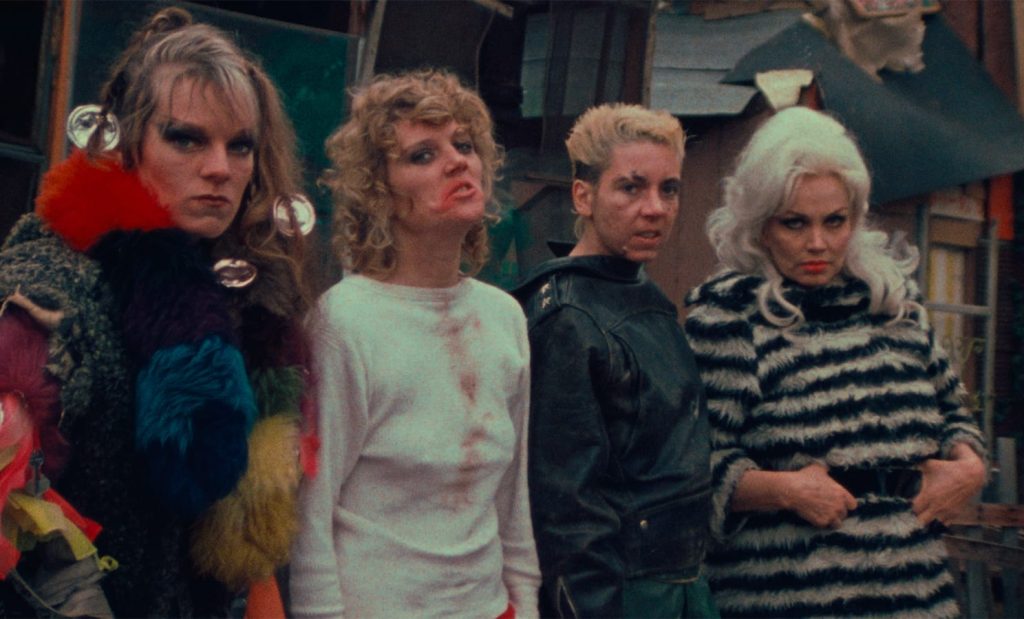
Waters, a die-hard Pasolini fan, once described Salò as being about “the pornography of power.” That sentiment could easily be applied to Desperate Living, which has more jokes and breast-shaped glory holes but is imbued with the same shameless rot as Salò. The dynamics of an uber-elite versus the starving masses is not unlike the set-up of a fairy-tale, and in Mortville, it’s a queen who rules the roost and demands increasingly ludicrous displays of loyalty, simply because she can.
Living under a dictatorial rule is hellish, but it’s also embraced by some, particularly those with power or an insatiable entitlement to it. Peggy wastes no time in going from accusing kids of trying to murder her with a baseball to sucking up to Queen Carlotta and declaring that only the rich should be allowed to live. She’s a social-climbing housewife hopped up on pills and a suburban power trip who takes to fascism like a duck to water. “Go ahead! A single gunshot can never destroy the beauty of fascism!” she later declares, dressed like a Disney villain with Hugo Boss styling. As time has proven, bragging about one’s own evil tendencies has never been a subtle endeavor.
But unlike Salò, filth and deviance is a universal experience for the residents of Mortville. Amid the pastel-toned bags of trash that line the shantytown, the locals flash one another as greetings and turn every semi-public bathroom into a free-for-all. Mole McHenry (Susan Lowe), a local thug and lesbian wrestler, wants gender reassignment surgery to please her lover, but when her girlfriend Muffy (Liz Renay) rejects it, Mort performs a penectomy on the spot. It’s one of the most shocking moments in the Waters canon, a scene of pure gender overkill that embodies the director’s commitment to assaulting the status quo (although, understandably, it’s also frequently labelled as one of Waters’ more problematic choices by 2026 standards).
Also unlike Salò, fascism does not win. Rebellion is always an option, and usually the more fun one. Of course Waters would not skimp on the glorious details of a movie ending with the message, “Eat the rich.” Desperate Living is no polemic, but it is as vocal as any other work in Waters’ filmography about the necessity of nonconformity. Crawling on your knees in service of power is a loser ideology, and it won’t save you when the dirty underbelly of society reaches its tipping point. Eat shit and die? Waters replies, Eat shit and live.
“Desperate Living” is out tomorrow on 4K UHD and Blu-ray from the Criterion Collection.