Zach Vasquez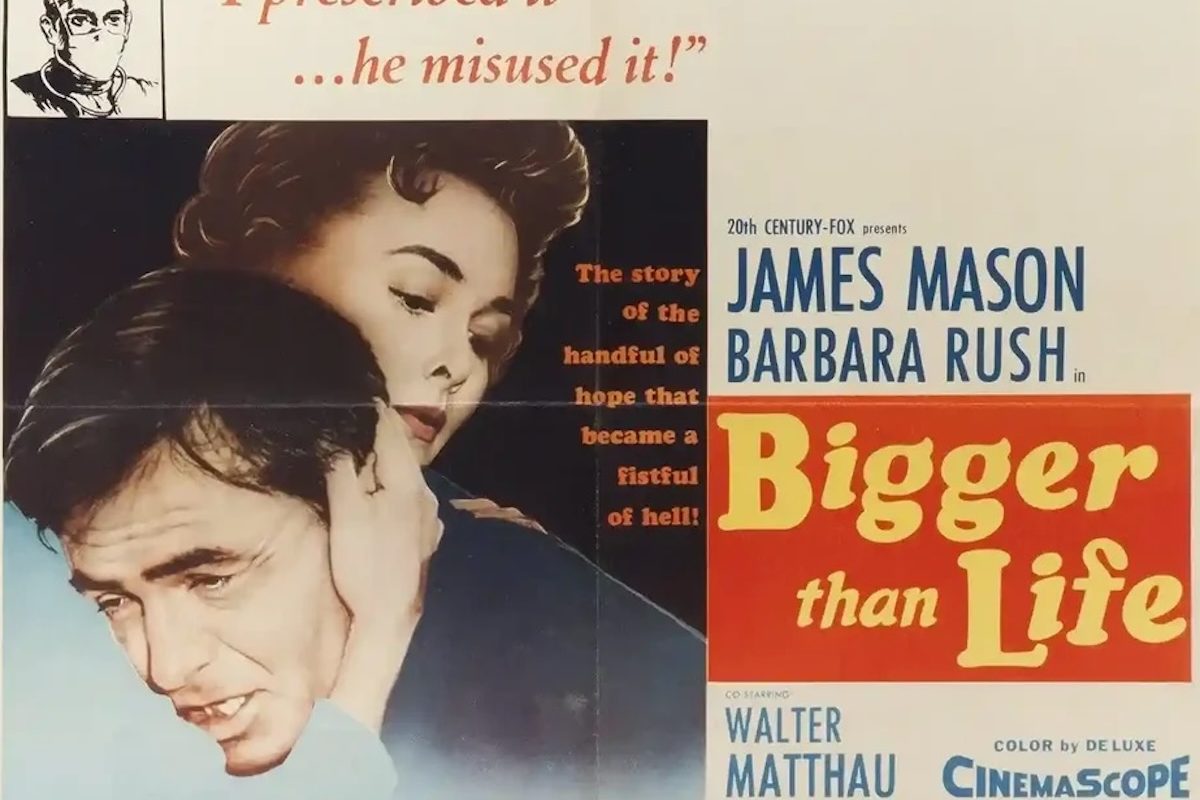
In 1955, director Nicholas Ray gave us one of the most indelible portraits of American suburban anxiety ever put to screen via his teen delinquent melodrama Rebel Without a Cause. He would plumb this dark terrain even deeper one year later with Bigger Than Life, which examines those same anxieties from the parents’ point of view.
You’d think the film about hormonal teenagers would be the most ferocious in terms of emotion and mortal danger, but nope: by the end of Life, the drama has taken on Biblical proportions. Literally.
Loosely based on a real case history documented by Berton Roueché in an article for the New Yorker (“Ten Feet Tall”, 1955), Bigger Than Life charts the harrowing descent into madness of Ed Avery (James Mason, who also produced), a friendly suburbanite school teacher and family man who, following a frightening and rapid health decline due to a rare and terminal form of arthritis, grows dependent on an experimental new drug called Cortisone. Scarier than his rapid addiction to the medication are the side-effects: wild mood swings, paranoia, physical ferocity, and eventually homicidal madness.
We witness this monstrous transformation—Jekyll and Hyde by way of Norman Rockwell—through the terrified eyes of his wife Lou (Barbara Rush) and young son Richie (Christopher Olsen), both held captive to Ed’s increasingly tyrannical forms of psychological abuse. Things reach the ultimate breaking point when Ed attempts to recreate the famous passage from Genesis wherein Abraham makes ready to sacrifice his son Isaac to God. When Lou points out that God ultimately had Abraham spare Isaac, Ed takes up the mantle of full-on deity and declares “God was wrong!”
On its face, Bigger Than Life plays like an indictment of medical malpractice first and foremost, an early warning cry about the ascendency of Big Pharma. No doubt the film would find favor amongst the anti-science contingent of today’s political landscape. But were this audience to look just past the surface (unlikely) at its subtext, if it can even be called such (working in a notoriously unsubtle genre—the melodrama—Ray loads every frame with symbolism), they’d see that the danger that envelopes the Averys was there from the start, bubbling just under the surface.
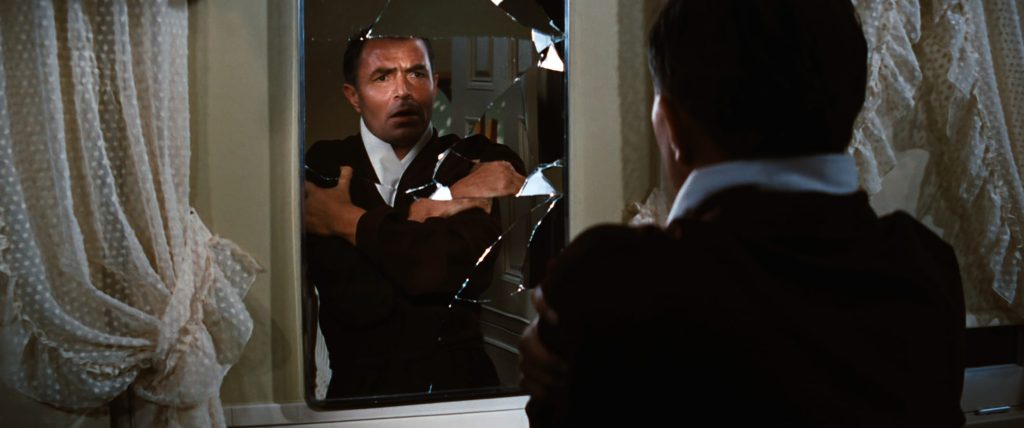
The bitter joke at the heart of Bigger Than Life is not so much that the cure is worse than the disease, but that both cure and disease are merely expressions of the same thing: the darkness inherent in the American Dream. Before the Averys’ world collapses alongside Ed, that darkness is already spreading, as made literal in one creepy scene where Ed follows an annoyed Lou from room to room turning off all the lights.
Ed supplements his meager teacher’s salary by working a couple days a week as a taxi dispatcher, but he keeps this secret from Lou because he thinks she’ll think it’s below him. But it’s clearly Ed’s own shame over his financial station that makes him hide the truth (later, when it’s suggested to Lou that she get a job, she makes it clear Ed would never allow it). A star quarterback in high school—or so he says, though we’re given reason to question this later on—and very obviously a thwarted intellectual, Ed suffers from the same crushing disappointments that drive George Bailey, the protagonist of the similarly-titled It’s a Wonderful Life, to attempt suicide. Note, for example, the maps and travel posters that line the walls of his home.
(The English Mason, great as he is here, seems an odd choice to play an all-American at first. But upon rewatch, the viewer can’t help but wonder if his character’s Mid-Atlantic accent isn’t just another affectation.)
Speaking of that home: while at first it appears the ideal of middle-class idyll, the more we see of it, the more it’s revealed to be wanting, from the way it’s squeezed between the neighboring houses to the tiny TV resting on a wobbly and narrow fold out stand in the den to the rusted water heater that stands naked in the cramped kitchen and which the characters consistently mention is on the verge of breaking down (I wonder if that’s a metaphor for anything?). It is incredibly telling that Ed’s first manic act upon leaving the hospital is to take his family on a shopping spree at a fancy uptown store that is way out of their price range. As Ed’s addiction and madness increase, the Averys hold off consulting his doctor because they simply can’t afford any more medical bills or the time he would have to take off work.
The Averys’ stress over their financial situation bleeds into their sex life. Lou is beset by jealousy, mistaking Ed’s busy afternoons at the cab company for an illicit rendezvous. She’s relieved when she discovers the truth, but her fears aren’t entirely unfounded. How else to explain the constant presence of the sexy, single new teacher at Ed’s school, who not only resembles a younger Lou, but is always needing Ed’s help with one thing or another? Though Ed never makes any overt passes at her, it’s clear she’s caught his wandering…eye (“I’d like to give her a push,” he remarks after she asks him to help get her car started).
Later, it’s Ed who becomes paranoid over the idea that his best friend, brawny gym teacher Wally (a young Walter Mathau, playing very much against what would become his type) has been courting Lou during his convalescence in an attempt to supplant him as head of the household. Ultimately, it will be Wally who topples Ed’s reign of terror during a demolition derby brawl through the Avery home, thus confirming at least some of his suspicions. (The small hints that Ray drops about Wally’s possible homosexuality add an extra psychosexual layer to this Freudian pie).
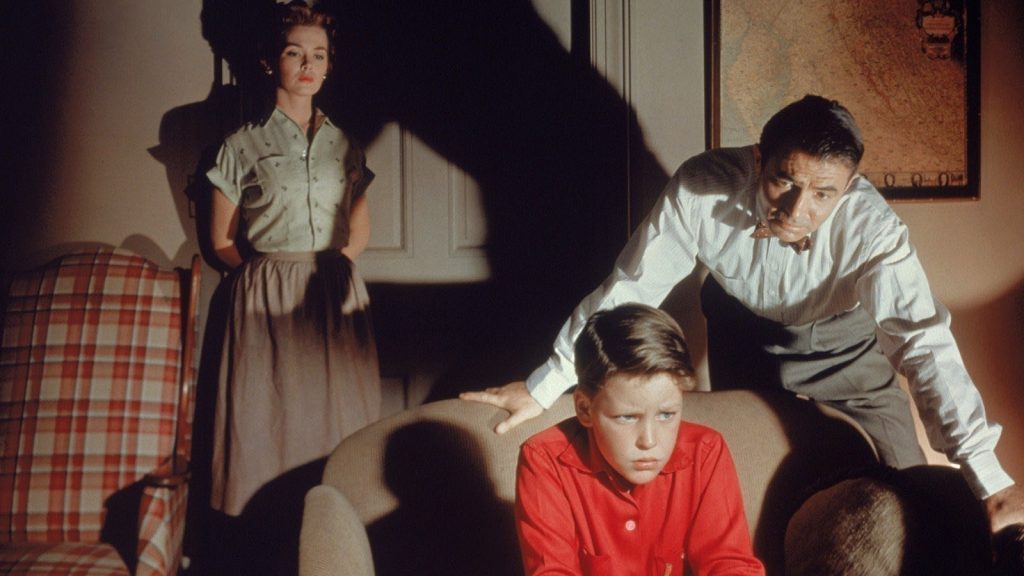
Granted, class and sex are universal problems, but the repression of them is one of the hallmarks of American suburbia, especially at the time of the film’s release during the height of McCarthyism. Speaking of McCarthy, Ed’s hideous metamorphosis sees him turn from a kind, liberal-minded Everyman into an unremittingly cruel (and sweaty) would-be despot with a noticeably nationalist bent. The fearful lessons he imparts to his terrified child (who constantly wears a bright red blouson jacket extremely reminiscent of the one James Dean made iconic in Rebel) come by way of two stolid symbols of American masculine strength: milk and football. One is reminded of writer William Gass’s dictum that “The first dictator of this country will be called Coach.”
Milk and football. About the only thing more American than that is an act of family annihilation, which Ed is all set to commit until he’s stopped at the last minute by Wally.
There is also something deeper and very strange going on under the surface that puts Bigger Than Life into capital-W Weird Fiction territory: the recurring motif of giantism, from the numerous reference to how big Ed feels—“He even looks bigger,” proclaims Wally at one point—to the way his shadow towers over his petrified wife and child like a fairy-tale ogre in the films most famous scene to a climactic dream that Ed has wherein Abraham Lincoln, “as big and ugly and beautiful as he was in life,” restores him to life. It is very clear that at some point this middle-class family drama has tipped full into the realm of the fairy tale.
Bigger Than Life proved a disappointment both critically and commercially upon release, but its reputation would be restored in the following decades, first by the Cashiers Du Cinema crowd, who worshipped at the altar of Nic Ray and rightly recognized this as one of his finest pictures, and later by his own country’s directors.
You can see the influence of Bigger Than Life in a number of prestigious movies from future auteurs: Stanley Kubrick’s adaptation of first Lolita (1962), which stars Mason as a different kind of psychotic schoolteacher and suburban menace, and then The Shining (1980), in which Jack Nicholson’s would-be family annihilator shares much DNA with Ed Avery; David Lynch’s fairy tale nightmares of middle-class psychosis, Blue Velvet (1986) and Twin Peaks: Fire Walk with Me (1992); and especially the neo-melodramas of Todd Haynes, in particular Safe (1995), which connects the suffocation of suburban life with a mysterious and all-consuming illness. Hell, you could even make the case that TV’s Breaking Bad, about a terminally ill school teacher who turns from “Mr. Chips into Scarface,” is an updated retelling of Ray’s film.
Today, Americans live under the rule of an ogre-like authoritarian (granted, Trump’s comportment is a far cry from James Mason’s), the middle-class is more anxious than ever about the increasing costs of housing and healthcare, and family annihilations are a regular occurrence. Seventy years later, Bigger Than Life looms larger than ever.
“Bigger Than Life” is streaming on the Criterion Channel.