Eric D. Snider
(Editor’s Corner is where Eric talks about overlooked gems, film history, or whatever he wants to talk about because he’s the boss and no one can stop him.)
In terms of lasting, positive impact, 1964 was a watershed year. The Civil Rights Act was passed, officially (if not yet literally) ending segregation. The Beatles and the Rolling Stones both released their first albums in the U.S., on their way toward changing rock music forever. And it was in this year that cigarette-smoking among American adults reached its peak, the rates declining thereafter largely due to something else that happened in 1964: the first Surgeon General’s report on smoking.
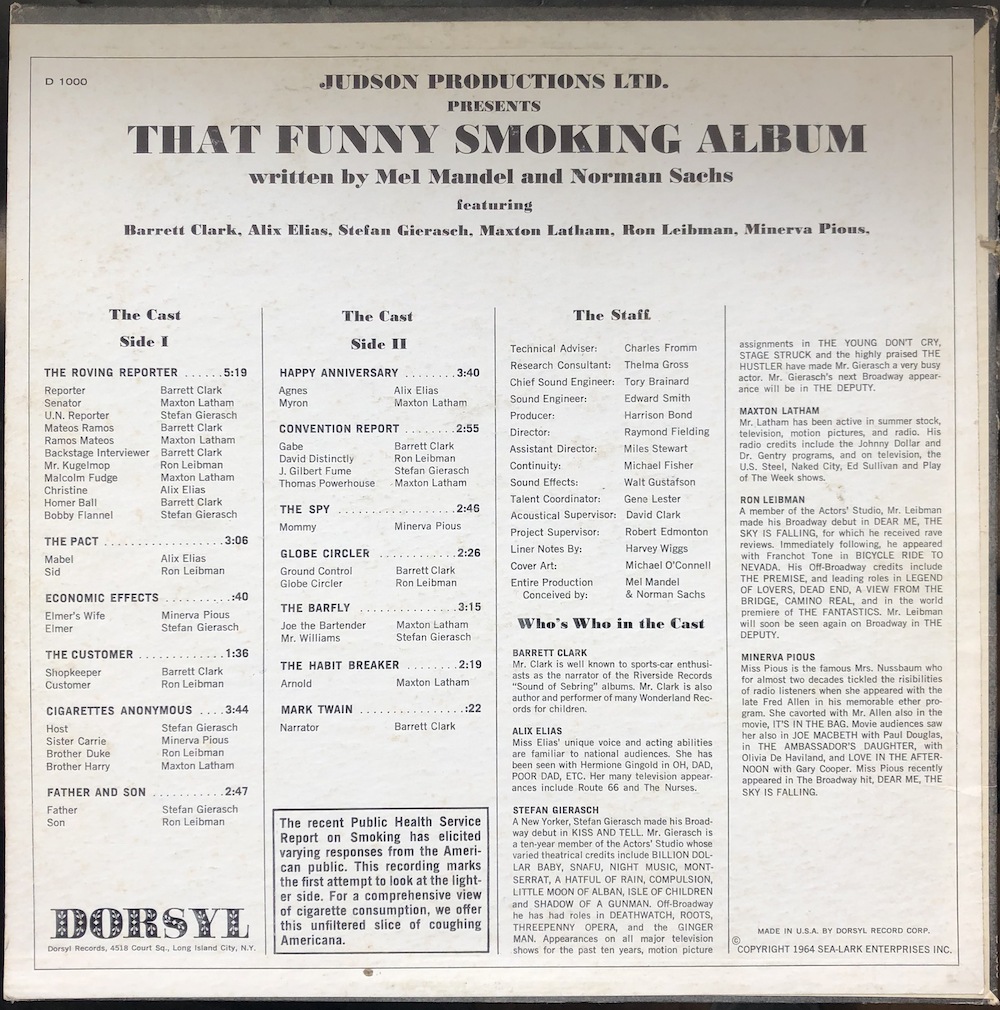 The idea that smoking might be unhealthy wasn’t revolutionary, but the report’s clear-cut language and prominence in the news cycle made it hard for people to ignore what should have been obvious since the first time someone set fire to a weed and inhaled it into his lungs. Attitudes about tobacco shifted significantly over the next decade. Before the year was out, comedy writers Mel Mandel and Norman Sachs released an LP called That Funny Smoking Album full of skits about cigarettes and quitting them. “Quitting smoking” became a socially popular thing to do.
The first Surgeon General’s warning appeared on cigarette packs in 1966 — “Caution: Cigarette smoking may be hazardous to your health” — and was updated in 1970 to be less wishy-washy: “Warning: The Surgeon General has determined that cigarette smoking is dangerous to your health.” Anti-smoking ads started appearing on TV in 1967, bolstered by an FCC rule that said stations had to air as many anti-smoking ads as they did cigarette commercials. That rule was hardly followed, though, and in 1971 cigarette ads were banned from TV and radio altogether. Meanwhile, after several decades of trending upward, the smoking rate dropped from 42.4% of American adults in 1965 to 37.4% in 1970 and continued to decline (it’s at 14% now). The Surgeon General’s report had sparked a cultural shift.
Among those trying to quit was Dick Van Dyke. A heavy smoker for some 20 years, he wrote in his autobiography that it was as if the Surgeon General’s report “spoke directly to me.” Realizing that there were millions of people in the same boat, Van Dyke conceived a movie idea about someone going to great lengths to give up the habit and pitched it to Norman Lear, co-writer of Divorce, American Style (1967), which Van Dyke had starred in. As it happened, Lear, who Van Dyke knew had been trying to quit cigarettes himself, had just read a novel called I’m Giving Them Up for Good in which not just one man but a whole town goes cold turkey.
And thus was Cold Turkey delivered to theaters in February 1971. Shot in the summer of 1969 but shelved because of questionable commercial appeal, it’s a satire about an economically depressed Iowa town whose 4,006 citizens all pledge to quit smoking for 30 days to win a $25 million prize from a tobacco company that’s looking for good P.R. Greed enters the picture eventually, but at first the townspeople — led by Van Dyke as a minister — focus on their genuine financial need. As depicted in an opening credits sequence showing boarded-up shops and dilapidated streets, accompanied by a Randy Newman song (his first film contribution) called “He Gives Us All His Love,” their town is dying. And not only would $25 million revitalize the community, it would make the town more attractive as a home for a new missile plant and Defense Department contracts.
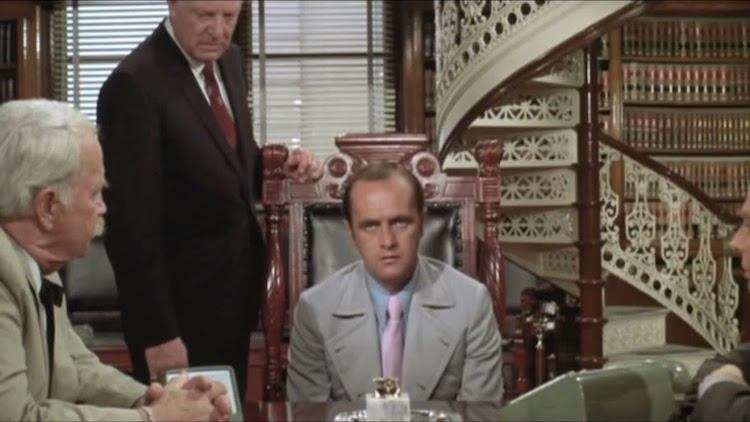
Norman Lear was 49 years old in 1971, a modestly successful TV writer with a couple of screenplays who was about to have a decade of unprecedented success in the sitcom business. His groundbreaking All in the Family premiered a few weeks before Cold Turkey did, and in addition to Jean Stapleton (aka Edith Bunker) as the mayor’s wife, the film has numerous actors who were either already recognizable from TV (like Van Dyke) or were about to be, including Tom Poston (Mork & Mindy), Paul Benedict (The Jeffersons), Vincent Gardenia (All in the Family), Graham Jarvis (Mary Hartman, Mary Hartman), Judith Lowry (Maude and Phyllis), and Bob Newhart, who was famous for his million-selling comedy albums and standup career but hadn’t done much TV yet.
(Lear must be a decent guy to work for, because almost everyone in the cast later guest-starred on at least one of his sitcoms. So far this is the only movie he’s directed, but he’s only 96, so who knows?)
The movie is straight-up MAD Magazine-inspired satire, including TV newscasters with parody names like Walter Chronic (Cronkite), Paul Hardly (Harvey) and Hugh Upson (Downs), all of them played by popular radio and TV comedy duo Bob and Ray. News reports on the contest include real clips of politicians of the day taken out of context to sound like they’re praising it. The tobacco execs, with Newhart as their P.R. man, are depicted as corrupt and cynical. The townsfolk are stock characters, some intended as objects of derision, others serving as straightmen, nobody exactly realistic.
Many of the gags are about the cessation of smoking, of course. Townsfolk grow cranky (“Who the hell do you people think you are?!” is what a crossing guard shouts at the children), and a radio host’s suggestion that “the act of physical love” may be a useful distraction has humorous results. But the film’s satiric reach is broad. A group of nonsmokers, based on the super-conservative John Birch Society, refuse to sign the town pledge on the grounds that being asked to do so is an overstep of government authority, but they’re more than happy to take on the assignment of policing the town’s borders, Gestapo-style, to prevent any tobacco products from being smuggled in. And of course there’s the whole thing where winning the contest (we’re healthy now!) will mean getting a missile plant (we’re making death machines!).
One underreported achievement is that Cold Turkey might be the first American film to feature an audible fart (the sound is out of sync, but here’s the scene). Blazing Saddles, often assumed to be the record-holder here, came out three years later (and, admittedly, featured a great many more farts and used them more memorably than Cold Turkey did). If anyone knows of an earlier American film with a fart sound — I’m aware of Ozu’s Good Morning (1959), from Japan — I urge you to notify me.
It would be appropriate for Cold Turkey to hold this distinction, coming from the creator of All in the Family, wherein TV viewers heard a toilet flush for the first time. That episode, “Success Story,” aired on March 30, 1971. It’s possible that on that date, someone caught a showing of Cold Turkey, experienced the first audible fart in American film history, then went home to watch All in the Family and heard the first televised toilet flush — two historical firsts, all in one night, all courtesy of Norman Lear. What a time to be alive.
How to watch it: Cold Turkey will air on Turner Classic Movies in the wee hours of Sunday, June 30, but it’s also on DVD and VOD.