Jeremy Herbert
As it has always seemed purpose-built to do, the ruggedly handsome face of Harrison Ford fills the screen. No squint, scowl, or dime-store frames can hide the curiosity in his eyes, that Coke-glass gleam of a reluctant academic who can’t help but study instead of observe. “If they saw an ice cube, they’d probably think it was…a diamond or jewel of some kind,” he says, underlining with his brows, timbre idling with self-satisfaction. Only he isn’t waxing philosophical to a packed classroom or pontificating to colleagues about a lost civilization. Instead, the biggest box-office draw of the 1980s, halfway between demolishing the Temple of Doom and setting off on his Last Crusade, is gawking at Black day-laborers over the wheel of a shit-can pick-up, imagining how grateful their primitive countrymen would be of his latest invention back in… whichever country they came from.
Details like that don’t matter to an American original like Allie Fox, a self-styled intellectual who dropped out of Harvard “to get an education” and learned the ways of the world better than anyone else in it (but especially employers and cashiers). Seconds before storming out of a hardware store because it only sells foam-backed rubber seal that was made in Japan, he warns, “I’m the last man.”
Allie Fox is not, however, an attractive role for movie stars, at least not in post-Star Wars Hollywood. One Flew Over the Cuckoo’s Nest producer Saul Zaentz optioned Paul Theroux’s 1981 novel almost immediately, with an eye toward a familiar, name-brand talent who still didn’t mind getting his hands dirty: Jack Nicholson. But the actor walked when Zaentz tried to undercut his usual fee, a decision that still haunted adapting screenwriter Paul Schrader as of the 35th anniversary: “And obviously, it would’ve been a much better film with Jack.”
Considering The Mosquito Coast would’ve been his second film of the decade about an unstable father confining his family to a special hell that only he deserves, that’s a cheap shot to call. But director Peter Weir, who was already attached when Nicholson bailed, found an unexpected runner-up in Harrison Ford while collaborating with him on 1985’s Witness. The star had signed onto that project over Beverly Hills Cop for the chance to complicate his heroic image, so it didn’t take much convincing, despite his agent’s objections, to blow that image up entirely.
With one of cinema’s greatest do-gooders at the helm, the first half hour plays uncannily like an off-the-shelf product of the times. Allie Fox is, first and foremost, a kitchen-sink mad scientist who never gets his due. Only his long-suffering wife and awestruck sons see the genius in his latest invention, a fridge-sized miracle that turns fire (and a little poison) into ice. When he decides on a whim to move them all to the remote jungles of Honduras, where his work will be properly appreciated, you almost brace for a trailer-ready reaction shot of Dame Helen Mirren mugging in disbelief. Even Fox’s prickliest witticisms just about pass muster by Reaganomic standards of cultural sensitivity; The Mosquito Coast competed for screens with Disney’s 40th anniversary re-release of Song of the South.
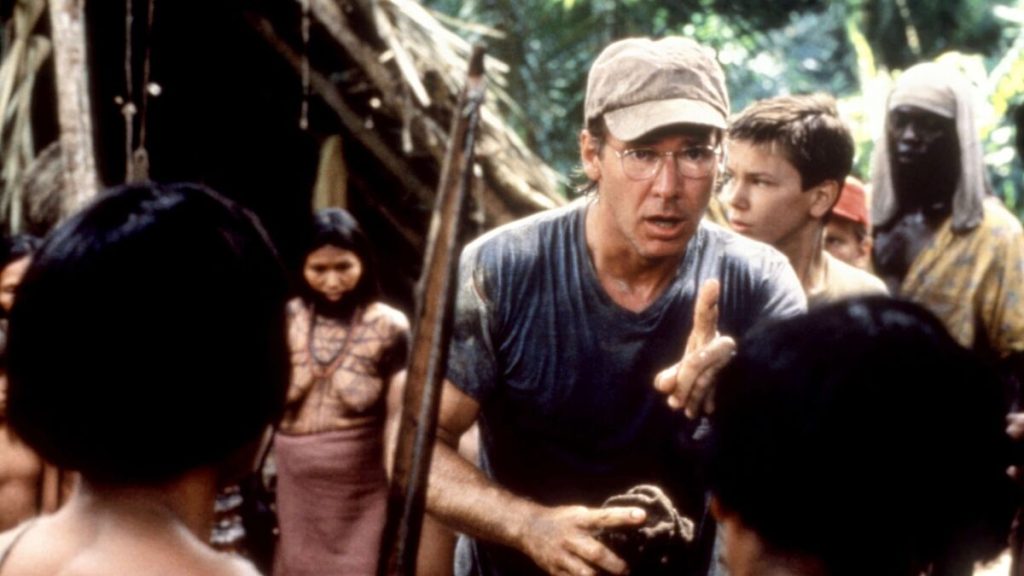
“The material and essential ideas of this film are so contradictory to mainstream American filmmaking, are so deeply unconventional, that I felt the form and shape of it should be very conventional,” the director explained in a contemporary interview, “in order not to repel the viewer.” It’s only natural, then, that an obligatory fix-it-up montage should begin as soon as the Fox clan arrives in their barely hospitable and completely undeveloped rainforest home. But no steel-drummy pop song presents itself, and nobody marches in tune lugging fresh-hacked lumber. Weir and the film suddenly, subtly refuse to aid or abet Allie Fox any further; in the jungle, he’s on his own.
“No one who has the slightest spark has to endure a moment’s oppression in this world,” he tells his boys when not busy commanding dozens of indigenous laborers in the construction of his treehouse utopia. To a pragmatist like him, religion is for quitters — on the Bible: “It doesn’t work” — but he’s perfectly at ease with his workforce calling him “Father.” And for such an educated man, Fox sees no irony in naming his breakthrough after both American bombs that leveled Japan: “Fat Boy.”
Considering Ford’s baggage, this may be the only instance of a movie star stealing his own film, taking it hostage like another helpless member of his fictional family. As the passion boils over into mania and Fox reinvents colonialism from base principles in a hang-loose Hawaiian shirt, it’s almost impossible to fully believe he’s that far gone. A lesson must be learned any minute now. A third-act sacrifice must be made. But then the point of no return arrives, when he turns his machine into an instrument of explicit evil to ward off the threat of other pale invaders. The apocalyptic honesty destroys them both, man and monster, and as he screams in the glow of its unnatural funerary pyre, Harrison Ford’s face doesn’t look like a face at all.
Unlike Witness, his second collaboration with Weir did not land him or anyone else involved an Oscar nomination. In a 1992 career retrospective for Entertainment Weekly, even his defense began by deeming it “the only film I have done that hasn’t made its money back.” More recent comments on his performance are still proud but characteristically terse: “I think it was just a matter of putting on the clothes—you know, going for it.” Though he’s never since been content to let his star power go unchecked for too long, Ford has yet to risk such abject hideousness again, leaving this film as a landmine-quiet reminder of his power as an actor at the peak of his action figure sales. And that kind of gamble, to quote Fox himself, takes “four-o’-clock-in-the-morning courage.”
“The Mosquito Coast” is available for digital rental or purchase.