Chloe Walker
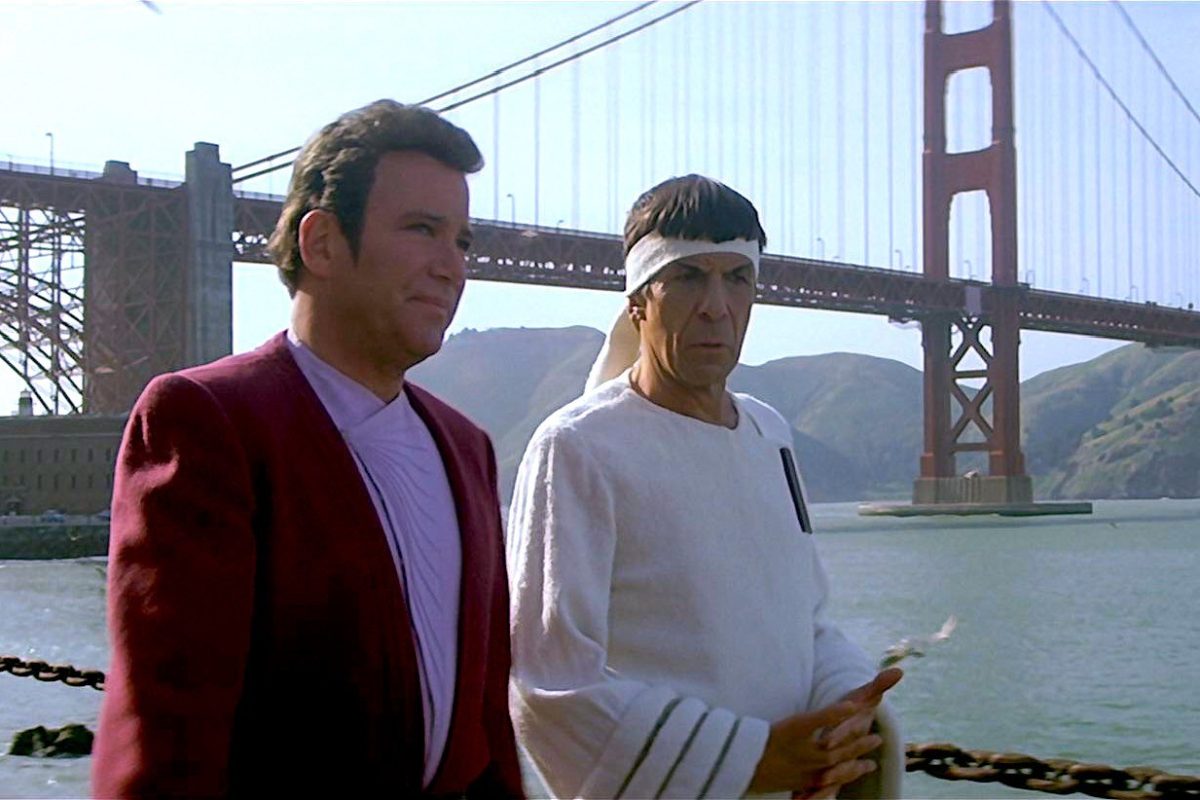
There was the beautiful but boring one. The one where Spock dies, and the one where he is revived. Then there was the one with the whales.
The fourth Star Trek movie came at an important time for Gene Roddenberry’s groundbreaking franchise. Seven years after the first film, and twenty after the TV series introduced these characters, Star Trek was inarguably an institution. And yet, after third entry The Search for Spock had completed a narrative that began with its beloved predecessor The Wrath of Khan, a reset was needed. What to do next? Bring our motley space crew down to Earth.
In The Voyage Home, Kirk (William Shatner) and the gang are on their way to a space tribunal, having to use a Klingon Bird-of-Prey ship following the destruction of the Enterprise in the previous movie. Before they get there, they are intercepted by a mysterious probe, causing destruction and emitting signals that sound strangely like the song of the extinct humpback whale. Let’s let the ever-exasperated Dr McCoy (DeForest Kelley) explain Kirk’s plan for saving the day: “You’re proposing that we go backwards in time, find humpback whales, then bring them forward in time, drop them off, and hope to hell they tell this probe what to do with itself?” So to San Francisco, circa 1986, they all go, soon finding an ally in whale expert Gillian (Catherine Hicks).
It’s all absurd of course, but by that point Star Trek had honed its ability to lend emotional heft and gravity to the most nonsensical of situations down to a fine art. The genius of The Voyage Home is how the action moves along with such a gleeful skip in the step, it refuses to let the audience dwell on the unhinged logistics of beaming humpback whales into a space ship. Why would you entertain such a dull thing as common sense when you could enjoy Spock (Leonard Nimoy) attempting profanity for the first time, or Scotty (James Doohan) trying to interact with a computer three centuries older than the ones he’s used to?
Leonard Nimoy – directing, starring, and with a “story by” credit – felt the need to move the series in a lighter direction after the tragedy of the Khan arc, but he’d also been reading E.O Wilson’s book Biophilia, and was horrified by its prophesies of widespread animal extinctions. After a discussion with a friend about the plight of the humpback whale, he put two and two together and found the movie’s dramatic and emotional crux. In his autobiography I Am Spock, Nimoy talks about reverse-engineering the narrative from that impulse: “What was the problem in the twenty-third century, and how would whales solve it?” Despite all the silliness, any time attention turns to the welfare of the whales, the tone turns charmingly sincere; “When man was killing these creatures, he was destroying his own future,” says Kirk, and it’s a credit to Shatner’s and the franchises’ distinct brand of campy gravitas that his earnestness rings entirely true.
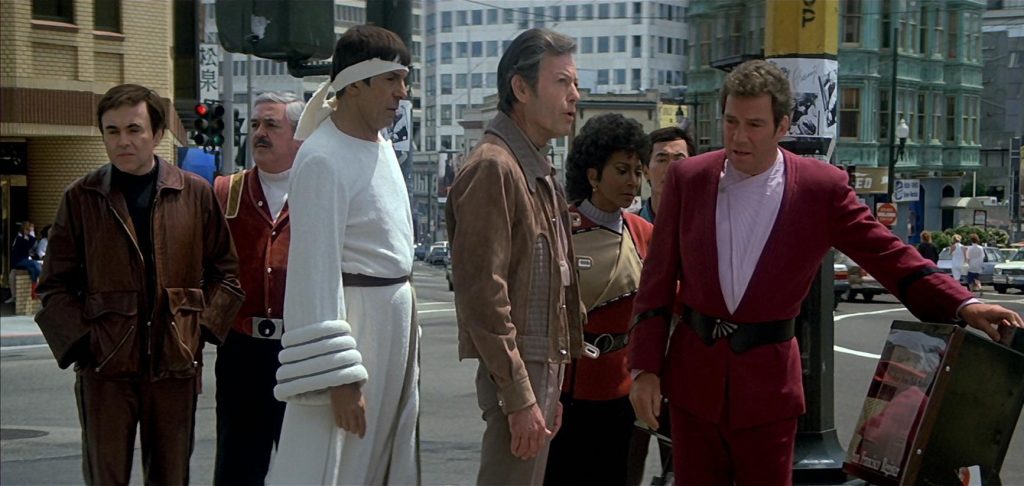
Though this was his second consecutive time in the director’s chair, Nimoy was offscreen for almost all of The Search For Spock. In The Voyage Home, however, Spock has many of the most memorable moments, chief among them giving the Vulcan nerve pinch to the obnoxious punk playing the boombox on the bus. Despite the oft-stated difficulties of directing yourself, Nimoy is a deft hand at the helm, as comfortable with the smaller character moments as the large set pieces. With the chops he exhibited here, it’s both a shame and surprising that after his next film, 1987’s Three Men and a Baby, his directorial career would soon fizzle out.
Along with Nimoy, one of the biggest creative forces on The Voyage Home was writer-producer Harve Bennett. Even before Nimoy had started narrowing in on whales, it was Bennett’s realization about the enduring popularity of 1967 Star Trek episode The City on the Edge of Forever, in which Kirk, Spock and McCoy find themselves in Depression-era New York with Joan Collins, that led to Earth being cemented as the setting for the fourth movie.
And that Catherine Hick’s 20th century earthling slots in so easily with the 23rd century crew is among The Voyage Home’s finest achievements. One of the loveliest sequences is when Gillian discovers the ship; though it is cloaked, the construction occurring on the whale tank, which seems to be taking place in mid-air, gives the game away. Realizing they’re rumbled, she’s beamed aboard, and her marvelling at what she finds is reminiscent of whenever a new Doctor Who assistant encounters the TARDIS for the first time. Because the original Star Trek crew so rarely visited Earth, they rarely got the chance to employ an audience surrogate like her, and the vicarious thrill of seeing someone get to join the long-established gang and hold her own is fundamental to the film’s abundance of joy.
The Voyage Home’s nimble melding of the ridiculous with the sincere was rewarded with a wealth of critical and commercial success, and the highest box office of any of the first six movies (although The Wrath of Khan did better proportionally considering its much smaller budget). The forty years that have passed since then have not dimmed its manifold pleasures one bit – to this day it remains one of the sprawling, medium-spanning, decades-long franchise’s very finest hours.
“Star Trek IV: The Voyage Home” is streaming on Kanopy and Paramount+.