Marshall Shaffer
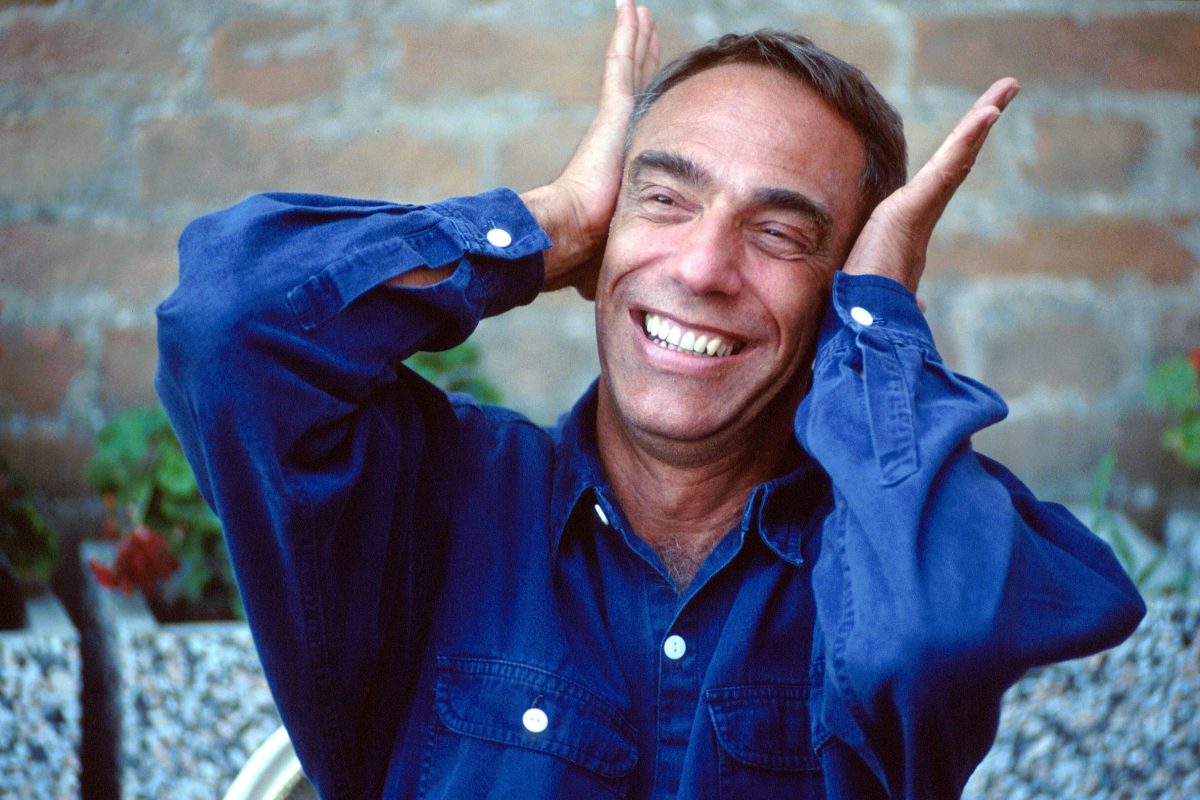
Fall 2026 has proven to be a great season for the late Derek Jarman, a British director at the vanguard of the late 20th century’s new queer cinema. His early work as a production designer on the anachronistic sets of Ken Russell’s The Devils gained a new generation of appreciators thanks to a glorious new 35mm restoration that did gangbusters at the box office for a revival run. Elsinore, a biopic where Andrew Scott portrays British actor Ian Charleson as he fights through AIDS to portray Hamlet on stage, also introduces Jarman as a person in his own right – and provides a key to unlocking his final film.
Jarman, as embodied by David Dawson, functions as a foil throughout Elsinore. Since the director gave Charleson his first screen role in 1978’s Jubilee, the out and proudly gay filmmaker proves a thorn in the thespian’s side. As the HIV epidemic rages around them and homophobia renders the public health response insufficient, Jarman laments that Charleson chooses to hide his diagnosis and “passing” to grow his career prospects with unsuspecting straight audiences rather than supporting the queer community. Charleson, for his part, points out that his working-class background does not give him the same structural advantages available to the posh and well-educated Jarman.
Yet Elsinore does not make out Jarman to be a villain in Charleson’s story. As time begins to run short for both men, Stephen Beresford’s screenplay begins to illustrate how the two men are fellow travelers on a journey of hanging on for dear life through the worst ravages of AIDS. Charleson, the film shows, persisted through painful treatments to perform 24 final, legacy-cementing shows of the physically taxing Shakespearean tragedy before his passing.
Jarman did something similar through his art, though viewers will have to watch another film to understand just how. “I’m going blind,” he tells Charleson in a scene by the beach late in the film. Those familiar with Jarman’s life and cinema might find themselves getting a giddy rush the same way Marvel fans guffaw at an Easter egg drawing on deep lore. Charleson sadly passes years before getting to experience how Jarman will ultimately turn this into one of the most profound meditations on the devastation of the disease.
Charleson confronts the nearness of death by clinging to the very thing that gives him life. Jarman’s equivalent, his 1993 experimental film Blue, achieves a similarly transcendent effect by staring his demise in the face. Released just a year before his death, the film places viewers squarely in the experience of the director’s deteriorating eyesight. Jarman was only able to see shades of blue when he made it, and the entire visual schema of Blue is, in fact, 79 minutes of nothing but a monochrome blue on screen. It’s a graceful yet furious surrender to the abstract nothingness that awaited Jarman as he shuffled slowly off this mortal coil.

To stare into Blue – to really look – is to let the color transform itself until it takes on a property of motion and mystery before one’s eyes. The simplicity becomes complexity; the literal, imaginative. Jarman finds a strange equalizing property in this work that makes it both avant-garde and accessible. It’s as if, in his fragile state, he’s pierced the thin veil separating the living from the dead.
As the accompanying audio soundtrack to Blue demonstrates, Jarman seems suspended on a new purgatorial plane between states of existence. Unlike Charleson, whose refusal to bow to the physical demands that AIDS took on his body plays often like delusional denial, Jarman accepts the inevitability of his fate. But no one could ever accuse him of acquiescing quietly, especially given how directly certain voiceover speaks to the grim realities of his weakening state: “The worst of the illness is the uncertainty.” “There’s death in the air here, but no one is talking about it.” The ears still bear witness when the eyes cannot.
Blue links the personal and the political in its wandering narration, with the grasping for a bygone childhood flowing seamlessly into whispered requiems for friends and lovers already claimed by the virus. Fantasy, memory, and hallucinatory reverie become as unified as the monochromatic screen through Jarman’s skillful artistry. He conjures something hauntingly beautiful, serene even, from staring into the abyss. Death becomes not merely the absence of life but the presence of something he can reach for but only grasp like a vapor.
In a way, Blue completes Elsinore by finishing the contrast begun in Simon Stone’s film. This testament to how Jarman discovered the undiscovered country, to steal a phrase from Hamlet, mirrors Charleson’s own nervy farewell. Jarman’s embrace of abstraction alongside the directness might prove a balm for those who find Charleson’s sublimation of his struggle into the Danish prince a touch too triumphalist.
Besides, it’s Jarman who got the last laugh between them. Charleson needed Andrew Scott’s performance in Elsinore to convert his ephemerally moving turn into something eternal. Jarman already is. He feels entombed inside Blue – and reachable, too, through a cinematic séance for anyone who wishes to commune in a shared blue void where vision flattens but time expands.
“Blue” is streaming on Kanopy and Hoopla.