Steve Erickson
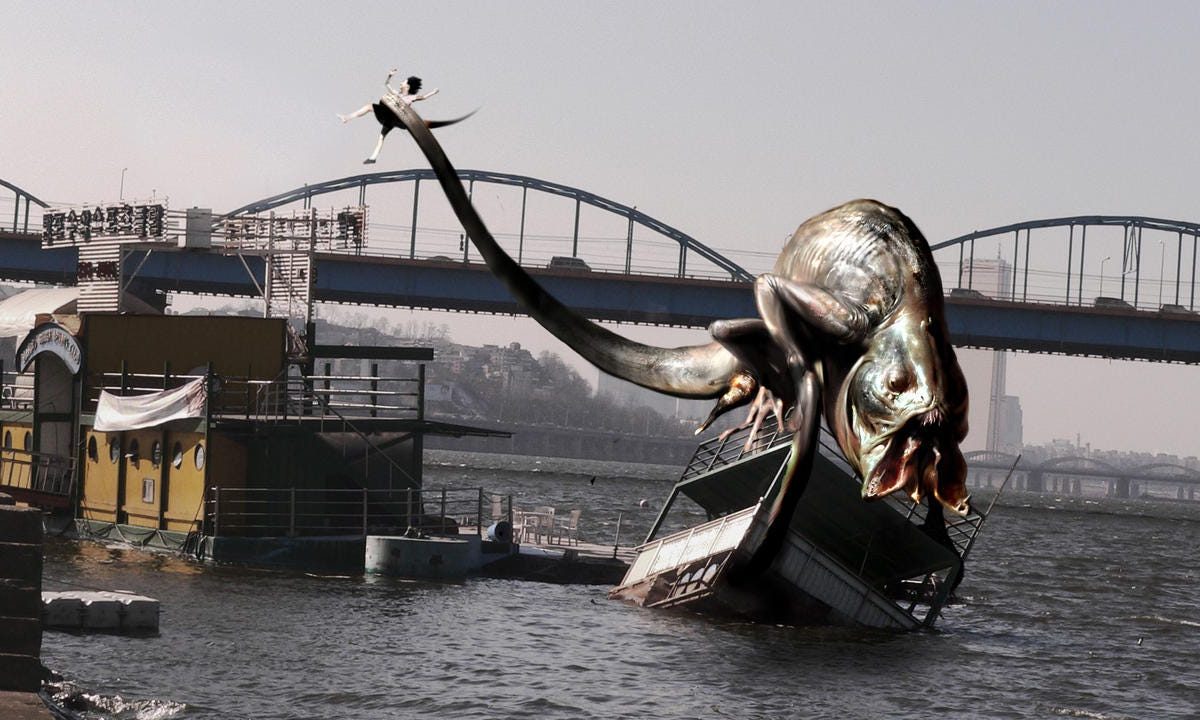
Visions of monsters are always creations of the human imagination. Bong Joon Ho’s third feature, The Host makes that literal with a cryptid mutated by pollution. Its kaiju, created with a blend of CGI and practical effects, is a splendid creation: a huge, ugly aquatic beast resembling a Lovecraftian squid. Although The Host, re-released on the occasion of its 20th anniversary, drew from earlier American and Japanese science fiction, it’s distinguished by its firm basis in real history. While not the first film to use such beings to speak about environmental destruction, it’s uncommonly direct. The U.S. still maintains a heavy presence, military and otherwise, in South Korea. Its opening scene reenacts an event that actually happened in 2000, in which Alan McFarland, an American mortuary worker, poisoned the Han River with hundreds of cans of formaldehyde, heedless of the fact that it supplies Seoul’s drinking water.
After that moment, The Host introduces us to a family who operate a food stand. Gang-du (Song Kang-ho) is a slacker who has trouble staying awake at work. While relaxing with his family at a park by the Han River, he sees the creature emerge and go on a killing spree, carrying off his daughter Hyun-seo (Go Ah-sung). In the wake of its violence, the survivors are confined to a hospital by the South Korean government, who claim the monster has spread a contagious virus. Gang-du finally gets motivated to action when he receives a phone call from Hyun-seo, realizing that she’s still alive.
The Host has one major Korean precursor, made in the North: Shin Sang-ok’s Pulgasari. That film adapts a folk tale about a metal-eating monster into an anti-capitalist parable. The Host takes on the style of U.S. blockbusters in order to turn it back on the country. It’s bookended by scenes that call out the American government’s arrogance towards South Korea. Disbelief in the authorities is a throughline. Their statements that the creature’s survivors are infected with a virus proves to be a lie designed to hide U.S. complicity for its existence. In fact, it’s an excuse to try to lobotomize Gang-du.
Bong’s first two international productions, Snowpiercer and Okja, take on some of The Host’s themes within a similarly fanciful framework, reflecting bigger budgets while continuing his exploration of class warfare. Still, there’s a bit of tension between the demands of such productions, including casting stars like Chris Evans and Tilda Swinton and a heavy use of English-language dialogue, and their politics. Returning to South Korea, Parasite proved less compromised – and it became his biggest hit around the world. As much as Bong makes serious but highly accessible work aimed at a large audience, his best films are those set in his own country.

The Host’s legacy can be located in two recent films at opposite ends of the budgetary spectrum, both of which pull aspects from it. Park Syeyong’s The Fin picks up on its aquatic imagery and portents of ecological catastrophe. Set after an apocalyptic disaster that’s filled Korea with toxic waste and destroyed the country’s reserves of fresh water, it depicts a society organized around hatred against Omegas, humans who’ve mutated to grow fins and extended feet. As in The Host, the seaside setting is crucial. The bodies of people themselves have become so warped by pollution that they’re becoming aquatic, and in turn, are treated as threatening.
Similarly, the Godzilla Minus movies transform the monster movie’s subtext into its surface. While the notion that Godzilla was a response to the trauma of the U.S. dropping nuclear bombs on Hiroshima and Nagasaki dates back to the ‘60s, Godzilla Minus Zero includes a flashback envisioning a charred corpse after that bombing. The Host’s anger at American foreign policy is lifted beyond metaphor: one of Godzilla Minus Zero’s characters dreams of using Godzilla in an act of revenge against the U.S., destroying Manhattan. The film could be re-written into a somber drama about Japan after World War II without the presence of Godzilla and Ghidorah. Even so, its polish and extreme reliance on CGI serve to distance it from these historical realities, unlike The Host.
Some of the virtues of The Host are easier to perceive with the passage of time. Bong was still a relative underdog when he made it. His identification with working-class people does not feel forced or distant. It’s set in a recognizable, grubby world. The Host finds heroism in flawed characters, rather than icons with perfect bodies. It’s a master class in using sci-fi horror to engage in political critique without overwhelming its excitement.
“The Host” returns to theaters Friday.