Sara Batkie
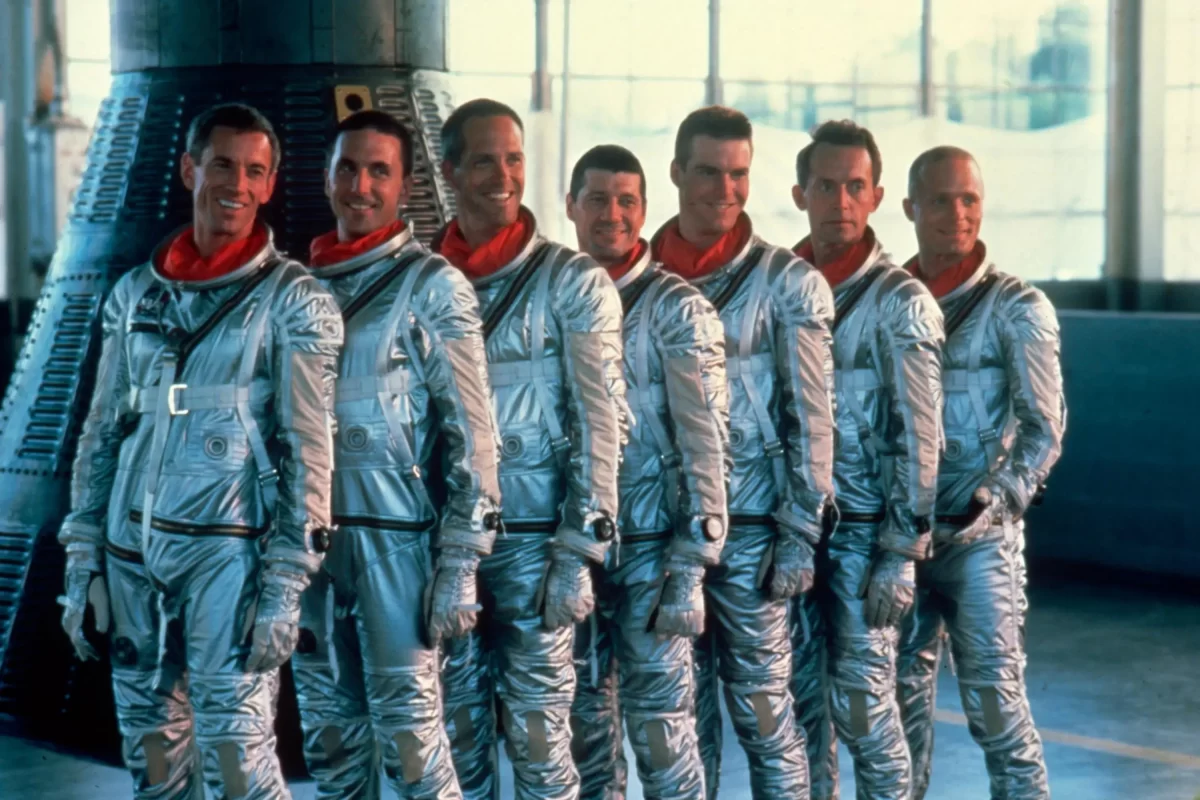
On November 15th, SpaceX celebrated the return of its Starship rocket after twenty-two hours in orbit. Officials for the company boasted that this accomplishment marked a crucial step in getting to the moon and, eventually, Mars, which CEO Elon Musk hopes to colonize. What was perhaps more remarkable, though, was with how little fanfare the greater public greeted the news. Gone are the days of televised liftoffs and ticker tape parades. It’s a sign of how much is lost when such programs shift from the government to private equity, and how much American dominance in the field has shrunk in the decades since the initial space race. The men who made up the Mercury Seven might not have foreseen this turn, but director Philip Kaufman was already anticipating it in his 1983 film The Right Stuff, which tells a decidedly down-to-earth version of their story.
Based on a book by famed New Journalism figure Tom Wolfe, The Right Stuff has the sort of sprawling runtime and subject matter that could easily skew jingoistic. But Kaufman has other aims, which he establishes with an extended prologue that at first seems to have little connection to Project Mercury. The first pilot we meet isn’t one of the astronauts but Chuck Yeager (a perfectly cast Sam Shepard), who will eventually be deemed “too independent” for the space program. In Kaufman’s telling he’s a literal cowboy, who becomes the first to break the sound barrier practically on a lark. He’s up there for the thrill of it, not the money or fame, and it’s an attitude that will cost him, at least in the short run.
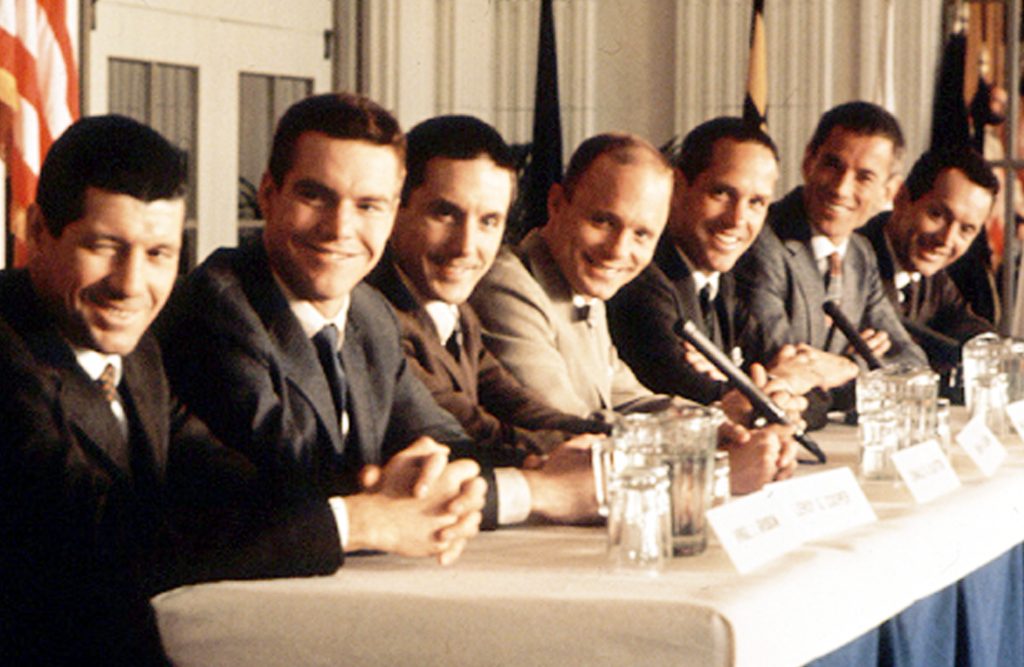
Once this flinty ideal of American masculinity has been set up, Kaufman immediately undercuts it by shifting focus to Edwards Air Force Base and introducing cocksure rookie Gordo Cooper (Dennis Quaid, absurdly charismatic). Along with Gus Grissom (Fred Ward) and Deke Slayton (Scott Paulin), he captures the attention of a couple government stooges (played with exquisite obliviousness by Jeff Goldblum and Harry Shearer). Eventually they’ll be selected with Alan Shepard (Scott Glenn), John Glenn (Ed Harris), Scott Carpenter (Charles Frank), and Wally Schirra (Lance Henriksen) for the Mercury program.
Kaufman takes his time setting up the personality differences between the major characters. Where Cooper and Grissom are all unearned swagger, Shepard is more of a prankster and Glenn more disciplined. The latter, who has already been putting in T.V. appearances for his supersonic transcontinental flight, becomes a natural spokesman for the group, which ruffles the feathers of some of the others. Kaufman doesn’t shy away from showing us their petty squabbling and extramarital pursuits. They’re vain and often selfish. That doesn’t mean they’re not heroes; it just means that they’re men. And men, in the words of one of the astronaut wives, can be assholes.
It’s just one of the ways in which Kaufman simultaneously honors and punctures the ideal of American exceptionalism. Some of this friction comes from the source material – Wolfe was a consummate satirist, but his interest in the men who joined up with NASA was genuine. He’s said that the book was inspired by a desire to understand what made the perils of space flight acceptable to a certain type of person – those with the titular “right stuff.” His research was extensive, including interviews with not only the astronauts but their wives, other test pilots, and military personnel, among others.
Such curiosity is reflected in Kaufman’s script. He spends a notable amount of time in rooms with the women, for example. Where a more blandly inspirational film might sand down their rough edges, here the wives are allowed to be prickly, skittish, frustrated when their dreams of meeting Jackie Kennedy are thwarted. And they’re not uniformly thrilled with their husbands’s new work requirements, particularly interacting with reporters (Kaufman cast an actual improv troupe as the press corps and buzzing locusts fill the soundtrack whenever they appear).
Like a work of reportage, Kaufman’s film proceeds not so much linearly as accumulatively. A less confident director likely would pass through the testing the Mercury recruits go through with a brisk montage. But Kaufman lingers on scenes of the men demonstrating their lung capacity and flirting with icy nurses. The level of detail might seem indulgent, but it serves Kaufman’s anti-imperialist aims to demystify a process that was largely shielded from the general public at the time. He also constantly subverts audience expectations – take, for instance, how he cuts immediately from Shepard rushing to relieve his bowels after an enema to the spectacle of the team’s first PR appearance.
Such instincts carry over into the depiction of the space race itself, which in the film’s telling was rushed to a dangerous degree. The capsules that the astronauts eventually use are cramped, and the camera heightens this claustrophobia, keeping tight on the men’s faces. Most of our views of outer space are limited to what the men themselves see through their tiny windows. There’s little grandeur; instead we get discomfort and setbacks. Shepard’s groundbreaking liftoff is marred by being forced to urinate in his flightsuit. Grissom blows his hatch door too soon, leading to a devastating loss of data. Glenn’s terrifying re-entry isn’t even dramatized. By the time Cooper makes his record twenty-two orbits of earth, a voiceover states that the Mercury program is already at its end.
It’s perhaps unsurprising, then, that many of the actual astronauts involved were critical of The Right Stuff upon its release. They were particularly angered by the depiction of Grissom as “cowardly,” especially given his tragic passing in 1967. Its withering portrait of Lyndon B. Johnson was also poorly received. Nor was the film a commercial success. At the time, America was only a couple decades removed from the onscreen events. Sixty years on, it’s clearer that Kaufman’s affectionate ribbing of the NASA program isn’t an indictment of the men themselves. To bookend the achievements of Glenn, Shepard, and the rest with Yeager’s stoic workmanship isn’t to elevate one over the other. It’s a demonstration of how capacious America’s history is, and how it’s still something we’re piecing together. Sometimes our greatest successes happen in spite of ourselves. It’s a lesson our current billionaire class should heed in the years ahead.
“The Right Stuff” is out on 4K UHD from Criterion tomorrow. It’s also available for digital rental or purchase.