Sara Batkie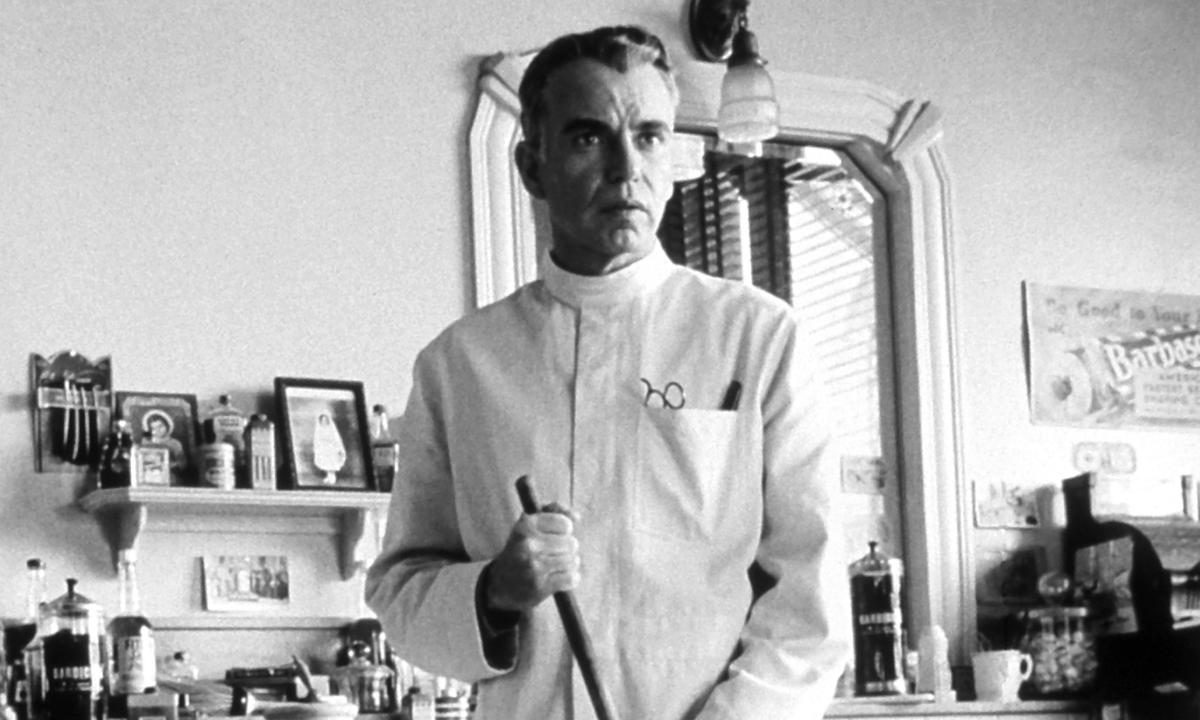
Some actors have faces made for certain genres. Edward G. Robinson’s bulldog grimace feels most at home in gangster pictures. Bruce Campbell’s elastic charm is ideal for the lively tonal shifts of horror comedy. Julia Roberts’s approachable beauty and capacious grin enchant in romantic films of all types. Though he’s mostly been slumming it these days on politically-suspect Western television shows, there was a time when Billy Bob Thornton’s uniquely craggy mien proved an ideal fit for neo noir, delivering a performance in 2001’s The Man Who Wasn’t There that’s a career best for both him and the Coen brothers.
This wasn’t the Coens’s first time at bat with the hard-boiled medium – their debut Blood Simple and 1990’s Miller’s Crossing were both fresh takes on criminal underworld tropes. And The Big Lebowski from three years earlier gave a distinctly absurdist spin to the work of author James M. Cain. But The Man Who Wasn’t There distinguishes itself from their oeuvre in other ways. It’s their only film together in black and white, though it was shot on color stock and converted in post-production since black and white rolls were scarce. The stylistic flourishes that often characterize the Coens’s work only appear sporadically. Instead cinematographer Roger Deakins shoots with a simplicity and diligence that match the story’s languid pacing.
Though Thornton appeared in A Simple Plan from Coens buddy Sam Raimi, he hadn’t worked with the brothers before. He apparently accepted the part without reading the script, later saying, “There are certain people you know you can’t go wrong with.” At that point in his career, Thornton was widely respected for his film work and widely notorious for his messy personal life – he married Angelina Jolie, his fifth wife, the year production began. He might not be the first performer to come to mind for a character whose defining trait is his invisibility, but that’s partly what makes Thorton’s disappearance into the role so impressive.
He plays Ed Crane, a barber in suburban California circa 1949. He’s a taciturn man, adorned with little more than a cigarette and a squint; as his noir-flecked voiceover says for him, “I don’t talk much. I just cut the hair.” Ed is married to Doris (Frances McDormand) and works for his brother-in-law Frank (Michael Badalucco). He suspects his wife might be having an affair with her boss, department store owner Big Dave Brewster (James Gandolfini). He’s marked by his ordinariness, not the sort who would seem likely to get involved in a criminal enterprise. The script makes a running joke out of how poorly people remember him. But that’s precisely why he proves a fitting mark for conman Creighton Tolliver (Jon Polito) who claims he needs $10,000 to start his new business venture. It’s called “dry cleaning.”
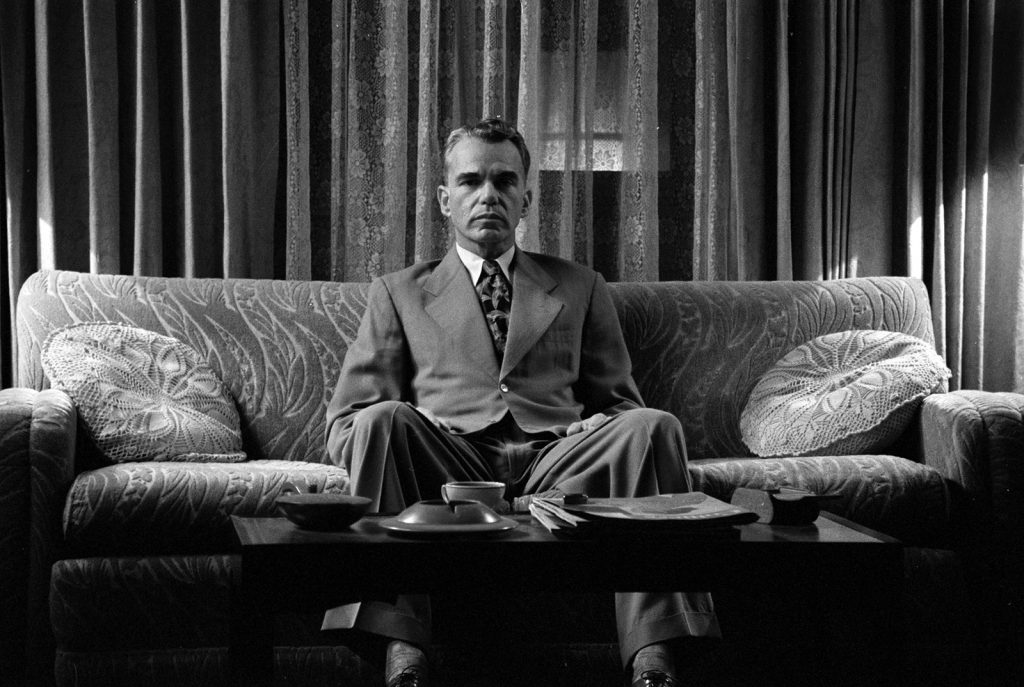
It would be possible to summarize the rest of the plot, but as with most Coens ventures, that would be beside the point. Suffice to say that blackmail, murder, mistaken identity, and even U.F.O.s figure into it. Through it all, Ed maintains an almost supernatural level of outward composure, his stoic expression rarely betraying more than a lifted eyebrow or creased forehead. Deakins’s chiaroscuro lighting plays off of Thorton’s naturally rugged countenance in ways that only heighten his opacity. At multiple points Ed is asked “what kind of a man are you?” He has no answer. His quietness is his greatest weapon – everyone he interacts with from cop to lawyer to teenage seductress rushes to fill the space he leaves them – but it will also lead to his downfall.
As with many of the Coens’s films, The Man Who Wasn’t There was more instantly a hit with critics than audiences. It premiered at Cannes and the brothers shared the directing prize with David Lynch, who won for Mulholland Drive. But it only grossed $18.9 million worldwide, the lowest haul for the Coens since The Hudsucker Proxy in 1994. It also came in for some of the typical complaints levied at the brothers – too academic, too aestheticized, too hollow. Michael Sragow of The Baltimore Sun declared it had “all the impact of a cap pistol.”
But much like its lead character, the film is harboring depths beneath its passive surface, and time has been kind to it. There’s a generosity to just how sprawling this seemingly small story eventually gets, and there’s a cast to match. In addition to those already mentioned, there’s excellent work from Katherine Borowitz, Richard Jenkins, Scarlett Johansson, and Tony Shaloub. And the elegiac resolution allows for the sort of graceful tenderness that’s rarely given to noir antiheroes. Thornton is in nearly every scene in The Man Who Wasn’t There so it’s only natural that we leave off with him, but that doesn’t mean his fate is settled. Midway through, a character brings up Heisenberg’s uncertainty principle, which continues to echo long after the final fadeout on Ed’s face: the more we look, the less we know. There’s grace in that, too.
“The Man Who Wasn’t There” is out on Blu-ray and 4K UHD tomorrow from the Criterion Collection.