Jason Bailey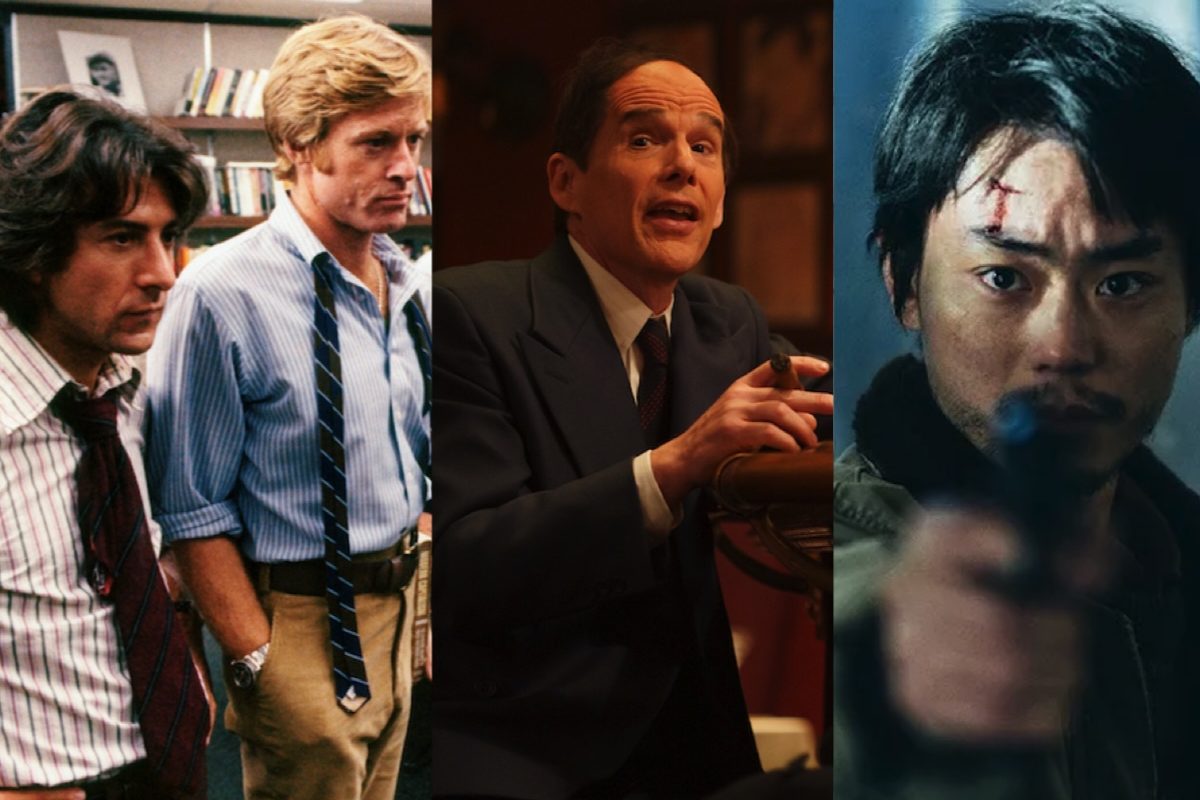
Every Tuesday, discriminating viewers are confronted with a flurry of choices: new releases on disc and on demand, vintage and original movies on any number of streaming platforms, catalogue titles making a splash on Blu-ray or 4K. This twice-monthly column sifts through all of those choices to pluck out the movies most worth your time, no matter how you’re watching.
PICK OF THE WEEK:
All the President’s Men: Alan J. Pakula’s chronicle of the Washington Post’s Watergate investigation hits 4K UHD just in time for its 50th anniversary, serving as a stark reminder of a time when a) the Post wasn’t a joke, and b) a criminal president could be held responsible for his crimes. The movie itself remains a miracle, a big swing that easily couldn’t whiffed — after all, it was Robert Redford and Dustin Hoffman as Woodward and Bernstein, with a script by Butch Cassidy’s William Goldman, so everyone was expecting a slicked-up, Hollywood-ized star vehicle, an easily digested (and just as easily forgotten) piece of studio fluff. But director Alan. J. Pakula takes a stripped-down, low-key approach (no signposting, no overdone exposition) and insists on documentary realism, coaxing lived-in performances out of his locked-in leads and a killer supporting cast (including Martin Balsam, Jack Warden, Hal Holbrook, Jane Alexander, Ned Beatty, and an Oscar-winning Jason Robards). The result was one of the single best films of one of cinema’s finest eras. (Includes featurettes and archival interviews.)
ON NETFLIX:
Blue Moon: An Oscar-nominated Ethan Hawke as Lorenz Hart, the lyricist half of the songwriting team of Rodgers and Hart, whom we first meet on his way to his death at 48. Robert Kaplow’s script then backs up seven months, to the opening night of Oklahoma!, Rodgers first of many collaborations with, essentially, Hart’s replacement, Oscar Hammerstein II. Hart can’t bear to watch all of Oklahoma! (I get it, brother), so he slips over to Sardi’s to get an early start on the opening night party. That evening, in Kaplow’s dramatization, becomes a moment of reckoning for the songwriter, in which the pieces of his romantic life and career bend until they break. His script is snappy and witty, equally adept at sparkling conversation (he spends much of the evening holding court on his favorite topics: music, art, and himself) and painful subtext. The latter is omnipresent in his strained conversations with Rodgers, who is played by Andrew Scott in a marvel of a performance; he communicates their whole history, all of his frustrations and resentments, in his body language and timing. (Margaret Qualley also provides a jolt of juice as the object of his “irrational adoration.”) Blue Moon feels overlong at 100 minutes, and the visual tricks to shorten Hawke’s 5’10” frame to Hart’s 5’ flat are a seemingly unnecessary distraction. But it stays with you.
ON HULU:
Splitsville: Michael Angelo Covino and Kyle Marvin broke through with 2019’s The Climb, proving themselves hysterically funny and also compact filmmakers: Covino directs, while they co-write, co-produce, and co-star. For their follow-up, they’ve added a couple of marquee names — Dakota Johnson and Hit Man sensation Adria Arjona — but kept the wry sensibility and wary self-awareness that made their earlier effort so special. They’re writing is deft, keenly observed and off-handedly funny (the references to Vanilla Sky and Lorenzo’s Oil are utterly inexplicable, which is part of why they’re hilarious), and it’s that rarest of cinematic beasts, a character-driven comedy that’s also visually dynamic. Splitsville is whip-smart, sexy as hell, and features what may be the single funniest fight scene in movie history.
ON BLU-RAY / DVD / VOD:
Blackberry: Matt Johnson’s “fictionalization” of the rise and fall of the handheld computing device (new on Blu from IFC) is constructed like a cross between The Social Network and Silicon Valley – an irreverent approach, with a wild comic sensibility and fairly broad comic characterizations, mostly keying off the awkwardness of engineers and similar tech types. (As ever, one must find ways to make dudes coding into compelling cinema.) Jay Baruschel and Johnson himself star as, respectively, Mike Lazardis and Doug Fregin the co-founders of “Research in Motion, Ltd.’: It’s Always Sunny’s Glenn Howerton is their hard-nosed, ball-busting business brain, Jim Balsillie, tossed like a grenade into a scrum of slackers and weirdos when he joins the company as co-CEO. Baruchel does quietly marvelous work as his tricky and jagged character, and Howerton is especially good in a polar opposite role as braying, power-grabbing jackass. And as the goofball (but conscience-heavy) Fregin, Johnson is a comic dynamo, roaring through his scenes like a bulldozer. He’s similarly impressive as a filmmaker – skilled at manipulating audience emotion, seeing the laughs when they’re coming and seizing them. (Includes audio commentaries, featurettes, interviews, blooper reel, trailer, and essay by BenDavid Grabinski.)
Cloud: The latest from writer/director Kiyoshi Kurosawa is a compelling piece of “how it works” cinema, with Masaki Suda as Yoshii, who works as a reseller, hawking bootleg goods and rarities at Ebay-type websites. That sounds like a thin foundation for a paranoid thriller, but Kurosawa spins his yarn with skill, and can draw tension out of damn near anything (witness how he gets a suspense moment out of Yoshii clicking in a price update). Part of his success lies in the nuances of the character, a harmless enough dude who’s just looking to get rich quick; it’s also a clever script, consistently peeling away our assumptions and expectations. (Also streaming on the Criterion Channel.) (Includes interview, trailer, and essay by Sean Gilman.)
ON 4K UHD:
Ladies and Gentlemen, The Fabulous Stains: Director Lou Adler and screenwriter Nancy Dowd made one of the great movies about punk rock — so, in true punk fashion, it was barely seen or appreciated in its time, only to find an appreciative cult audience in the passing years. Then-newcomer Diane Lane is pure punk bravado as the lead singer of the title band (alongside Marin Kanter and a baby-faced Laura Dern), whose provocative persona and striking style makes them an underground sensation. Adler came from the world of music, giving the picture a knowing, lived-in sense of scene, while Dowd’s script (written as Rob Morton, a pseudonym she took on when Adler changed her ending) burns with second-wave fury. It’s still a scorcher, and Fun City Editions’ new 4K looks and sounds spectacular. (Includes new and archival audio commentaries, deleted scenes, archival featurette and interview, alternate opening title sequence, and music video dailies.)
Network: When Paddy Chayefsky wrote this insider’s account of network news in particular and network television in general, it played like a piercing satire; now, in our age of non-stop reality slop and a Bari Weiss-ified CBS News, it feels like he was soft-balling us. Peter Finch won an Oscar for his show-stopping turn as the suicidal evening news anchor whose rallying cry of “I’m as mad as hell and I’m not going to take this anymore!” turns him into an unexpected cultural sensation; Faye Dunaway also won a golden boy for her work as the ruthless, rising executive who sees a way to exploit him across the network. Chayefsky’s script is fast, furious, and funny, and director Sidney Lumet finds just the right balance between far-out derision and lived-in exposé. A new addition to the Criterion Collection, and a worthy one. (Includes audio commentary, making-of documentary, full-length Chayefsky documentary, and essay by Jamelle Bouie.)
The Man Who Wasn’t There: You’ve gotta love the power that a sleeper hit and a ubiquitous soundtrack will get you. When the Coen Brothers had their biggest financial success to date with O Brother, Where Art Thou, it might have been tempting to make a follow-up that was even more audience-friendly. Instead, they used their momentary capital to make one of their most bizarre and introverted films—in black and white, no less. Nonetheless, there are real pleasures here: a hilariously deadpan Billy Bob Thornton performance; stellar supporting turns from (among others) Frances McDormand, James Gandolfini, and Tony Shalhoub; a gloriously nonsensical plot; and (most of all) the luminous photography by Coens regular Roger Deakins, breathtakingly captured by Criterion’s excellent 4K presentation. (Includes audio commentary, new and archival interviews, deleted scenes, and essay by Laura Lippman.)
Richard Pryor… Here and Now: New to 4K, Richard Pryor’s third and final theatrically-released concert film also marked his directorial debut — a sensible first step to his candid and confessional semi-autobiographical drama Jo Jo Dancer: Your Life is Calling three years later. This one catches Pryor on the tail end of what would be his last stand-up tour, entertaining a rowdy New Orleans crowd with a mixture of observation, crowd work, and often-pointed character bits, including an extended riff as a desperate junkie that blurs the line between comedy and tragedy with grace and pathos. It’s not as fall-down funny as Live in Concert nor as nakedly confessional as Live on the Sunset Strip, but it catches the best to ever do it at his most confident and relaxed, and his interactions with the raucous Bayou crowd are priceless. (No bonus features.)
Boxcar Bertha: Like many of his New Hollywood contemporaries, Martin Scorsese got his first real job working for Roger Corman, directing this quickie Bonnie and Clyde riff (making its 4K debut from Cinématographe) back in 1972. The borrowing from Bonnie doesn’t feel as exploitive as it probably was, since Scorsese certainly studied (and was inspired by) the same run-and-gun thirties and forties B-pictures as Arthur Penn and screenwriters Benton and Newman. He sprinkles in plenty of atmosphere and some inspired touches, and ably showcases Barbara Hershey’s earthy beauty and David Carradine’s sideways charm. The gunplay of the final sequence is also impressive—this is one of his earliest pure action sequences, and it is a good one. Bertha is fairly low in the Scorsese canon, quality-wise, but there are enough flashes of what was to come to keep viewers on their toes. (Includes audio commentary, interviews, video essay, “Trailers from Hell” commentary, intro with Corman and Ben Mankiewicz, storyboard gallery, and booklet with Scorsese interview and essays by Robert Daniels, Bilge Ebiri, Beatrice Loayza and Glenn Kenny.)
Body of Evidence: One of the most blatant of the Basic Instinct ripoffs that flooded the marketplace (and, more specifically, the video store shelves) in the early-to-mid ‘90s, this erotic thriller pairs Willem Dafoe and Madonna under the guidance of director Uli Edel — whose previous efforts (including Christiane F. and Last Exit to Brooklyn) were a lot of things, but they weren’t really “sexy.” That peculiar tension sits at the center of Evidence, in which Madonna is a woman on trial for killing her husband with her lethal sex (hers is the titular “body,” get it?!?). It’s by no means traditionally good; Dafoe looks uncomfortable, co-stars Joe Mantegna and Julianne Moore even more so, and the endless courtroom scenes are chock full of submissions of exhibits and murmuring in the gallery and surprise witnesses and thundering objections and the Stern Black Lady Judge™ responding “I’ll allow it.” But it’s never boring, thanks to the memorable sex scenes, Madonna’s campy leading turn, and Douglas Milsome’s silky photography, which has never looked better than on this Vinegar Syndrome release. (Includes uncut and theatrical versions, interviews, video essay, archival featurette, trailer, and essays by essays by Scout TaFoya, Walter Chaw, and Abbey Bender.)
Excalibur: Director John Boorman was still rebounding from the loud belly-flop of his Exorcist II: The Heretic when he crafted this robust adaptation of the Arthurian legend, and in doing so, reminded audiences and critics of his filmmaking virtuosity. Using visual motifs and design concepts developed for a potential Lord of the Rings film more than a decade earlier, Boorman’s may well be the best film version of the King Arthur story, rendered with grime and grit, guts and gore, cheerfully eschewing the family-friendly approach of other contemporaneous adaptations (it’s rated R, and earns it). Nigel Terry is a bit of a blip as Arthur, but Helen Mirren and Nicol Williamson are fierce as Morgan and Merlin; keep an eye out for Gabriel Byrne, Liam Neeson and Patrick Stewart in early roles. (Includes audio commentaries, interviews, featurettes, TV version, trailers, and essays by Charlie Brigden, K.A. Laity, Kimberly Lindbergs, Josh Nelson, Philip Kemp, John Reppion, Icy Sedgwick and Jez Winship.)
The Visitor: This 1979 oddity, also new to 4K via Arrow, is a dead-solemn yet inescapably goofy sci-fi epic shot in cruddy, TV-movie style. Unapologetically swiping elements of The Omen, The Birds, Carrie, The Exorcist, Close Encounters, and maybe even Ice Castles, featuring acting turns by John Huston and Sam Peckinpah (suggesting a hope the film would end up well directed merely by osmosis), and including Shelly Winters at her scenery-chewing, kid-slapping, “Shortnin’ Bread”-singing finest, it’s the kind of movie that can only be explained by Hollywood’s rampant cocaine use at the time it was made. None of which should discourage you from seeking it out — The Visitor is awesomely entertaining in its total badness. (Includes audio commentary, video essays, archival interviews, and essays by Marc Edward Heuck, Richard Kadrey, Craig Martin and Mike White.)
ON BLU-RAY:
Eclipse Series 8: Lubitsch Musicals: When Criterion relaunched their Eclipse series (box sets of films connected by filmmaker, period, writer, or region) late last year, it wasn’t clear if they would be upgrading their previous DVD-only sets to Blu-ray. Thankfully, they’ve begun that process with arguably the best of the first wave, this beautiful collection of pre-Code talkies from the great Ernst Lubitsch. The Love Parade feels a lot like a 1929 musical — a touch overlong, cinematically lead-footed, etc. — but it’s light and sophisticated (read: dirty) in Lubitsch’s fashion, the chemistry between stars Maurice Chevalier and Jeanette MacDonald is fire, and Lillian Roth is a blast in a key supporting role. The following year’s Monte Carlo is delightfully randy, further exploring his ongoing preoccupations with sex, class, and station, and One Hour With You is also plenty randy, its winking, conspiratorial approach underscored by Chevalier’s frequent and funny fourth-wall breaks. But the best movie in the box is The Smiling Lieutenant, another Chevalier vehicle — but one unapologetically shoplifted by Claudette Colbert, who comes on like a lightning bolt. Playful, witty, and knowing, every movie here is a treat. (Includes an essay by Michael Koresky.)
Goodbye, Columbus: Both Richard Benjamin and Ali McGraw made their feature film debuts in Larry Peerce’s 1969 adaptation of Philip Roth’s novella, and it’s easy to see why they both kept so busy in the ensuing decades — they’re both charming, funny, and empathetic, and skillfully make their somewhat mismatched relationship believable. (Benjamin comes right out of the gate as one of our best cinematic avatars of stammering horniness.) The influence of The Graduate is quite pronounced, for good and ill (it’s a tad montage-heavy), and as with that classic, Peerce admirably sustains the shift into heavier material in the home stretch. It’s a movie that knows how intense young love can be — and how precarious. (Includes audio commentary and new and archival interviews.)
6-Film Collection: Broadway on the Big Screen: The first of Warner Archive’s new multi-disc themed sets is one of their best, collecting a half-dozen film adaptations of musical theater favorites. It runs a delightful gamut, from the more traditional (and delightful) likes of Brigadoon and Guys and Dolls to the somewhat riskier Gypsy, Damn Yankees, and The Pajama Game to the out-there, Ken Russell-helmed The Boy Friend. But it’s a solid mixture, offering throwback pleasures (the way Sinatra wears his hat in Guys and Dolls, Gwen Verdon’s sheer chutzpah in Damn Yankees, Gene Kelly’s delightful confusion in Bridgadoon) and some surprisingly timely themes (the pro-union messaging of The Pajama Game, the “sex work is work” ethos of Gypsy). It’s toe-tapping fun at a prime price. (Includes deleted scenes, featurettes and trailers.)
4-Film Collection: Fred Astaire: Musical comedy fans will also want to snatch this quartet of Astaire’s non-Ginger movies, though he’s well matched with Cyd Charisse (The Band Wagon, Silk Stockings) and Judy Garland (Easter Parade), both of whom provide sparks and laughs while singing and dancing with impressive skill. (Finian’s Rainbow is the dud of the bunch, but that’s not Petulia Clark’s fault.) The Band Wagon is probably the best-known of the bunch, and it’s easy to see why; this is director Vincente Minnelli at his peak, and the script by Singin’ in the Rain scribes Betty Comden and Adolph Green is witty and warm. But don’t sleep on Easter Parade; Astaire and Garland are spectacular together, and their slooooowly blooming romance is endlessly charming. (Includes audio commentaries, featurettes, outtakes, dailies, radio adaptations, radio promo, shorts, cartoon, and trailers.)
4-Film Collection: Spencer Tracy: If this set only had Bad Day at Black Rock and three clunkers, it’d still be worth picking up — that’s how good John Sturges’s gruff, taciturn neo-Western is, with Tracy absolutely crushing it as a stranger in town utterly uninterested in suffering fools. The narrative is marvelously minimalist, a script that keeps secrets without cheating, while the dialogue is roughly eloquent; the frames are filled with some of the all-time great movie faces. But it also has three more terrific Tracy pictures: he’s sympathetic and suitably self-righteous as an innocent man targeted by a lynch mob in Fritz Lang’s Fury, light on his feet as part of a romantic square (alongside Jean Harlow and The Thin Man’s William Powell and Myrna Loy) in Libeled Lady, and a robust man of action in King Vidor’s Northwest Passage. Tracy was pointedly unpretentious about his line of work (“Come to work on time, know your lines and don’t bump into the furniture,” he famously said), but that feels like modesty — this was one of our finest film actors, and this set shows his considerable skill and versatility. (Includes audio commentary, shorts, cartoon, radio spot, and trailers.)
Duel to the Death: 88 Films’ latest release from the Golden Harvest library comes in hot, with a killer opening combining clanging swords, burning torches, and gigantic group fights. The plot has more resonance than your average wuxia flick, detailing a once-in-a-decade battle between the finest warriors in China and Japan, and dipping into themes of nationalism and pride with some nuance. But don’t worry — there are also full-on ninjas with throwing stars, a wacky old sidekick with a mouthy parrot, and fight scenes that are absolute poetry. Director Tony Ching moves the camera gracefully and energetically, and goes so far over the top that he veers into outright surrealism by the devilishly entertaining closing scenes. (Includes audio commentary, new and archival interviews, featurette, alternate English credits, and trailers.)
She Shoots Straight: Another blast from the Hong Kong action files, this time also via 88 Films, with the reliable Cory Yuen spinning the yarn of a family of cops taking on bloodthirsty Vietnamese gangsters. It takes a minute to get clear on the relationships, and some of the melodramatic material in the picture’s middle gets a little turgid. But Joyce Godenzi is a good, fierce lead, co-producer Sammo Hung has fun in his supporting role, and the action (as expected for Yuen) is tip-top — acrobatic shoot-outs, inventive kills, and a final fight sequence that’s a real ripper. (Includes audio commentary, interviews,alternate English credits, and trailer.)