Max Borg
The Berlinale has been in an awkward position for the past couple of years: it takes pride in being the most overtly political of the big European festivals (this year marked the 40th anniversary of the Teddy Award, which goes to the best LGBTQ-themed film in the overall program), but it’s also largely State-funded and must therefore fall in line with Germany’s stance on Israel – namely, if you criticize the latter in any way, you can end up in jail (last year, at least one filmmaker attending the event ended up investigated by the police after making pro-Palestine remarks at a screening).
As such, the 76th edition, the second curated by Tricia Tuttle, was off to a staggeringly tone-deaf start as jury president Wim Wenders, in a clumsy attempt to shield his colleagues and the festival from criticism, said they should “stay out of politics.” Some commentators shared the sentiment, arguing one should talk about films in the context of a film festival. Except, of course, that rationale doesn’t hold water for the reasons mentioned above – one needs to think no further back than 2020, when the Golden Bear went to the Iranian drama There Is No Evil, whose director Mohammad Rasoulof was jailed and subjected to a travel ban at the time.
Wenders’s remarks were even more ridiculous in light of the selection itself, in particular when it came to two films screened on the first two days: the out-of-competition festival opener No Good Men and the Competition entry Yellow Letters. The latter, which went on to win this year’s Golden Bear, deals with academics and artists suffering from political oppression in Turkey; the former is about a female camera operator in Kabul and the issues she must face as a woman living in Afghanistan. Both projects were actually filmed in Germany (with Yellow Letters openly identifying the cities standing in for Ankara and Istanbul, as though they were cast members), as their topics made it impossible to shoot on location.
Regular moviegoers also found a way to object to the stated lack of politics, via the Audience Award bestowed upon a movie playing in the Panorama sidebar. This year, the prize went to the German courtroom drama-thriller Prosecution, where a female State Prosecutor of Asian descent goes after the neo-Nazis who tried to set her on fire and puts them on trial. It’s an entertainingly contrived film that at times stretches plausibility, but it’s also a furious indictment of the self-proclaimed objectivity of the German judicial system –and given the political climate of the last few years, it’s no surprise local viewers responded as enthusiastically as they did.
Going back to the main competition, the lineup was arguably the weakest since 2019. Some pleasant surprises, such as the Finnish horror movie Nightborn (where a couple has to deal with the possibility that their child is not, strictly speaking, human), could not fully make up for a selection that boasted plenty of familiar yet underwhelming names. Walkouts abounded during the press screening of Alain Gomis’s Dao, for example, perhaps partly as a protest against the decision to schedule the preview for that movie – a meandering three-hour ensemble drama – at 9.15 PM.
Angela Schanelec’s My Wife Cries was much shorter (93 minutes), but felt just as long, with its scenes of people – primarily the two halves of the central couple – talking about their sadness. The German director’s style is very much an acquired taste; I’m among those who haven’t acquired it yet, and this time the jury was on the same wavelength, after Schanelec previously won Best Director in 2019 and Best Screenplay in 2023. Also empty-handed was Karim Aïnouz, whose Rosebush Pruning – a Lanthimos-like loose remake of Marco Bellocchio’s Fists in the Pocket – was a pseudo-provocative bowl of nothingburgers, with Pamela Anderson giving the lone genuinely interesting performance.
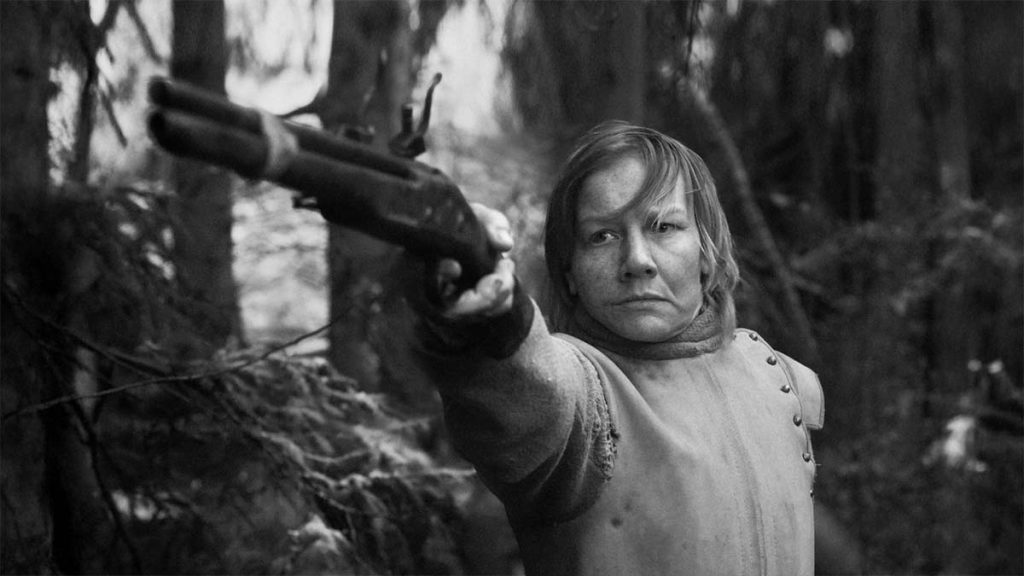
One can imagine Wenders and his fellow jurors were in a situation similar to the one he had already lived through in Venice in 2008: back then, the group heavily implied they had disliked the vast majority of the Competition titles, and the fairly telegraphed nature of most of the awards suggests things weren’t much different in Berlin this year. Granted, no one would have objected to Sandra Hüller winning Best Leading Performance for Rose (where she plays a woman who for years has pretended to be a man), or to Tom Courtenay and Anna Calder-Marshall sharing Best Supporting Performance for Queen at Sea (as an elderly man and his dementia-afflicted wife, respectively), but under the circumstances they felt like the only logical winners in a playing field that was largely barren.
The Berlinale Special section was notable once again for attempting to showcase a wider array of mainstream American productions (Carlo Chatrian, who ran the festival from 2020 to 2024, was sometimes criticized for his excessively arthouse leanings), but some people were left scratching their heads over the absence of truly buzzy titles – most notably Marty Supreme, whose German release date of February 26 made it an ideal candidate for the traditional national premiere slot given to an Oscar hopeful that hasn’t yet completed its international rollout. Then again, since the Berlinale is famous for having the largest audience in Europe and sells out screenings regardless of the names attached to the individual film, one wonders if such attempted pandering to the mainstream is even necessary.
To that point, this edition marked the first time in my fifteen years of attendance that I had to use the rush line to get into a screening for a film that was officially sold out, meaning I would only get in if there were no-shows from people who had forgotten to cancel their ticket. Now, was this for, say, Gore Verbinski’s Good Luck, Have Fun, Don’t Die, the entertaining anti-AI romp starring Sam Rockwell? Or perhaps for Ulrike Ottinger’s The Blood Countess, a very Austrian vampire comedy with none other than Isabelle Huppert as the titular bloodthirsty noblewoman?
No, this was for an Estonian film called Dead Mountaineer’s Hotel. A thriller with sci-fi elements, it was originally released in 1979 and played here as part of Berlinale Classics, the festival’s showcase for newly restored archival gems. And a gem it truly was, with the audience absolutely captivated for its brief but rich 83-minute runtime. With no one in attendance (the director and most of the cast are no longer with us), it was still harder to get into than the latest by Berlin regular Hong Sang-soo, whose The Day She Returns was part of the Panorama batch rather than in Competition. A bit of a shame, as it would have been fun to see the reaction of the critics in attendance inside the Berlinale Palast: this time, the minimalist black-and-white dramedy is about an actress who, after sitting through three interviews in a row, has to re-enact them as part of an acting class…