Jeremy Herbert
In a 1997 interview with Charlie Rose after the release of Lost Highway, Bill Pullman tried to explain why David Lynch cast him as a man who probably murdered his wife: “He thought that it’s important to have a guy the audience wouldn’t give up on.” By then, he’d earned his place on Hollywood’s speed-dial as the nice guy you didn’t want to finish last—Sleepless in Seattle, Malice, The Last Seduction, even Casper in a sense. But for actors, likability is a rule, not an exception, which makes Lynch’s other observation more telling: “Bill looks like a guy who can get himself into a lot of trouble.”
Pullman owes his entire film career to that look. Shortly after playing a bottle-blonde Russian tank commander in a Los Angeles production of Nanataiwai, he booked his first audition for the Zucker-Abrams-Zucker comedy Ruthless People. The role was a stone-faced serial killer, but Pullman earned so many unintended laughs in his read that they rewarded him with a bigger one. His agent couldn’t explain it either: “I don’t know what it was, but they love you, and they want you to keep your hair exactly that way.”
With his two-tone pompadour and baggy linen suits, sleeves perpetually rolled as if stapled that way, Earl Mott is a cartoon skunk in Don Johnson drag. His only demonstrated competence is in the bedroom, even if he can’t always tell an orgasm from a death rattle; strangely, Lost Highway was not the first time Bill Pullman had been tormented across the Hollywood hills by ambiguous camcorder footage of a sexually charged homicide. But as a criminal, a mistress’s mister blackmailing her already-blackmailed husband, he’s more like a guilty bystander. That soft face full of trouble is a study in barely controlled confusion. Police snipers flattening a brand-new tire on his AMC Gremlin does not drive Earl to cover but the verge of tears. Surrounded by comic ringers like Danny DeVito and Bette Midler playing to the multiplex rafters, with performances they unjustly assumed would end their careers, it is Bill Pullman’s implosive ignorance that leaves the biggest mark. Moments before his hopes of seeing the three remaining seasons of Miami Vice crash around his frosted tips, he asks, “Do I look that stupid?”
“Yes,” says a man wearing a fright wig and clown nose. “You do.”
In Lucky Numbers, 14 years later on the other side of the law, he still does. Although Earl Mott was a crook merely longing to be a cop—may his goldfish, Crockett and Tubbs, rest in peace—Detective Pat Lakewood is a cop who seems to regularly forget that he is one. Confronted with video evidence that an ongoing disability leave has not gotten in the way of his woodchopping, he’s quick with an ironclad defense: “The lower back, it’s an enigma.”
That’s the only thing Lakewood is ever quick with. He even types slowly, based on the five seconds it takes him to spell “Jerry” with three Rs. Without intervention from his long-suffering partner, he would’ve written off a battered corpse with a plastic bag taped over its head as an accident: “Why is everyone around here so foul play happy?”
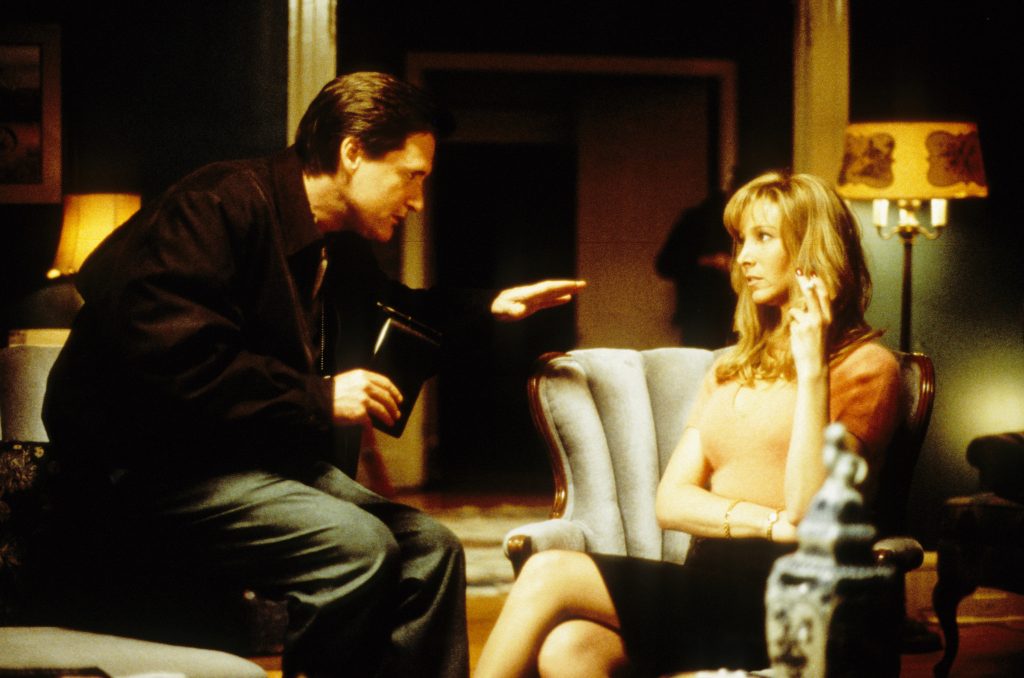
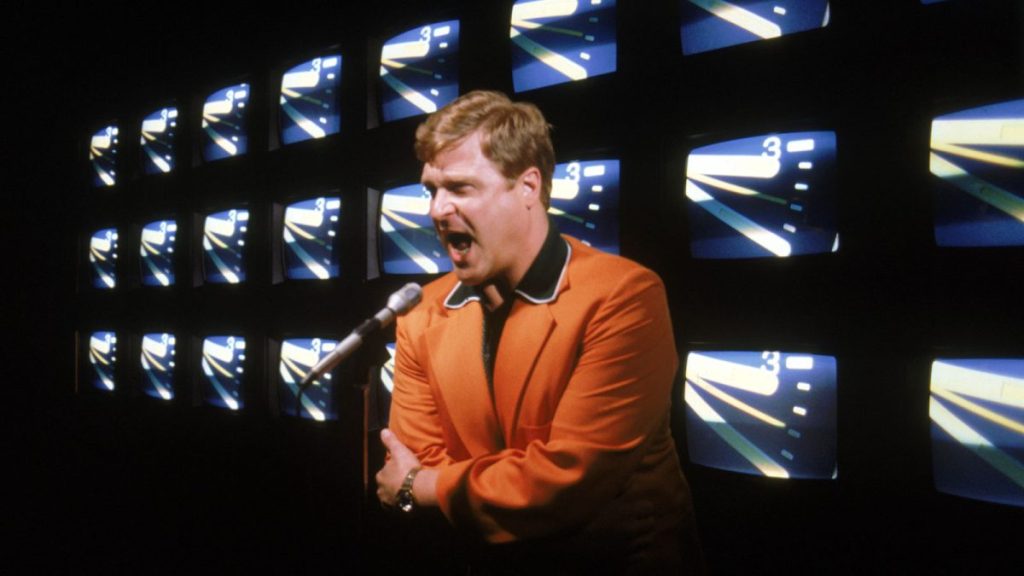
Just as Earl’s stupidity does the police more favors than his accomplices, Pat’s pathological laziness provides the perfect cover for Harrisburg’s assorted strivers and connivers. He is immediately seduced by the neon sleaze of Tim Roth’s strip club owner, who happens to be responsible for the death he’s begrudgingly investigating. He treats John Travolta’s big-fish-in-a-small-market weatherman as a fellow civil servant, asking him to pay for the cruiser windshield he mysteriously impaled with a crowbar and no further questions. But it takes a cashmere sweater from K-Mart’s Double Indemnity collection to reveal his biggest blindspot. In a brief crime scene chat with Lisa Kudrow’s yinzer femme fatale, Pat short-circuits, his head ratcheting around like a Chuck E. Cheese animatronic leaking hydraulic fluid. He’s so desperate to flirt, to beg this woman to ruin his life when that still meant something, to even respond in a timely manner, that she accepts his request for noir oblivion on look alone: “I’m available.”
By 2000, Bill Pullman wasn’t as available as he used to be, making his seventh-billed pinch-hitting that much stranger. He did not hit the late-show circuit for Lucky Numbers. In a testament to the film’s immediate failure and continued obscurity, even The AV Club’s otherwise-exhaustive Random Roles profile left it off the record. Reuniting with Nora Ephron must’ve enticed him, but he still regretted taking such a thanklessly soppy role in Sleepless in Seattle. Shortly after admitting this career-destructive remorse to Charlie Rose, he charts it as his North Star: “I think some of the parts I did were almost like anti-leading man.”
Earl Mott and Pat Lakewood are so alike in stature, stupidity, and screentime that they double as bookends of Pullman’s interest in traditional movie stardom. As affable dopes in deep, they match the broad strokes of his most famous characters, but their delusions are safely quarantined away from the plot, self-contained and inflicted. In the midst of these high-stakes comedic gambles—Ruthless People and Lucky Numbers both marked the first time their respective directors worked from scripts that they didn’t write—his presence is given and taken for granted. No matter how the rest of the cast is faring, whatever becomes of the conspiracy in his squinty peripheral vision, the audience will never give up on Bill Pullman. Even battered Lucky Numbers scribe Adam Rifkin, who wrote Pat Lakewood for Chris Elliott and hated the finished product, had to hand it to him: “He might have been one of the few things in the film that kind of worked.”
As Lynch understood, the Bill Pullman Type isn’t a list of attributes but an absolute—just looking at him, you believe, now and forever, this poor bastard is the cause of all his own problems and pray that he might be the solution to them just this once, stupid hairdo or no.
For a 2020 retrospective with Entertainment Weekly, Pullman watched one of his career-favorite lines from Lost Highway: “That’s fuckin’ crazy, man.” He cackled, repeated it to himself, and cackled again.Without Earl Mott surveying his brand-new passport, including the dumbest photo ever approved by the United States government, and purring, “Cool,” there is no Lost Highway. Without that cackle, at one of the most disturbing lines in it, there is no Bill Pullman, and there has only ever been one Bill Pullman Type.