Chloe Walker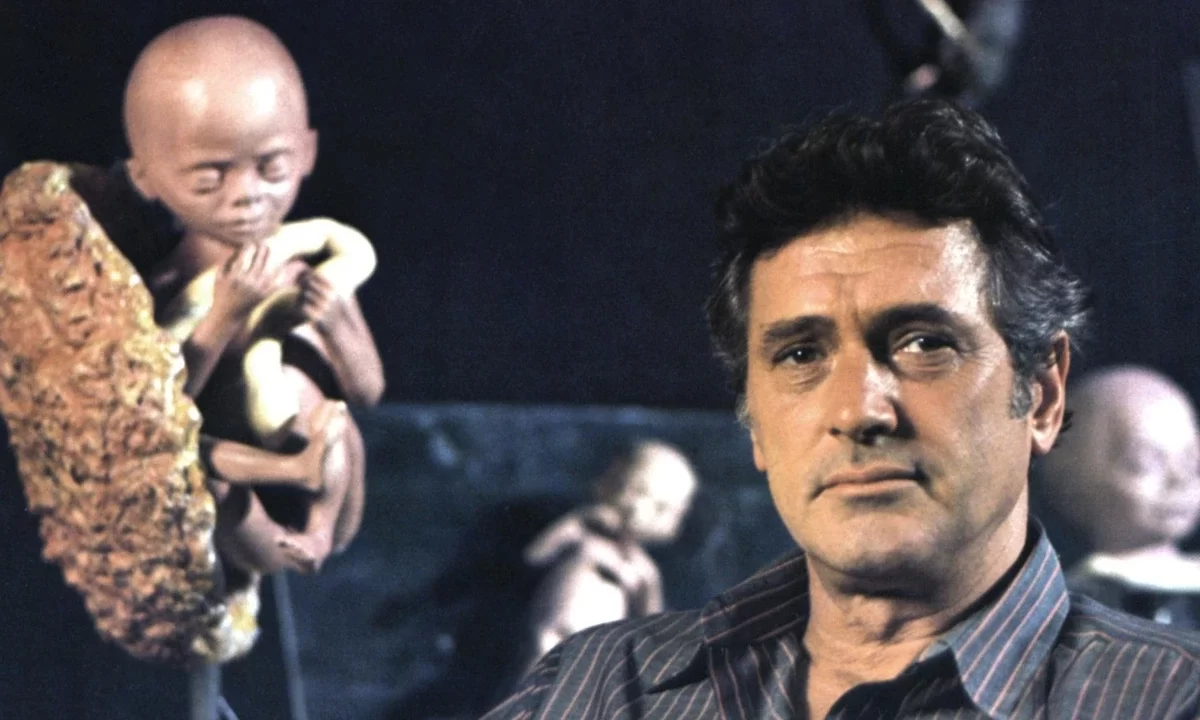
Rock Hudson’s star had started to fade by the mid-‘60s, with the lush melodramas and sex comedies that had made him a big name having fallen out of fashion. In the ‘70s, he transitioned to TV with his starring role in McMillan & Wife. Still, he made six features during the decade, among them a big budget musical bomb (Darling Lili); a surprisingly brutal war picture (Hornet’s Nest); a lurid sexploitation film (Pretty Maids All in a Row), a charming late-period western (Showdown), and a flaccid disaster movie (Avalanche). While none were great hits – a couple were notorious failures – taken together they were indicative of an adventurous actor hunting for a place for himself in this new big screen era.
And then there was 1976’s Embryo.
After accidentally running over a pregnant dog one day, and then managing to preserve one of her puppies by accelerating its growth in an external womb, geneticist Dr. Paul Holliston (Hudson) takes the…obvious next step. He decides to grow a person, using an unwanted, illicitly obtained embryo from the local hospital. Victoria (Barbara Carrera), as the memorable tagline puts it, grows “from embryo to woman in 4 ½ weeks.” At first, things go better than Paul ever dared hope, as she soaks up information and rapidly becomes as intelligent as she is beautiful. Soon though, as tends to happen when cinematic men dare to play god, events take a dire turn.
Despite the clear ludicrousness of the premise and the deranged final fifteen minutes, most of the action progresses at a steadily engaging pace. He never quite achieved the fame of some of his peers, but director Ralph Nelson had a solid filmography that ably spanned numerous genres, and largely keeps Embryo’s wilder elements from pushing it too far off the narrative rails. Nelson was a particularly good director of actors, having steered two (Sidney Poitier and Cliff Robertson) to Oscar glory the previous decade, and indeed it’s the performances that make it harder to write the movie off as merely an oddity.
While it had bombed at the time, Hudson remained rightfully proud of his work on chilling 1966 cult classic Seconds. It’s easy to see how the chance to revisit those medical sci-fi themes could have appealed to him. Additionally, he had spent years grounding the preposterous narratives of Douglas Sirk melodramas with his steady presence; though the movies were totally different, his natural gravitas does help some of Embryo’s wilder moments go down easier. For the first half-hour we’re mainly in the lab with Hudson, as he spouts medical jargon and paces around, looking alternately excited and concerned.
The first time he, and we, see Victoria in the incarnation she’ll exist in for the majority of the film, she’s naked, her long hair artfully hiding her breasts, and Gil Mellé’s score is swelling romantically. We know where this is going to go, and later on, in the most eye-roll-inducing scene of the whole movie, it goes there – Victoria asking, “Paul, I want to learn, to experience. Will you teach me?” before the two of them jump into bed.
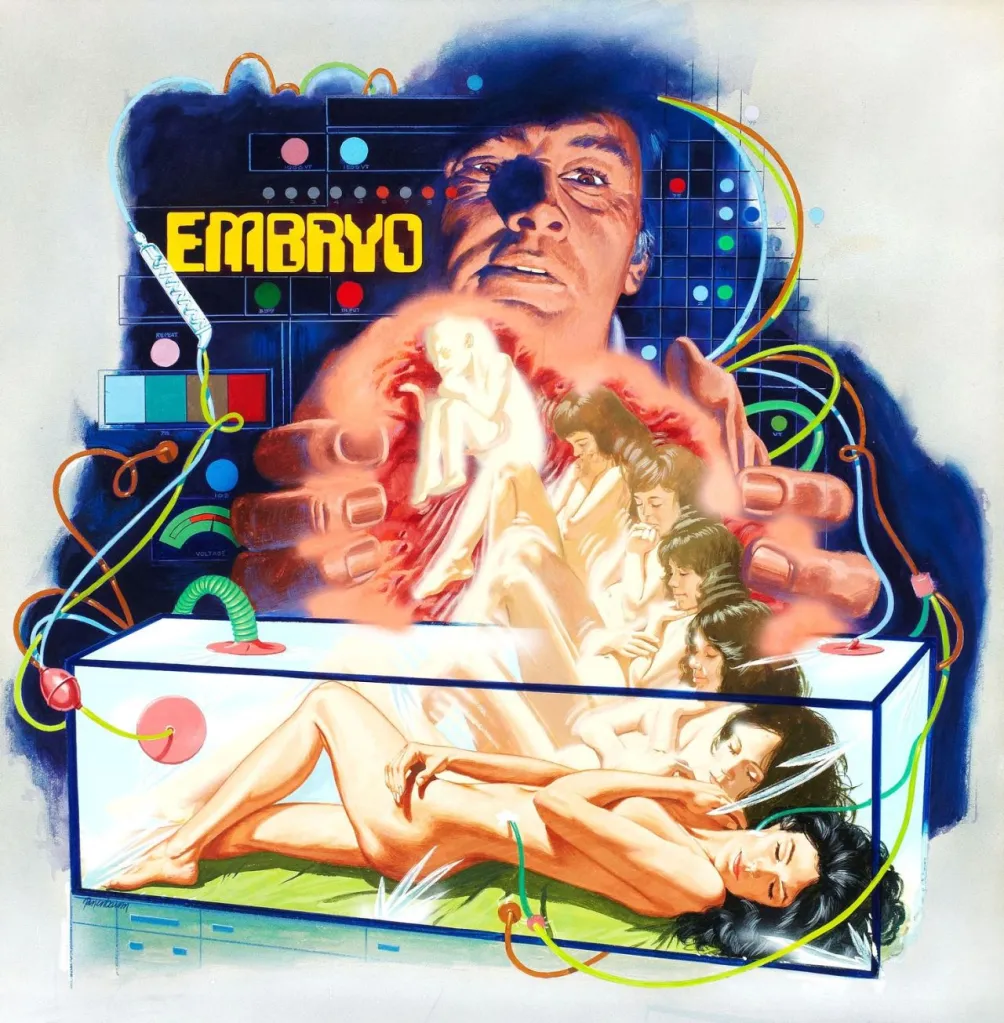
Yet it’s a credit to Barbara Carrera that, only three films into a career that would go nowhere impressive, she’s able to find humanity within a character that dives whiplash-quick from male fantasy to terrifying monster. She’s wonderfully wry at a party where Paul first introduces her to his friends as his research assistant, and she beats a furious man (Roddy McDowall, in a very funny cameo) at chess, despite having never played before (“I’ve only read books!”). Later on, when she starts rapidly aging again, and must kill to stay alive, her desperate fear cuts through the general silliness with quite a jolt.
Beyond that central duo, there’s an awful lot going on in the background. Dianne Ladd plays Martha, the sister of Paul’s dead wife, who now lives and works with him. Embryo can’t seem to decide whether she hates him, or she’s jealous of Victoria, or if she’s the sole sensible one in the entire thing.
Then there are the adventures of Number One, the super-intelligent puppy that Paul was able to save. Number One is so smart that he’s able to climb in the front seat of a car and pull the door shut behind him, and put his food bowl in the sink when he is done with it. But when we witness him kill a smaller dog and hide its body, it proves a grimly amusing bit of foreshadowing at what might be to come with Victoria.
Ultimately, it’s hard to know what to make of Embryo, which ends with Rock Hudson trying desperately to drown a pregnant, murderous old lady who was ‘born’ just a few weeks earlier. It’s deeply daft, devoid of logic, full of cheesy tropes and ludicrous moments. However, thanks to the performances of Hudson and Carrera, far better than they needed to be, there’s a melancholy to the whole production that’s hard to shake off – the way Carrera inspires genuine empathy for her monster makes Frankenstein comparisons feel justified on an emotional level, not just a narrative one.
It wasn’t a success at the time. It didn’t revive Hudson’s movie career, or catapult Carrera’s to anywhere remarkable. If it survives at all in the cultural consciousness, it’s as a comic footnote. Nevertheless, fifty years on from that initial release, it remains an experience that’s still very much worth having.
“Embryo” is streaming on a variety of ad-based services.