Josh Bell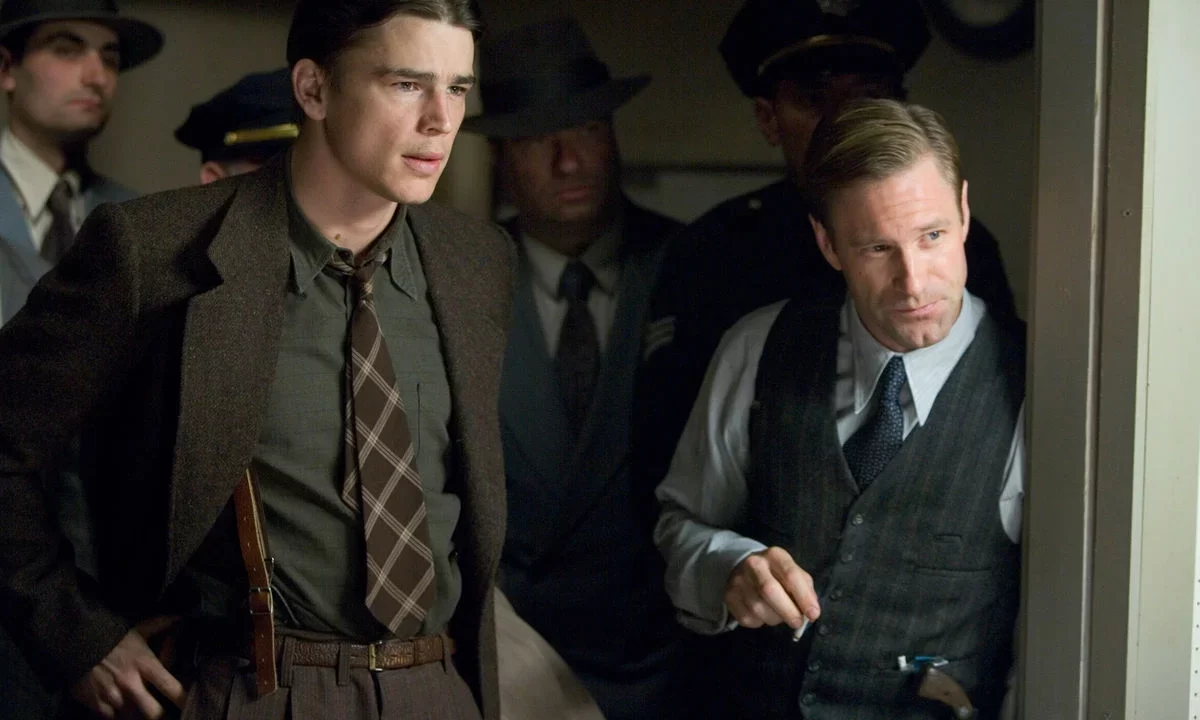
No matter how many of Brian De Palma’s initial failures have been reappraised as masterpieces, that distinction seems to have evaded 2006’s The Black Dahlia, which was released 20 years ago this week. Even among De Palma’s late-period boondoggles, the noir-tinged thriller based on James Ellroy’s novel has been all but forgotten, relegated to footnote status in both the filmmaker’s and the author’s careers. Yet The Black Dahlia is prime for reassessment, as De Palma’s final major-studio production, and a stylish reflection on the twisted psychosexual dynamics of film noir.
As is often the case with De Palma, The Black Dahlia is a movie about cinema itself, even though it’s ostensibly about something else. The title refers to the 1947 murder of Elizabeth Short, one of the most famous unsolved cases in American history. And Short plays a key role in the story, which focuses on fictional characters within a real-life context. At the same time, the entire investigation into her death is De Palma’s version of an Alfred Hitchcock-style MacGuffin, a reason for the characters to engage in their own tortured breakdowns and break-ups.
Short (Mia Kirshner) appears primarily in excerpts from studio screen tests that look more like therapy sessions or reality-TV confessionals, with De Palma himself as the voice of the offscreen director coaxing her into stark personal revelations. She also shows up in an underground fetish film alongside her roommate and fellow aspiring actress Lorna Mertz (Jemima Rooper), and De Palma knows that the line between this explicit, illicit pornography and the kinky manipulation of the pseudo-legitimate screen tests is paper-thin.
The same goes for the line between investigation and instigation when it comes to LAPD detectives Dwight “Bucky” Bleichert (Josh Hartnett) and Lee Blanchard (Aaron Eckhart). They’re introduced as opponents in a promotional boxing match that serves as a cover for police department graft, and nothing about their jobs is free from the influence of corruption. These aren’t upstanding noir heroes who are compromised by insidious outside forces; they’re compromised from the start, and they only sink deeper as they probe the sordid details of Short’s murder.
Bucky and Lee have no problem beating up sailors during Los Angeles’ notorious Zoot Suit Riots, which is where they first meet. De Palma presents that civil unrest in one of his elaborate, astonishing tracking shots, and he does the same thing 25 minutes later, when Short’s death is depicted as essentially a background element in an intricate tableau of Bucky and Lee staking out a criminal target. It’s an elegant reflection of the characters’ priorities, and the way that the horrific murder of a beautiful young woman becomes merely a tool for powerful men to exert their authority.
Later, a room full of stone-faced cops watch Short’s nudie film, and Lee is the only one who gets agitated, storming out of the office in a display of chauvinistic rage. His expression of emotion is deemed unprofessional, but it doesn’t come from a place of compassion. He’s angry at his own impotence, dating back to the disappearance of his sister when he was a teenager. He becomes obsessed with Short’s case as a way of compensating, but the victim herself is merely an abstraction.
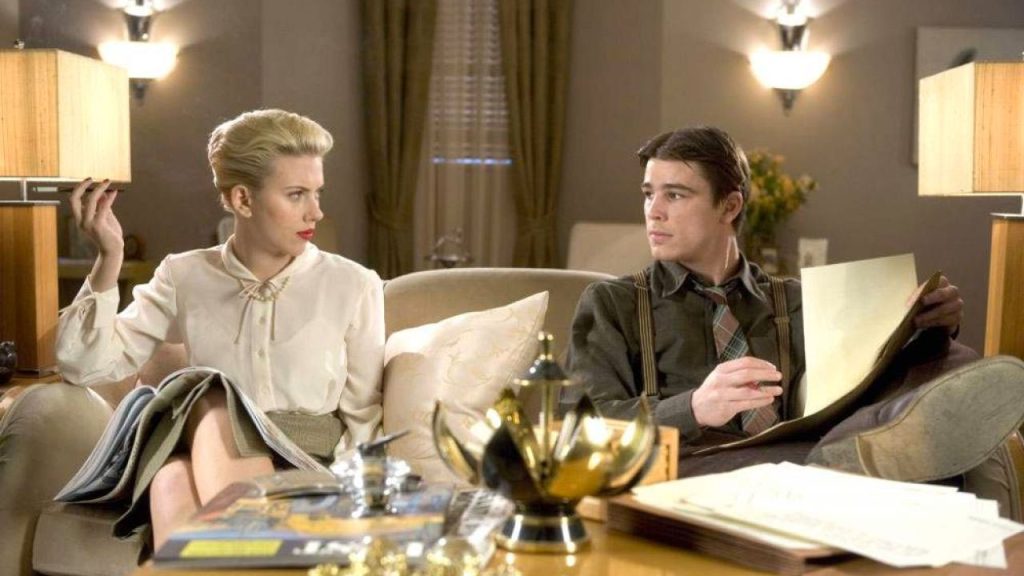
That’s not to say that The Black Dahlia is solely a movie about emotionally stunted men. The women are just as complex and just as anguished, starting with Lee’s girlfriend Kay Lake (Scarlett Johansson), whose outward boldness hides inner trauma. She ends up in a sort of platonic throuple with Lee and Bucky, grasping both of their hands at the movies during a frightening moment, and cooking dinners for both of them in a distorted reflection of domesticity. Johansson is tender, vulnerable, and ferocious as Kay, and the performance is a key building block in her maturation as an actor, even if it’s been subsequently downplayed.
Hilary Swank is even more striking as spoiled heiress Madeleine Linscott, who’s connected to Short via clandestine meetings at LA lesbian bars. Swank almost never gets to play this kind of sultry seduction, and she affects an exaggerated mid-Atlantic accent as Madeleine, in another of De Palma’s many nods to classic cinema. It’s a campy performance in a campy movie that doesn’t get enough credit for its knowing absurdity, the way it subverts and perverts vintage Hollywood iconography, from the Hollywood (or, at the time, Hollywoodland) sign to the landmark melodrama The Man Who Laughs.
Nowhere is the absurdity more evident than in a surreal dinner scene in which Bucky meets the Linscott family, which De Palma shoots partially from Bucky’s own point of view. It’s an almost Coens-eque comedy of manners, with Fiona Shaw chewing scenery as Madeleine’s mentally unstable mother. Shaw’s hammy performance exemplifies De Palma’s self-aware skewering of film noir’s fixations (and his own). If The Black Dahlia baffled audiences and critics at the time it was released, that puts it in good company with plenty of De Palma classics, and it deserves the same retroactive appreciation.
“The Black Dahlia” is available for digital rental or purchase.