Jason Bailey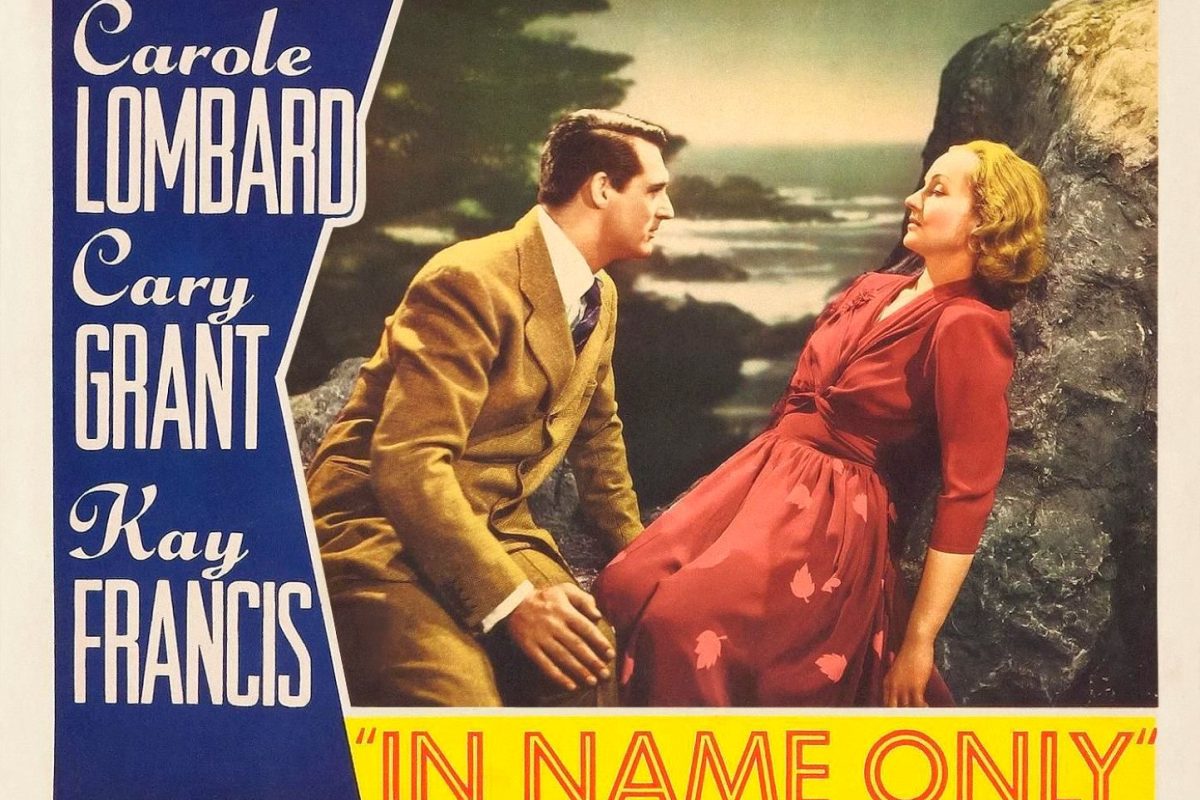
The first thing that make you sit upright and take notice in John Cromwell’s In Name Only—the reason we’re there, really—is Carole Lombard and Cary Grant’s chemistry. She’s fishing, and he has a chuckle and tells her, “You won’t catch anything that way,” and she doesn’t skip a beat before sneering back, “Well, I might!” She says it so convincingly that you believe her, even after he tells her there have been no fish in that pond for twenty years. She seems like the kind of gal who’ll find a way.
Their chemistry is so potent (The way she looks at him! Jesus!) that it’s a little shocking to discover that this was, in fact, originally conceived as a vehicle for Grant and Katharine Hepburn. It would have been their fourth pairing, after Sylvia Scarlett in 1935 and both Holiday and Bringing Up Baby in 1938, but the financial failures of the latter duo put the kibosh on their pairing, at least for the time being. (Luckily, Hepburn’s savvy cultivation of The Philadelphia Story made that hiatus a short-lived one.)
It’s not that Hepburn wouldn’t have been good in the role; she’s good in damn near everything. But the character’s vulnerability is much more Lombard’s wheelhouse, and In Name Only is much more of a melodrama than the kind of rom-com you’d expect from a Hepburn/Grant pairing—or, frankly, a Lombard/Grant pairing. The scenes of tragedy are, generally speaking, less successful than the Meet Cute and Being in Love stuff, not because the former are bad, but because the latter sparkle so brightly.
And when we meet him, Grant is ready for some sparkle. The poor guy has a lot going on, none of it terribly good, mental health-wise; he’s trapped in a loveless marriage to Maida (Kay Francis), her obnoxious best friend is trying to seduce him, and he’s falling hard for Lombard, a single mom and window who’s recently relocated to their lyrical little town. When he discovers proof that Maida married him for convenience and not love, and confronts her with it, she owns up—and then, hilariously, insists, “I hope you don’t think that telling you this will… condone anything you might do!”

And do things he does! Grant is such a smooth operator, and so devastatingly handsome, that it’s sort of startling to see him summon up such longing, pleading with her, “Have you so many friends you can’t have one more?” Her answer is simple: “Because it wouldn’t stay that way.” And she’s right; they kiss about four seconds later. Lombard and Grant each deploy their considerable charm and charisma in this middle section, which we need, when considering what they’re up against in a story like this, told in this period. Yet even when the material grows heavy, they’re just delightful together; witness the wonderful scene where she calls him up to brag about a payment check for her work, and offhandedly notes that she can’t wear a veil when they finally get married, so she’ll just wear a hat. IT’S JUST VERY CUTE. (There are also plenty of opportunities for him to call her “dahling,” and you have to appreciate a movie that provides that.)
Poor Kay Francis, on the other hand—no slouch in the charisma department herself—has to play a vile, relentless jerk, ruthless in her grip on Grant’s family money, clinging to this terrible marriage long beyond reason. She’s such an asshole that when Lombard finally gives in, despairing, “We never had a chance, Alec, from the very beginning,” you believe her, and by the time the big tragedy occurs, it feels like the only way anyone could break the logjam of this thing. (That turn also strangely mirrors Grant’s An Affair to Remember nearly two decades later—though the film was inspired by, Love Affair, was also released in 1939. Everything is connected!)
One more element worth noting: the tremendous work of Maurice Moscovich as Dr. Muller, who comes in for a couple of scenes at the end and absolutely disarms us. The melodrama has, by this point, come to such a fever pitch that he wisely underplays, turning in a quiet, muted, but effective performance. Game recognizes game; Lombard nails the closing beats of those scenes by tuning in to that wavelength, and her face as she listens to his instructions (“Tell him whatever you think he wants to hear”), her eyes misty, her chin trembling, is overwhelming.
John Cromwell also directed Lombard in Made for Each Other this same year, so he knew what he was working with; she only made four more films before her tragic death in a plane crash in 1942, and it’s just too depressing to think about how many more we were robbed of. The New York Times called it a “soap opera par excellence,” and that was before the phrase had as negative a connotation. But it’s an accurate description—both halves.
“In Name Only” is available for digital rental or purchase.