Sara Batkie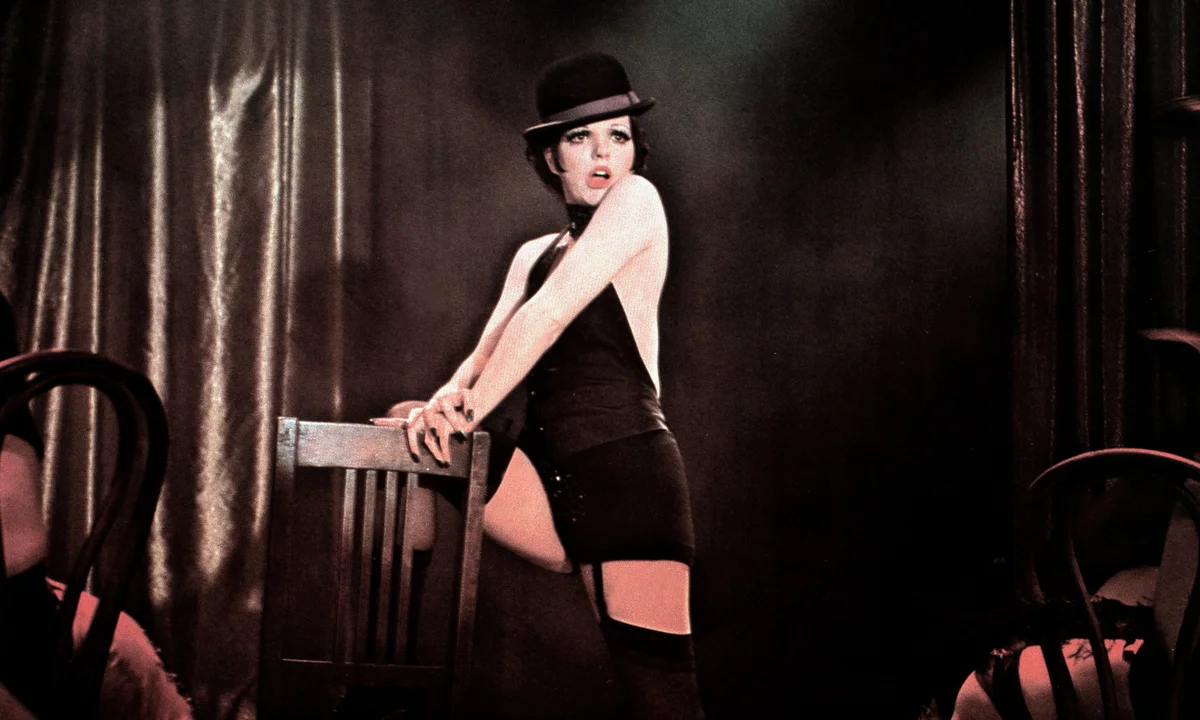
If you haven’t seen it in awhile, it might come as a bit of a surprise to realize that Sally Bowles isn’t the lead character of Cabaret. She doesn’t sing the majority of the songs nor is she present for the film’s most infamous scene. But as embodied by Liza Minnelli, who turns eighty years old this week and was only twenty-five at the time of shooting, she becomes director Bob Fosse’s central symbol of the willful ignorance that allowed fascism to flourish in Weimar-era Germany.
The 1972 film adaptation was, of course, not the first iteration of the story it tells. It’s based on both a 1966 stage musical with songs by Kander and Ebb, which itself was based on a play by John Van Druten, and the novellas Goodbye to Berlin and I Am a Camera by British author Christopher Isherwood. The character based on Isherwood – named Brian in the film and played by Michael York – is the one through whom most of the action is relayed, albeit indirectly. Like Isherwood, he arrives in Berlin in 1931 with a boyish naivete about the degeneracy that awaits him in the city’s dark corners. It’s Sally, who was based on the British cabaret performer Jean Ross, who’ll introduce them to him.
For Sally, everything is a performance. When she first greets Brian at the boarding house where he’ll soon take a room, and eventually move into hers, she’s all doe eyes and glittering fingernails. Showing him around and introducing him to the tenants, it’s clear she’s honed a routine that’s impossible not to be drawn into. She’s a loose woman, reckless with her heart and body if it means a potential break into movie stardom, but she knows it and that awareness carries the protective weight of armor. The motto she lives by, along with much of the rest of her libertine cohort, is “what does it matter if you’re having fun?” But her time with Brian will put that adage to the test.
Sally works at the Kit Kat Klub. “In here, life is beautiful,” the Emcee (played with puckish wit by Joel Grey) boasts. Fosse made the conscious choice to narrow the musical’s focus, excising all the numbers that take place outside the club’s walls (“Tomorrow Belongs to Me” being the one exception). As captured by his camera, it’s a claustrophobic space. There are no establishing shots to give us a sense of how large it is inside; instead we’re thrust almost immediately close to the onstage action, which Fosse renders at almost nauseatingly low angles, as if we too are a part of the leering audience. It’s a deliberately disorienting way to direct a movie musical, and Fosse, coming off the box office disappointment of 1969’s Sweet Charity, takes a perverse delight in thwarting expectations. When Sally performs her barn-burning “Maybe This Time,” it’s a shock when the lights reveal that hardly anyone is watching her.
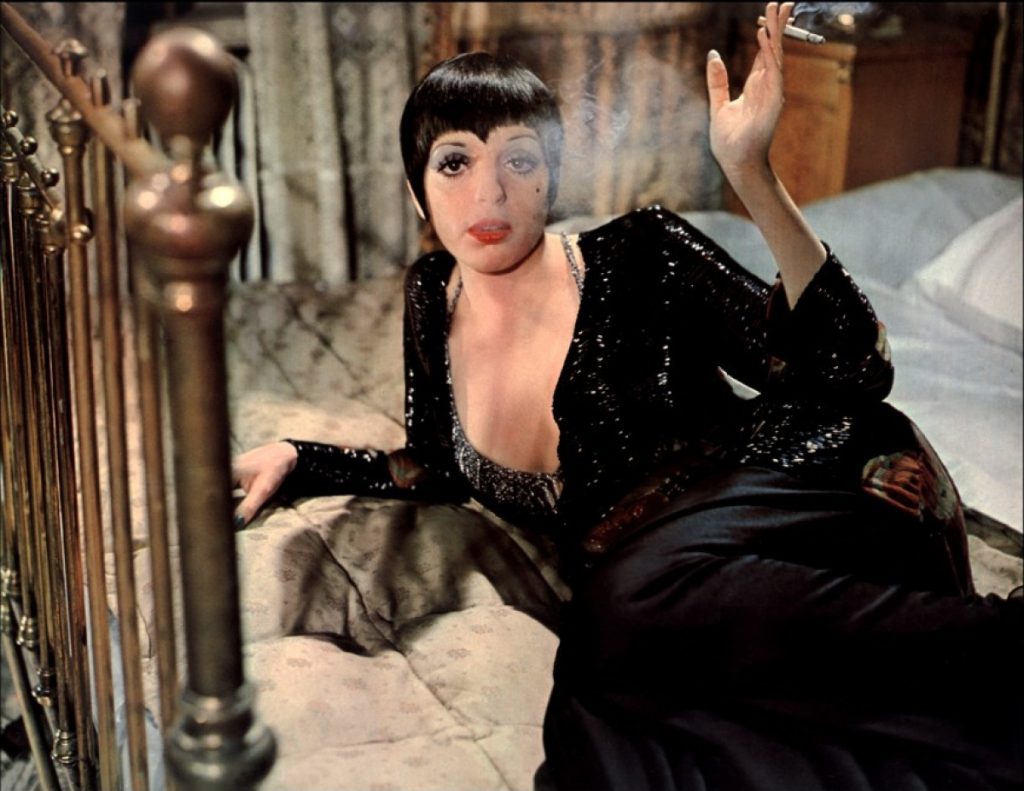
Fosse also choreographed the dancing with his trademark angular style – elbow laden, emphatically spasmic. Minnelli, who’d already won a Best Actress Tony but was still fairly new to film, has a lithe forthrightness that compliments his rigor and was rewarded with one of Cabaret’s eight Academy Awards. At the suggestion of her father, director Vincente Minnelli, she modeled her appearance and insouciance on silent-era legend Louise Brooks, who also expatriated to Weimar Berlin in the hopes of finding stardom. But inevitably there are echoes of her mother Judy Garland, who died when Liza was twenty-three – not in Sally’s stage performances so much as the moments when it seems like her veil of invulnerability may finally drop.
But Sally is a congenital liar; it’s bad for her personal life but ironically it might make her the sole character of Cabaret who could conceivably survive the Nazi party’s rise. Ross did, though she was far more politically conscious than her inspiration, being a lifelong member of the Communist Party and a film critic for The Daily Worker. Sally, on the other hand, seems to have thrown her lot in with the bohemian crowd of strivers, for better or, more often, worse. Through her affairs with Brian and rich baron Maximillian (Helmut Griem) and the complications of an unplanned pregnancy, she maintains a superhuman level of cheerful self-preservation. She’s bought her own bullshit so long that she doesn’t realize she’s bankrupt.
The only thing that seems to penetrate her delusional fortifications is when someone tells her she’s talented, something the book and stage versions of Sally was pointedly never intended to be. Still, it’s hard to hold that against Minnelli when she’s belting out the closing “Cabaret” number, with its chilling lyrics about Elsie, the “happiest corpse [you’ve] ever seen.” In those moments, Sally is part of the delusion, too. But be careful how long you look away from evil. Soon it might be the only thing looking back at you.
“Cabaret” is streaming on Hoopla and available for digital rental or purchase.