Zach Vasquez
For many a cinephile, the start of summer is simultaneously the most depressing and the most wonderful time of the year. That’s because, for the fifth year in row, the first week of June celebrates Bleak Week: Cinema of Despair. The annual series, curated by the American Cinematheque (the Los Angeles-based year-round film festival started in 1985 by director Sydney Pollack and Filmex founders Gary Abrahams and Gary Essert), “spotlights some of the greatest films from around the world that explore the darkest sides of humanity, as well as some of the bleakest points in human history.”
Since its debut in 2021, Bleak Week has become one of the Cinematheque’s most eagerly anticipated series, growing exponentially to meet demand. Starting last year, it expanded from three theaters in L.A. (The Egyptian, The Aero, and The Los Feliz 3) into seven other American cities, as well as London. This year, it will run in 73 cities at home and abroad, in countries across North and South America and the UK.
The heftiest section of the festival remains within its home base of Los Angeles, with 46 films programmed over the course of seven days. Said films run the gamut from classic Hollywood (Criss Cross, Fear Strikes Out) to New Hollywood (Heaven’s Gate, Tess); Euro arthouse favorites from through the decades (Shame, The Piano) to modern cult classics (Mysterious Skin, Southland Tales); blockbusters (The Godfather Part II, A.I.) to true indies (Castration Movie Chapter III: Junior Ghosts–Premorphic Drift: A Fragmentary Passage).
As with the majority of the Cinemateque’s programming, the movies themselves are only part of the experience, with rare prints, restorations, and Q&As featuring filmmakers, actors and special guest moderators appearing at many, if not most, of the screenings. The last two fests have included retrospectives centered around guests of honor (Bela Tarr and Claire Denis), with this year’s spotlight shared by French icon Isabelle Huppert and the current king of American black comedy, director Ari Aster.
While I don’t want this article to read as an advertisement for Bleak Week, there’s no point pretending I’m a neutral observer. For the past three years—I was down with COVID during the fest’s inaugural run, which honestly feels fitting—Bleak Week has been my favorite recurring film event of the calendar year. The ferocity of its expansion into other markets, as well as the quickness with which several of the most anticipated titles sold out, makes it clear I am not alone in this.
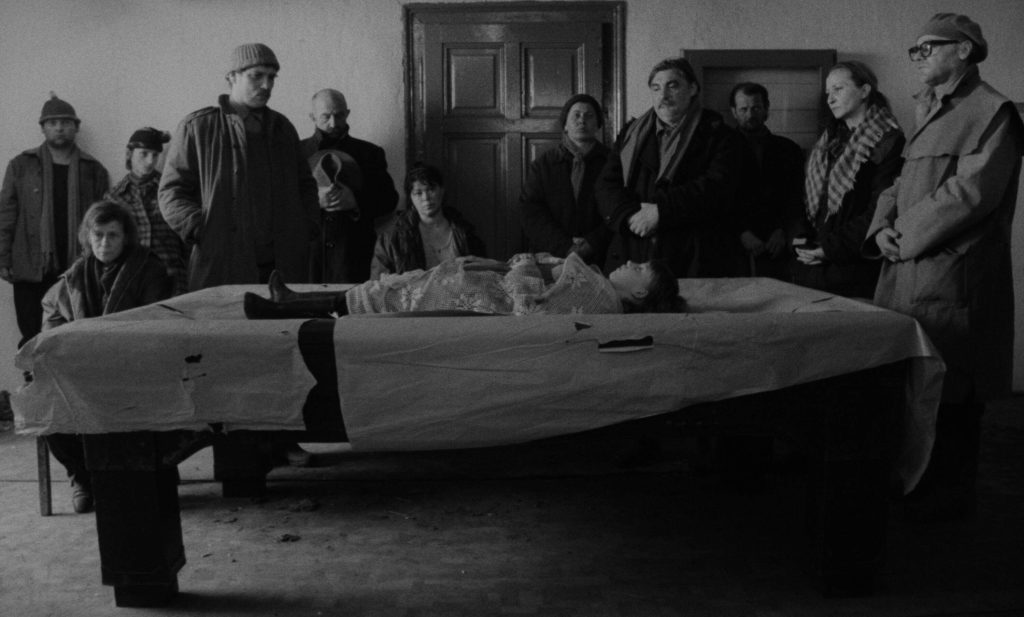
On its face, Bleak Week seems like a parody of the arthouse scene: let’s all get together and watch the most depressing shit imaginable! But there’s something to be said about leaning fully into that idea, if only for a week. While unfunny idiots on TikTok make the same hack joke about Film Bros only liking the most pretentious and grueling sounding movies (even though they never, ever manage to actually come up with a convincing parody), there’s no denying that some of us are attracted to challenging movies—because of their content, form, length, or, in the case of perennial Bleak Week favorite Satantango, all three—and that the more challenging they are, the more we treat watching them as a personal accomplishment.
Which is not to say that every film played during Bleak Week is a purely punishing experience. While the majority of picks are heavyweight bummers —along with aforementioned Satantango (1994), recurring picks include Come and See (1985), Salo: Or the Hundred Days of Sodom (1975), and The Piano Teacher (2001)— there are some fun-ass titles that also just happen to be bleak: the nuclear apocalypse romantic comedy Miracle Mile (1988), the Coen Brothers’ deadpan comedy of noir errors The Man Who Wasn’t There (2001), the demented Category III Hong Kong actioner Run and Kill (1993), and Paul Verhoeven’s transgressively hilarious rape-revenge thriller Elle (2016), to name just a few. Hell,your dad’s favorite sports movie of the last 15 years, Moneyball (2011), even played at last year’s fest (gonna be honest: not quite sure how that one fits the bill, but regardless…).
That said, my most memorable moments attending Bleak Week have come via the heavy hitters: the grueling but unbelievably rewarding experiencing of sitting in a theater for Satantango’s seven-plus hours; crossing the notorious psychosexual Spanish horror film In a Glass Cage (1986) off my to-watch list 20 years after first learning of its existence; watching an audience of first-time viewers react to one of my favorite celluloid bummers, the family annihilation drama Natural Enemies (1979); being utterly unprepared for Claire Denis’s icy noir nightmare Bastards (2013; and at this point, my pick for capital B-Bleakest movie I’ve ever seen). This year, I’ll finally get to see what I consider the greatest of all animated films, and the only one that has ever made me out-and-out bawl, The Plague Dogs (1982), on the big screen.
The experience of dedicating an entire week to this undeniably perverse engagement with art does result in a weird reverse effect, where both the idea and act of watching such despairing stories becomes legitimately fun. Bleak Week acts as a kind of immersion therapy, one that, for me at least, can actually produce positive mental health effects. These are bleak, despairing times we live in, and often, the only way out is through. There’s something to be said, too, of not turning away from the darkness—kiss my ass with that “prioritize self-care” jive—but embracing it.
Bleak Week is, ultimately, a communal experience. If we all have to be miserable, let’s at least be miserable together.
Bleak Week is currently underway — check for a theater near you here.