Audrey Fox
In a film made during the self-censuring Production Code era of classic Hollywood, nothing is quite what it appears to be. A 1930s starlet reapplying lipstick is never just fixing her makeup: She’s giving a subtle indication to the audience that there is sexual content afoot that the filmmaker isn’t able to show outright. Likewise, the Hays Production Code came with an explicit ban on LGBTQ characters, refusing what they referred to as “any inference of sex perversion.” Despite these restrictions, many Hollywood filmmakers were uninterested in erasing the entire existence of the LGBTQ community, and found their own workarounds. George Cukor’s Holiday is a perfect example of this; this classic screwball comedy, a delightful collaboration between Cary Grant and Katharine Hepburn in their prime, is perhaps one of the most overtly queer-coded films of the classic Hollywood era.
Grant stars as Johnny Case, a free-spirited young man who impetuously decides to marry Julia Seton (Doris Nolan), a high society girl he has a fling with while on vacation. He’s worked hard his entire life, and now that he’s squirreled a little bit of money away, he wants to retire early and travel before deciding what he wants to do next. This bohemian lifestyle isn’t quite what Julia had in mind, though; she expects her future husband to take on a respectable job at her father’s company, leading a traditional upper-class life. To Johnny’s surprise, he finds himself drawn to Julia’s oddball sister Linda (Hepburn) instead, and the two can’t help but fall in love.
From the very beginning, it’s clear that Holiday has a number of thematic elements that lend themselves to a queer reading of the film. There are repeated references to being an outsider (Linda refers to herself as the black sheep of the family) and not quite fitting in with the social set they were born into. Both Linda and Johnny make unconventional choices that buck the norms of the mainstream nuclear (read: heterosexual) family, especially in an ultra-traditional WASP community. They are willing to defy the expectations that have been set for them, even if it means inviting strife, in order to live in a way that feels authentic to them.
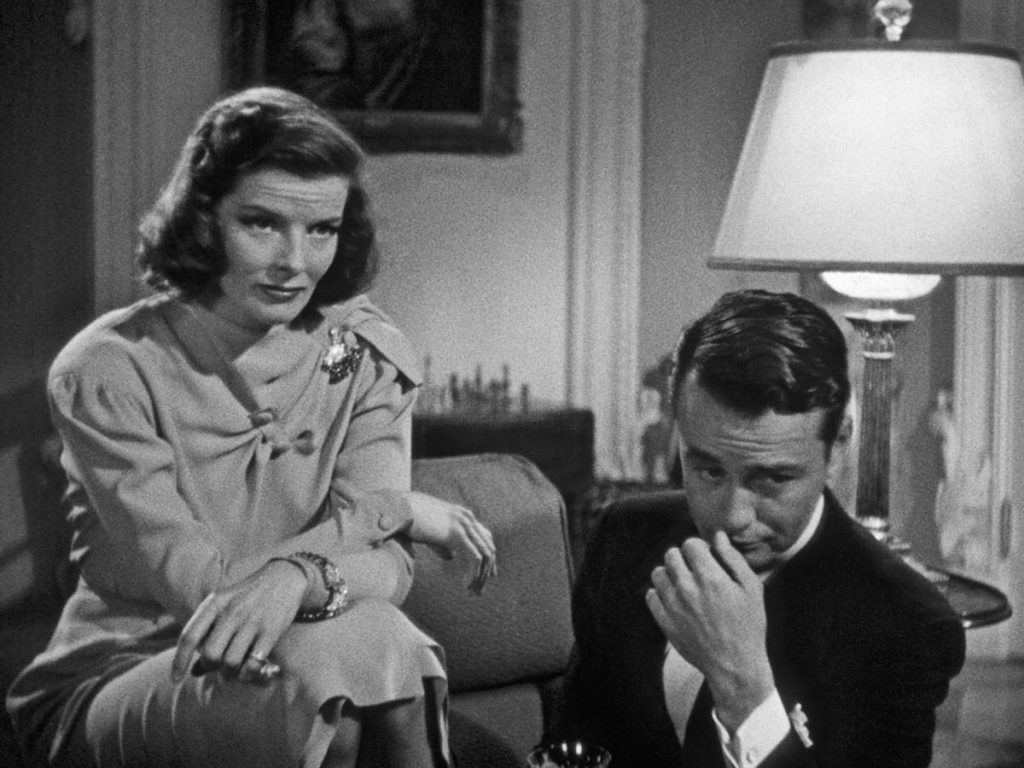
And all of this is to say nothing of Linda’s brother Ned Seton (Lew Ayres). The film employs every trick of the trade to imply that Ned is gay – even if they’re not allowed to come right out and say it, audiences would have to be blind not to pick up on the cues. He is played with a wry sense of humor and a bottle always at the ready, hidden away in the family’s playroom, the only place where he and Linda feel free to be themselves. Ned’s alcoholism can be seen as a way to numb the pain of desires he is unable to act upon. Whenever Ned and Johnny are together, he seems to be as much in love with the strapping eccentric as Linda is. And where Julia will likely be able to find another man who better meets her expectations of a marriage, and Linda chases after Johnny to get her happily ever after, Ned is stuck, trapped in a job he doesn’t care about and an existence he finds intolerable, surrounded by people who don’t understand him.
In the case of Holiday, we can be pretty confident that the queer coding is intentional. George Cukor’s homosexuality was an open secret in Hollywood, where he was at the center of the movie industry’s queer community. Although he was largely left alone by law enforcement, he was on at least one occasion arrested on vice charges, which were promptly covered up by his studio and not publicly reported on at the time. Grant and Hepburn were part of his inner circle, and were both often rumored to have had queer relationships throughout their careers. And finally, Holiday’s script was written by Philip Barry, who had a reputation for the exact sort of subtlety required in the Production Code era – director Jack Marshall said of him, “Nobody could write between the lines better than Philip Barry.”
The end result of all this is a screwball comedy from the 1930s, starring two of the biggest romantic leads of all time, that ends up being surprisingly queer-coded, even with the morality police out in full force. Holiday seems to take the restrictions of the Hays Production Code as a challenge, willfully obeying only the letter of the law, unleashing chaos in its subtext.
“Holiday” is available for digital rental or purchase.