Jason Bailey
TORONTO, ONTARIO: I suppose it says something about the fundamental kindness of the Canadian people that they still welcomed Americans across the border for this year’s Toronto International Film Festival, considering that our dipshit president has decided to start a trade war with them for reasons beyond the grasp of any reasonable human being. Even better, this year’s TIFF lineup has turned out to be positively stacked, with several first-class pictures and (for this viewer, at least) only a handful of misfires.
Martin McDonagh is a master of the two-hander, and in its broad strokes, his new film Wild Horse Nine is plotted and structured like his first, In Bruges, another story of somewhat mismatched colleagues on a working vacation. But the shagginess of the narrative allows him to indulge in (by now) signature vernacular speech, giving stars John Malkovich and Sam Rockwell line after line of quotable dialogue to chew on, swish around, and spit out, often at each other.
It helps, of course, to have as eccentric an actor as Malkovich acting as the motor of such scenes; he can make even the most banal dialogue seem like an alien language, so you genuinely believe these are the kinds of questions and hypotheses he might formulate. His work has generated a fair amount of buzz on the fall festival circuit, understandably, since he’s terrific (as he always is). But it’s the show-off role, and I found myself drawn to the reactive presence of Rockwell. He also gets a good rhythm going with Parker Posey as his miserable wife; it’s a delight to watch these two fine actors spitting absolute bile at each other, but then their sparring gives way, unexpectedly, to a humanity and honesty that’s frankly astonishing. (There’s not enough Parker Posey, but you can say that for pretty much every movie, even the ones she’s not in at all.)
I’ve never felt older while watching a movie than I felt during the opening of Jordan Firstman’s Club Kid, which begins in Brooklyn circa 2016 with protagonist Peter (Firstman) and his wild group of friends hitting a club and indulging in everything: drugs, booze, dancing, and sex, all accompanied by strobe lighting and pumping house music. “My god, this is my nightmare,” my fifty-year-old hand jotted into my notes, but that setup is over quickly — though the events following the “a decade or so later” indicate that Peter hasn’t outgrown it yet. “You’re literally a fucking child,” his bestie and business partner Sadie (Cara Delevingne) chastises him, and that kinda says it all; title notwithstanding, he’s not a kid anymore, and she cuts ties with him.
Perhaps too coincidentally enough, he returns home to find that the son he never knew he had, from a one-time high-as-a-kite fling with a British woman, is waiting there for him, newly without a mother and needing care. What follows is wildly predictable, but it still works — at least early on, as Firstman and child actor Reggie Absolom develop an easy rapport, and Firstman (who also wrote and directed) makes some quietly effective choices in how he covers, plays, and cuts his scenes. But he starts to steer into corn and cringe in the second half, and as it threatens to creep into a third hour, it starts to feel more than a little self-indulgent; how many scenes is he going to shoot of himself crying? Club Kid isn’t a bad movie; it’s stylishly made and has some big laughs (many of them supplied by a well-used Colleen Camp as a brassy neighbor). But it’s not as subversive as it should be — or as Firstman seems to think it is.
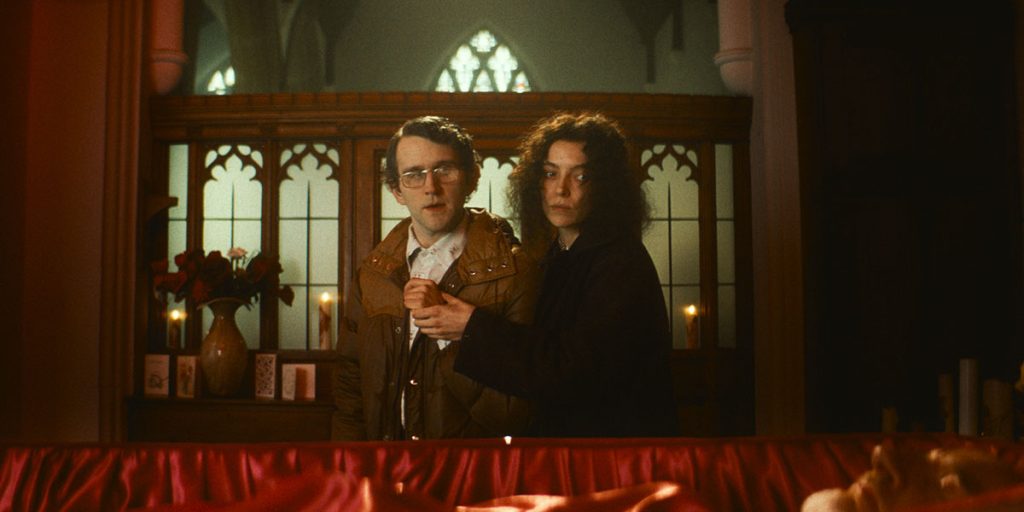
Twenty years back, would anyone have guessed Harry Melling would be the most consistent and reliable actor of the Harry Potter franchise? To go from the woefully fatphobic caricature of Dudley Dursley to the likes of Buster Scruggs, The Old Guard, and Pillion is mighty impressive; he continues this hot streak with the black comedy/romance/ musical Stuffed, starring as Bernie, an assembly line worker with one of those lives of quiet desperation that Thoreau wrote about — tapping into the universal human fear of being unnoticed while you’re here and forgotten when you’re gone. Even his own mother, wrecked by dementia, doesn’t know who he is, which makes him the perfect subject for taxidermist Aramrita (Jodie Comer, in a gloriously peculiar performance), who wants to apply her skills to a human subject.
A musical is only as good as it songs, and these (with music and lyrics by Joss Holden-Rea) are cleverly constructed and well-orchestrated, their lyrics loaded with longing and vulnerability; these are not subtle works, nor should they be, as they’re dealing with the big topics of live, love, and death. When Bernie and Armarita start singing simultaneously during the big, romantic climax, it works — not just as a wink, not as a sick joke, but as a musical. Contemporary attempts at the form are a real all-or-nothing scenario, and you’re either with them or you’re not. I was with this one, all the way to and through its twisted conclusion.
It’s tough to get into much detail about why you should see Everybody Wants to Fuck Me without spoiling one of the great bait-and-switches in recent cinema. If you walk in, as I did, knowing little beyond its star and provocative title, the opening scenes might convince you it’s a contemporary Boomerang; we do love when a ladies’ man meets his match, don’t we? And then something happens with that match that turns the entire movie on its head, and takes it in a direction this viewer, for one, absolutely did not see coming.
Suffice it to say that this deliriously strange movie is whip-smart and casually funny, that its score is hilarious, and that Taron Egerton is rapidly entering that rarified Robert Pattinson air, using his matinee idol looks and celebrity at the service of unconventional indies with something to say. In this case, that something is the scourge of the nice guy, and how many men use it as a deliberate pose for the most base of desires — the “covert predator,” as one character so eloquently put it. Within that framework, the button of the closing writer/director card may be the best gag in the movie.
The standard “based on a true story” disclaimer that kicks off The Stunt Driver assures us that while it is based in fact, certain events, places, and names have been changed “for dramatic purposes.” Wait, you might ask. Why would a name be changed for dramatic purposes? And here’s why: because the events writer/director Michael Dowse (Goon) is dramatizing were first seen in Robert Fortier’s 1981 documentary The Devil at Your Heels, which is such a cult item among a specific kind of comedian and/or cinephile that it provided the creators of Eastbound and Down with the moniker of that show’s lead, Kenny Powers.
Of course, the documentary-to-narrative pipeline is a spotty one (see The Walk — or, frankly, don’t), and the best news about The Stunt Driver may well be that it deepens and enriches its source material, showing us scenes that Fortier’s cameras weren’t privy to, exploring and expanding the interpersonal dynamics, and ultimately, pushing past the ribbing giggles of the documentary to get at the genuine emotions and pathos underneath. Ken Carter is a cartoon, but he’s also a real guy with real fears, and Jay Baruchel beautifully conveys this man’s micro-specific mixture of bombast, machismo, insecurity, and bullshit. It’s probably the best acting he’s done in a movie, and that’s not a small statement.

They say they don’t make them like they used to, but Anna Biller sure does. Her tricky mission, established in her previous features Viva and The Love Witch, is to make films that are both throwback exploitation films and metatextual social satires of them. Her latest, The Face of Horror, seems to be channeling Hammer Horror and Corman’s Poe cycle, with generous helpings of Jess Franco and Andy Milligan thrown into the mix. It’s all rendered in a kind of arch, vamping camp; Biller and her players keenly understand the comic value of a well-timed music sting or a properly raised eyebrow.
There is a plot (adapted from a kabuki play, apparently?) of various machinations and shifting loyalties between its various lords, ladies, maidens and knights. But her work is mostly exercises in style, and this one is a hoot — mostly. An argument can be made that the costumes (which Biller designed) and makeup effects are just a little too good, compared to the pictures she’s paying tribute to. And as is her way, it’s entirely too long (even The Love Witch overstayed its welcome); those Hammer and Corman pictures got the job done in 90 minutes max. But I’m glad she’s out there, carefully crafting these handmade curiosities, a filmmaker who, via slavish imitation, is paradoxically a striking original.
Barbara Kopple’s Union Town opens with a startling (but believable!) statistic: every day, 2.5 million packages are delivered across New York City. NYC is the union town of the title — historically, at least, though the current corporate hostility towards organized labor complicates matters considerably. Kopple has made union stories a through-line of her filmography, from her 1974 breakthrough Harlan County USA to her 1990 Oscar winner American Dream; Union Town is the third chapter of this unofficial series.
She takes a three-pronged approach, detailing the struggles of the city’s UPS drivers (mostly via their 2023 contract negotiations), app delivery workers, and the employees of Amazon (and their 2024 attempts to unionize). She’s not afraid of getting into the weeds, and the nuts and bolts of both how these workers are screwed and how they attempt to fight back are fascinating and frequently infuriating. The outlook is grim, and by the end, Kopple and her subjects are really clinging to the small victories. But it’s slickly shot and crisply cut, interweaving the narratives with skill (and equality), and as with American Dream, the shadings and nuances of the “good” guys are important (watch how defensive and condescending the Teamster long-timers get when there’s pushback to the terms they landed on). Only one complaint: Kopple misses the chance for an easy lay-up by not diving into the hell turn of Teamsters bigwig Sean O’Brien, who is seen promising, “We’re gonna make sure we kick the shit outta corporate America,” and then… well.
I wish I weren’t so knee-jerk dismissive when a horror movie reveals itself to be about trauma and grief, but I am, and River is. It comes in the wrapping of a straight-up slasher, and its ingenious opening seems to confirm that, but then it spins off into a loooong stretch of setting up its pat characters and their tired dynamics: the prodigal daughter (Jessica Rothe), the anchor step-sister (Jane Levy), their zonked-out baby brother (Max Mattern) take the family boat out for one last toast to their recently departed dad, and to spread his ashes into the river he loved. They end up doing a lot of arguing — or, more accurately, exchanging clichéd dialogue of people arguing.
It’s a shame that Joshua Giuliano’s writing is so lackluster, because he’s a fine genre director; he knows how to create dread, how to compose an arresting image, how to build a set piece, and the scares, when they come, are well-timed and brutally effective. (There’s one late jump-scare that put me right out of my seat.) But he also doesn’t know when to roll the credits, and by the end, River has become so over-the-top brutal and viscerally unpleasant that it’s ultimately just exhausting.
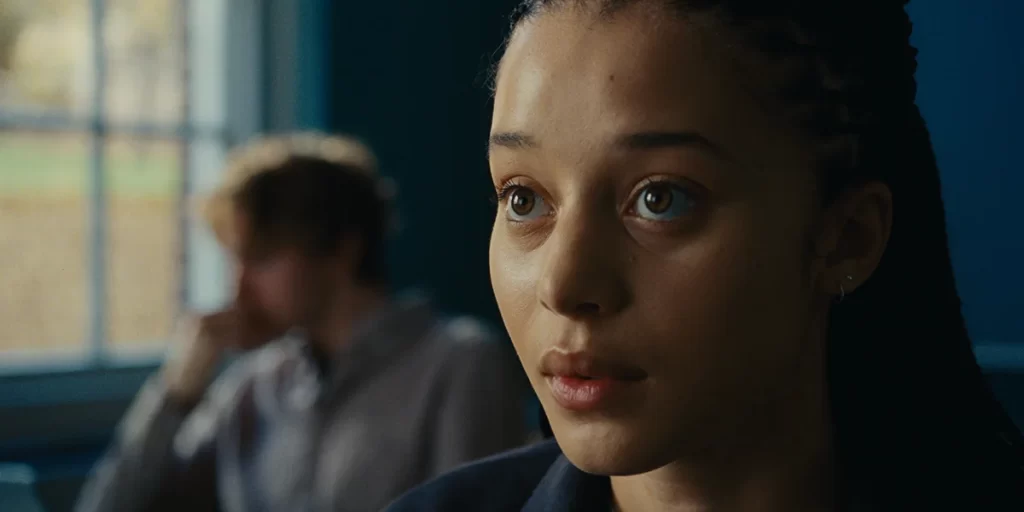
If it accomplishes nothing else, The Julia Set makes the case for Chase Infiniti’s ongoing movie stardom, proof positive that her work in One Battle wasn’t just a fluke of good casting in a great movie. She’s got immeasurable charisma and screen presence; her wide eyes and open face let you in on every fleeting thought. (Also, I hope whoever thought to cast Carmen Ejogo as her mom bought themselves a nice steak dinner to reward a job well done.)
It starts out well enough, with Infiniti as Julia, a freshman undergrad tapped by dreamy TA and soon-to-be boyfriend Pascal (Christopher Briney) for an elite math study group, prepping for the ultra-competitive Putnam Test under a terrifying professor (Nina Hoss, up to the task), with writer/director Niki Byrne pulling the Good Will Hunting trick of making math — or at least its surface — dramatic and cinematic. But as Byrne moves into the second act, a crucial structural issue reveals itself: he’s a much less compelling character (and actor) than she is, yet the script keeps focusing more of its attention on him, at her expense. The deeper it goes, the more insufferable he gets, becoming such a hambone slab of comic strip villainy that you half expect him to start twirling a mustache. Infiniti, again, is a movie star, and she’ll find a more appropriate vehicle soon enough.