Guy Davis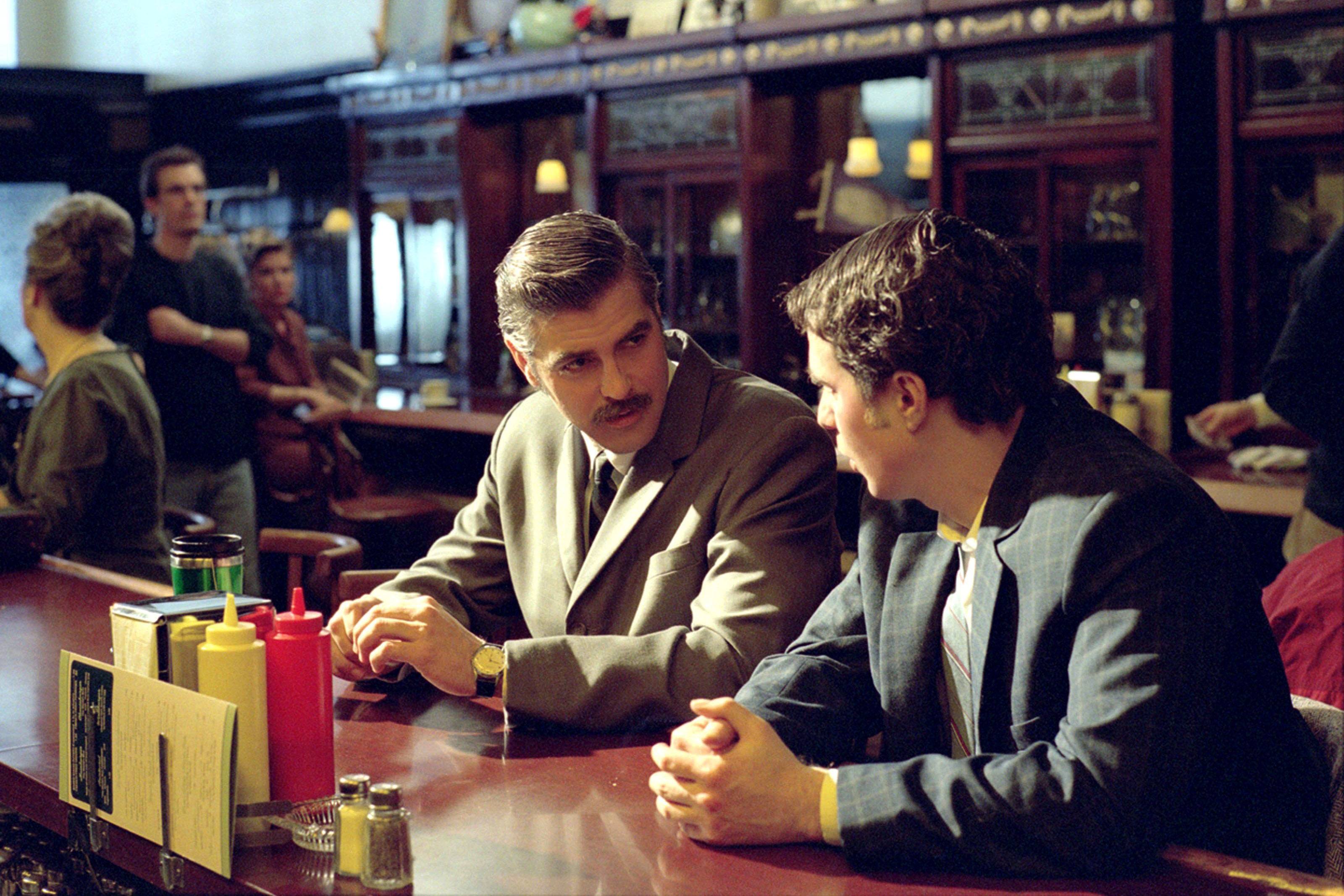
Even after he became a star, it took a minute for George Clooney to become George Clooney.
His first big-screen roles after his star-making performance as Dr. Doug Ross on the smash medical series ER (and a Rick Dalton-ish ‘80s of recurring roles, guest spots and B-movies) were smart choices on paper – a hotted-up neo-exploitation flick opposite Quentin Tarantino, a breezy rom-com, a bustling actioner and a big-budget superhero adventure are textbook opportunities to show off presence and versatility, after all.
He’s commanding in From Dusk Till Dawn, all snarl and swagger. There’s nothing wrong with One Fine Day and The Peacemaker, but they’re unmemorable. Batman & Robin…well, it’s memorable for all the wrong reasons – a gaudy monstrosity that swallows Clooney whole.
A course correction was in order, and fortunately it came by way of collaboration with intelligent, idiosyncratic filmmakers (even if in the case of David O. Russell, who directed Clooney in 1999’s Three Kings, the combination of elements was combustible) and perhaps a realization on the actor’s part that his substantial charisma and unforced, grown-up masculinity could prove to be a big-screen drawcard, provided he trusted the material, his colleagues…and himself.
By the early 2000s, with O Brother, Where Art Thou? a critical success (and Clooney seemingly confident enough to fully embrace and indeed revel in the role of an amiable, self-assured dimwit), The Perfect Storm a commercial hit, and Ocean’s Eleven a combo of the two, he’d divested himself of his small-screen tics and techniques (mostly – you get the odd head-tilt now and then) to become a bona fide leading man.
He had respectability, bankability and clout. What better way to use it than on two productions that basically screamed box-office poison?
Clooney actually has three onscreen credits in 2002. Welcome to Collinwood, a small-scale crime caper written and directed by brothers Anthony and Joe Russo (you know who they are), was produced by Section Eight, the company set up by Clooney and Steven Soderbergh, and one imagines the actor’s brief appearance as a wheelchair-bound safecracker was designed to help sweeten the deal for distributor Warner Bros.
Far more interest – or perhaps curiosity – surrounded Confessions of a Dangerous Mind, an adaptation of Gong Show creator-host Chuck Barris’s “unauthorised autobiography” vividly detailing the showbiz impresario’s unlikely sideline as a CIA contract killer, if only because Charlie Kaufman’s screenplay was a magnet for top-tier talent that failed to stay attached.
Clooney was one who stuck around, however – cast as Barris’s menacing, imperturbable handler Jim Byrd, he was linked to the production as early as 1997, when Curtis Hanson was in line to direct Sean Penn as Barris, and remained on board while the likes of P.J. Hogan, Mike Myers, Bryan Singer, and Johnny Depp came and went.
Recalling the heady combination of anything-goes nihilism that accompanies the end of one millennium and the anything-goes optimism that accompanies the beginning of another, one can understand why Confessions was such a hot property among creatives at the time. At the same time, it’s not hard to understand why financiers were reluctant to bankroll it, even for a relatively low sum – it’s positively redolent with self-loathing, sexual frustration, and personal and professional regret. Not exactly multiplex fare.
With one of the biggest stars in the world offering to direct for scale, and making use of his good relationship with other draws like Julia Roberts (cast as a cold-blooded femme fatale) to round out the supporting cast, however, a $30 million budget was scraped together and a green light finally achieved.
Clooney has directed seven movies since Confessions, and his 2005 follow-up Good Night, and Good Luck is widely regarded as his finest. But the brio and ambition he initially displayed as a filmmaker seems to have ebbed – he’s become a tasteful director of tepid movies that flash with energy, wit or conviction only occasionally. In Confessions, he’s throwing everything at the wall, as you might expect from a first-time filmmaker. But his aim more often than not is true.
The film is full of tributes and homages and flat-out thefts (the Confessions audio commentary Clooney recorded with cinematographer Newton Thomas Sigel is a litany of ‘70s classics), not to mention tricky camera set-ups and compositions – the majority of which were achieved practically, of which the director seems justifiably proud – but they feel seductive rather than show-offish, pulled off with the kind of panache where one admires the effect rather than applauding the effort. It does verge on overwhelming at times, that can’t be denied. But Clooney knows when to pull back and simply let the actors play to their strengths, or to the strengths of the material.
Scenes between Sam Rockwell, ideally cast as the impish, prickish Barris, and Drew Barrymore, just as good as the sweet, slightly dazed woman who loves him despite his chronic infidelity, are presented with subtlety and sensitivity, the manic, saturated intensity that accompanies the central character’s real and (presumably) fantasy life eschewed.
And Clooney’s own performance is, for mine, one of his finest. I don’t know if his underplaying stems from the exhaustion that would result from his double duty on both sides of the camera, but Byrd is a hypnotic figure, malevolent and mournful – a living, breathing cautionary tale for Barris who is also framed by the director as the devil on our protagonist’s shoulder, luring him into life as a trigger man.
The exhaustion of making Confessions definitely bled over into Clooney’s next project, however – one he actively pursued after one of the best actors in the world turned it down, and started making almost immediately after his previous project wrapped.
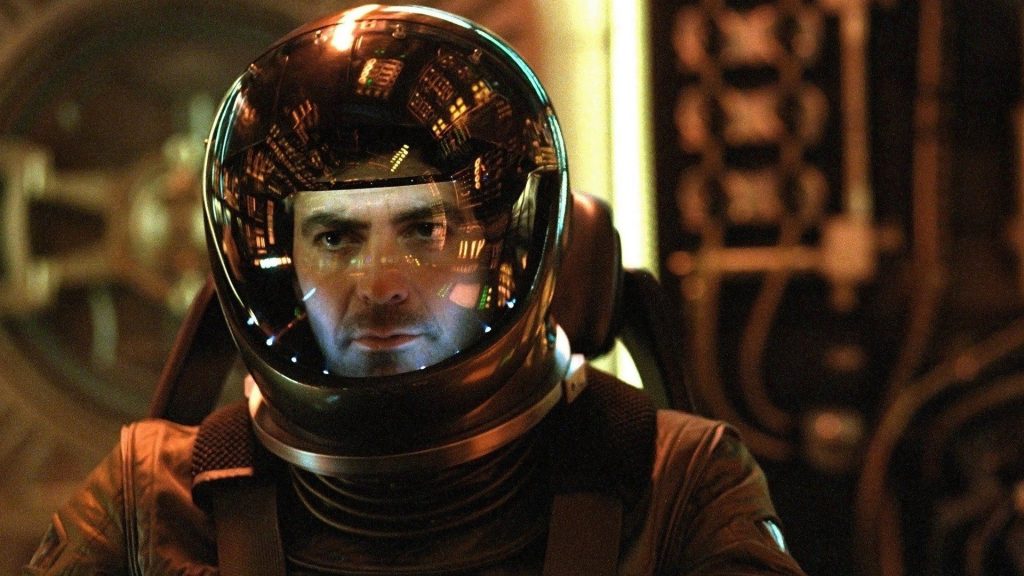
Daniel Day-Lewis was Steven Soderbergh’s first choice for the role of Chris Kelvin in Soderbergh’s adaptation of the Stanislaw Lem novel Solaris, already brought to the screen by Andrei Tarkovsky three decades earlier. When Day-Lewis claimed he “wasn’t in a working mode at that point”, in Soderbergh’s words, Clooney reached out via a letter to his friend and creative partner, expressing his interest in Kelvin, a clinical psychologist consumed by grief after the suicide of his wife, Rheya.
Dispatched to investigate strange phenomena experienced by the crew of a space station orbiting the planet Solaris, Kelvin discovers the planet draws from the crew’s memories to create replicas of the crew’s loved ones – he learns this when Rheya returns to him. Kelvin is withdrawn verging on morose when we first encounter him, and the reappearance of Rheya (played with heartbreaking vulnerability and unsettling stillness by Natascha McElhone) jolts him back to life – but in a confused and confronted way that poses a formidable acting challenge.
With the exception of a handful of tender scenes showing Kelvin and Rheya’s flirtation, courtship, and deepening love, Clooney is stripped of the charm and charisma that characterised his most popular performances and indeed made him a star. He’s instead required to convey bone-deep grief and regret as the ghost of his past is made manifest and he literally faces the consequences of his past actions.
Is he up to it? He is. The traditional Clooney persona works to the advantage of the performance; as producer James Cameron says on the audio commentary recorded with Soderbergh, viewers actively want Kelvin to regain the lightness of spirit shown during his happy times with Rheya. But there’s a raw, unpolished – almost unwieldy – openness to Clooney’s work, as there is to Kelvin’s pain.
He’d refine his expression of sadness, soul-weariness, bewilderment and acceptance over time, bringing that capability to characterizations in the likes of Michael Clayton and The Descendants that would broaden what audiences would come to expect from George Clooney. Solaris, however, was the first step on that path – it’s just one of the things that makes it such a valuable film.