Josh Bell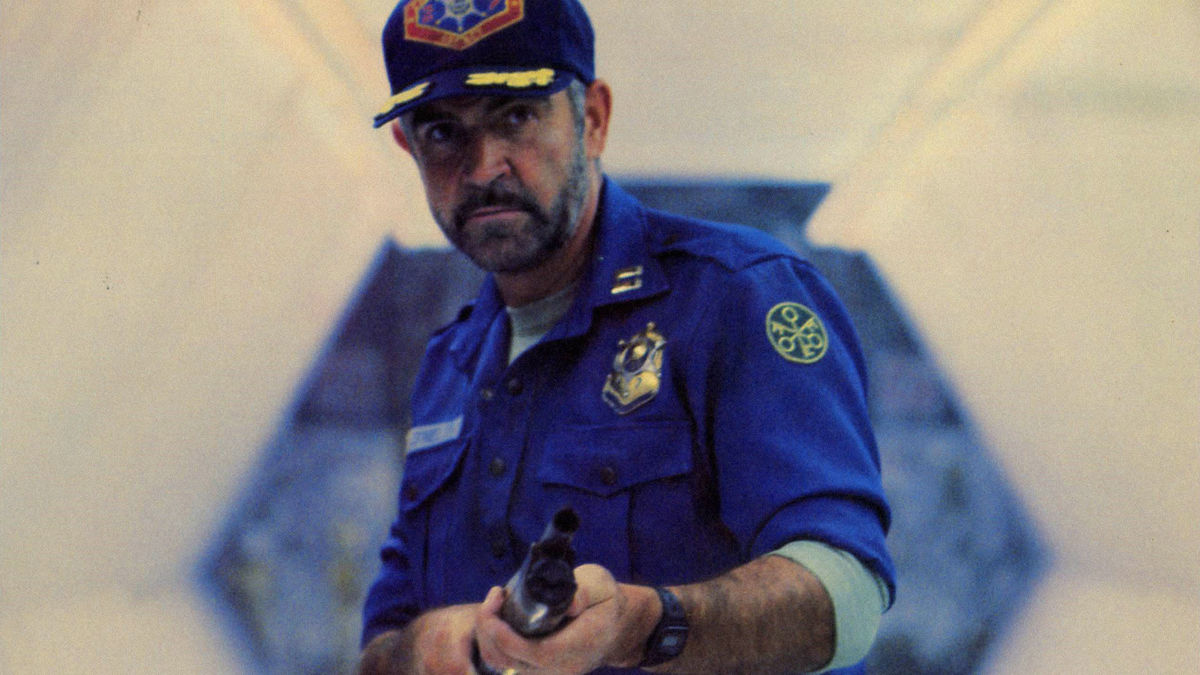
If Elon Musk or someone like him ever ends up actually colonizing Mars, it won’t just be a place for wealthy space tourists. It’ll require a whole cadre of engineers, maintenance workers, domestic attendants, and other low-level support staff who can keep such a complex and hazardous operation running. And there’s no way that billionaire industrialists like Musk will stop at providing human habitats and leave the raw materials of Mars or any other planet alone. Current companies are already racing to exploit the minerals found on the moon.
In that way, writer-director Peter Hyams’s 1981 sci-fi thriller Outland, released 45 years ago this week, is depressingly prescient. The wonder of space exploration is nowhere to be found in Hyams’s grimy, cynical film, which takes place at the rundown mining facility on Jupiter’s moon Io. Although he’s clearly influenced by the ramshackle aesthetic of 1979’s Alien, Hyams forgoes any depiction of alien life. The monster in Outland isn’t an extraterrestrial — it’s capitalism.
Intergalactic corporation Con-Amalgamated could be traded on a future stock exchange right alongside Weyland-Yutani, and life at the Con-Am outpost on Io is just as grim as the hardscrabble existence of Weyland-Yutani workers depicted decades later in the opening of Fede Alvarez’s Alien: Romulus. Outland begins with a pair of anonymous miners griping about management cutting corners and dismissing their concerns, while behind them one of their co-workers hallucinates spiders crawling all over his body, then kills himself by disconnecting his pressurized suit.
Newly arrived federal marshal William T. O’Niel (Sean Connery) is alarmed by this development, but everyone he talks to tells him that it’s just part of life on Io. Miners burn out and take their own lives, and the company simply jettisons their bodies into space and moves on. In his first staff meeting after arriving at the base, O’Niel gets a veiled but pointed warning from Con-Am’s general manager Mark Sheppard (Peter Boyle) to look the other way. After all, Io has broken Con-Am productivity records, and everyone is getting bonuses. What does it matter if some workers don’t live to appreciate them?
“If you’re looking for sterling character, you’re in the wrong place,” Dr. Marian Lazarus (Frances Sternhagen) tells O’Niel. No one has ended up on Io because things have gone well for them, and that includes O’Niel. His wife takes their son and departs on a shuttle one day while he’s working, leaving behind a Dear John video message that he plays over and over. Connery plays O’Niel as world-weary but honorable, and when he decides to stand up to Sheppard, it’s partially out of moral obligation, and partially because he wants to feel like he isn’t totally worthless.
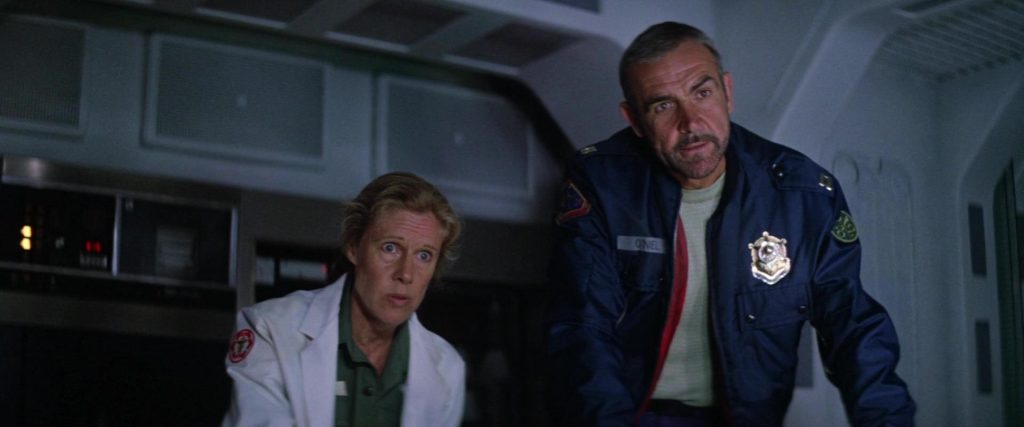
He shares that feeling with Lazarus, and Connery and Sternhagen have excellent chemistry as the two ostracized professionals, practicing compromised versions of their vocations on the outer reaches of the solar system. The plot of Outland is broadly modeled on Fred Zinnemann’s classic 1952 Western High Noon, reconfigured for the forthcoming greed-is-good era of the 1980s. When O’Niel first confronts Sheppard in his office, the manager is using one of those little golf putting machines that are the universal sign for “1980s corporate douchebag.” He’s unapologetic about bringing in drugs that increase worker output by 200 percent, but also turn a certain percentage of their users psychotic.
It’s no mistake that O’Niel’s rank is marshal, rather than something like captain or commander, and he embodies the futile nobility of many Western heroes, not just Gary Cooper’s outnumbered marshal in High Noon. Stopping the supply of drugs to Io won’t stop the overall drug trade among Con-Am facilities, and it certainly won’t reform the system that exploits desperate, addicted employees. Yet O’Niel goes to extreme lengths to bring the perpetrators to justice, at great risk to his personal safety.
Outland is part of a robust tradition of working-class sci-fi, from Alien to more recent films like Moon and Prospect, which highlight the drudgery and danger of life on the margins of space travel. The equipment on Io is rickety and dirty, and it rattles and shakes when people use it. There are no gleaming surfaces here, no sleek lines or whooshing portals. Connery may be incapable of looking anything less than dashing, but everyone around him is scruffy and craggy, with rumpled clothes that look like they could use a wash.
The visual style of Outland is often breathtaking, without losing that sense of neglect and disrepair. Using a combination of miniatures and front projection, Hyams immerses the audience in this harsh yet recognizable environment, and the practical effects in Outland hold up better than plenty of modern CGI. When O’Niel chases a suspect through long corridors and cramped communal quarters in a fantastically staged sequence, it has more weight and physicality because he’s traversing actual constructed spaces.
Hyams builds suspense as O’Niel moves inexorably toward a final confrontation with Sheppard and his associates, and Outland is as tense as any great Western, without losing sight of its sharp social commentary. Someone like Elon Musk might misread it as aspirational, but to anyone who has to work for a living, it’s an expertly crafted warning.
“Outland” is available for digital rental or purchase. It is also available on 4K UHD from Arrow Video.