Sara Batkie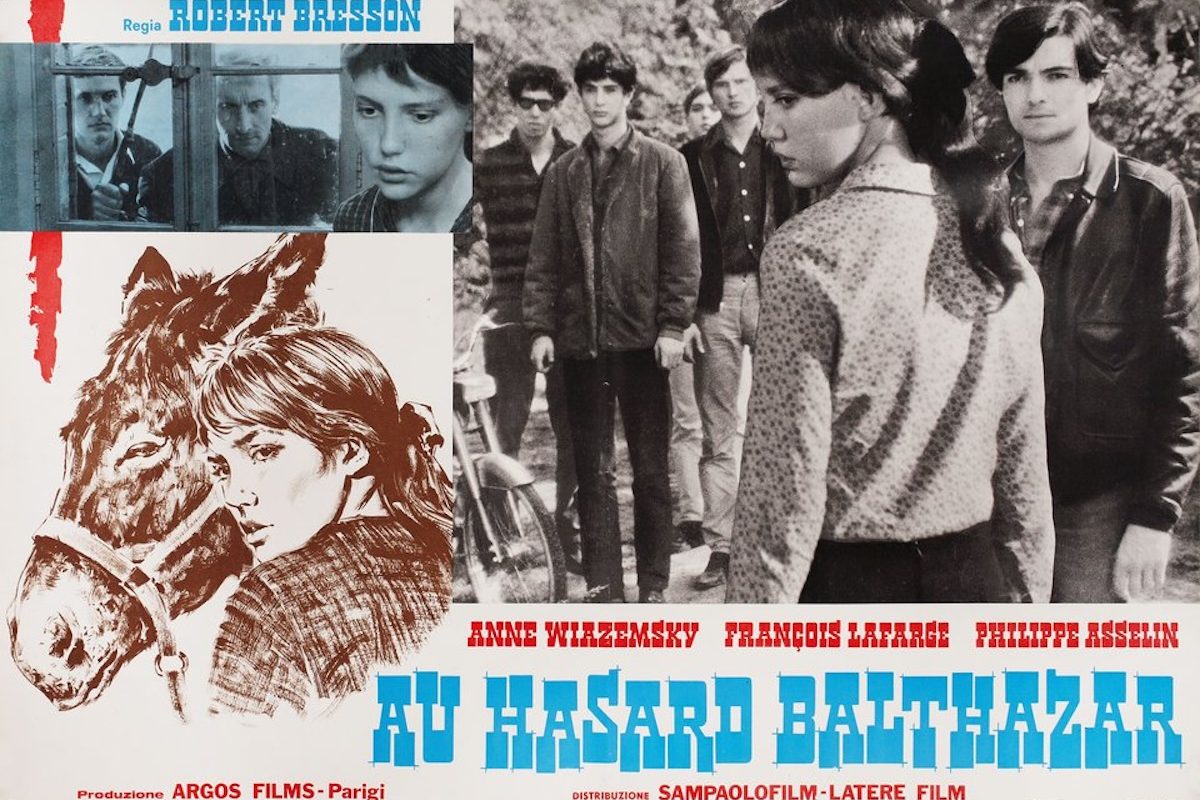
In Jean Luc-Godard’s (or D.W. Griffith’s, depending who you ask) famous formulation, all it takes to make a movie is a girl and a gun. His countryman Robert Bresson opted for another approach with 1966’s Au hasard Balthazar, which roughly translates to “Balthazar, at random.” All he needed for that film was a girl and a donkey (though he made his share with guns, too, including this one). Godard also claimed that Balthazar contained “the world in an hour and a half.” While things have changed considerably in the sixty years since it first premiered at the New York Film Festival, it’s difficult to disagree. It lasts about as long as a traditional Catholic mass but it might be the more transcendent experience.
The story is simple, as all fables are. Balthazar begins life like any other young creature: happily partaking of his mother’s milk. It’s mere moments of screen time, though, before he’s whisked away by a pair of farmer’s children who wish to keep him as a pet, a careless act that will come to define the rest of his existence. He is then shuffled through various owners, who treat him with everything from indifference to affection to intentional cruelty. He is whipped by a miller and exploited for a circus sideshow. He is also, in the words of one suffering character, “a saint”.
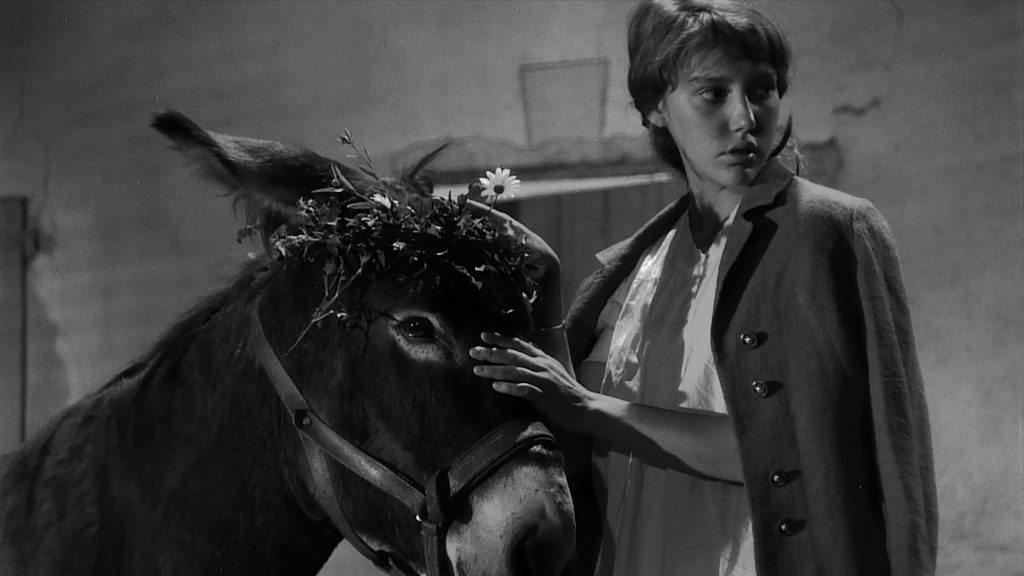
His experiences are mirrored, to a certain extent, by those of one of his most steadfast companions, Marie (Anne Wiazemsky in her debut role). If you’re inclined to read the film as an allegory for Jesus then her name provides some major evidence for doing so, as does the Pieta-like pose she often strikes with him. Marie lives with her schoolteacher father on an adjacent plot to the children who bring Balthazar home. Years later, the two are reunited, but their happiness won’t remain idyllic for long. Marie soon falls under the abusive influence of a local tough named Gérard (François Lafarge) at the same time that her father is sued over a land dispute. Soon the family will be destitute and Marie reduced to debasing herself in exchange for money or a little food.
Throughout all of this, Balthazar remains an impassive presence. As Roger Ebert points out in his Great Movies piece, Bresson is extremely careful to never give his audience what could be construed as a “reaction shot” from the donkey. This isn’t to say he isn’t given a defining set of traits. But he is not anthropomorphized in the way modern screen animals like Marley and Babe are, nor does he do anything that seems coaxed or even particularly scripted. Instead Balthazar absorbs the things that happen to him with a quietness that invites empathy but not necessarily understanding. Rather than coming to “know” him as a character, we come to recognize who people are by how they interact with him.
Bresson mentioned several sources of inspiration for Balthazar. One was Fyodor Dostoyevsky’s novel The Idiot, which similarly follows a guileless and simple character, albeit a human one, as he struggles to be understood by the world. Critics have long considered it to be one of Dostoyevsky’s most personal and spiritual works, a sentiment that has similarly been expressed about Bresson and Balthazar. Bresson was also influenced by the Jansenist movement, a theological belief system that emphasized the essentiality of divine grace and the limited function of free will in salvation. The Catholic church considered it heretical, but Bresson’s convictions are deeply moral and bolstered by his ascetic approach.
As with most of his work, Bresson casts Balthazar with nonprofessional or first-time actors. Their stilted delivery and often stiff body language evoke a different response than the methods of, say, Kubrick or Fincher, who were or are notorious for demanding excessive takes until the innate performativity of their famous faces is drained away. Instead we are left with something more pure and close to the skin, a realism that can feel borderline confrontational. As Ebert writes, “The actors portray lives without informing us how to feel about them… we often have stronger feelings than if the actors were feeling them for us.”
Not everyone reacted to Bresson’s demanding aesthetic favorably at the time. Notices out of the New York Film Festival were mixed; even Ingmar Bergman apparently found it “completely boring”. Godard was one of the film’s early supporters, and his enthusiasm proved prescient. Esteem has grown for Balthazar in the years since and it regularly makes the top twenty of Sight & Sound’s “Greatest FIlms” poll. Watching it now, at a time when engagements with faith at the multiplex can feel as cynically monetized as blockbuster fare, Balthazar is striking for its rigor and seriousness of purpose. It’s a timely reminder that how we treat our beasts of burden often reflects how we care (or don’t) for society’s most vulnerable. As the Bible verse quoted in the film insists, we are all “children of men” no matter how many legs we stand on.
“Au hasard Balthazar” is streaming on the Criterion Channel.