Sean Burns
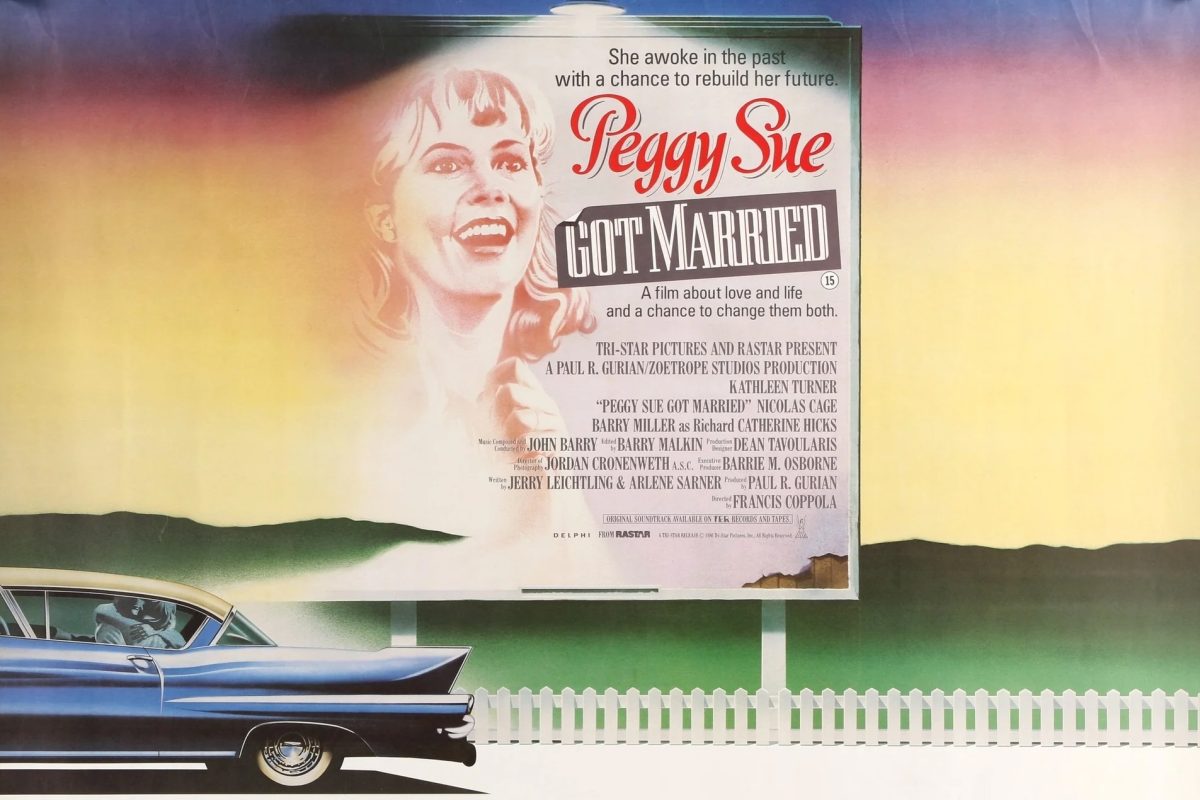
In their 1973 hit “Ooh La La,” The Faces sang, “I wish that I knew what I know now, when I was younger.” It’s a thought that occurs to most of us at least once a day, the daydream of correcting youthful follies with the wisdom of age. Heck, if Rod Stewart had any idea the song would endure the way it has, he probably never would’ve let Ron Wood sing lead on it. (Stewart even re-recorded his own solo version 25 years later, but it can’t compare to the original.) It’s a nice fantasy, but in reality our mistakes make us who we are, and most life lessons are only learned the hard way. Francis Ford Coppola’s funny and wistful Peggy Sue Got Married offers its middle-aged, soon-to-be divorced heroine a chance to go back to high school and do it all over again, only to discover that all the hindsight in the world can’t change who we love.
Kathleen Turner stars as the title character, suiting up for her 25th high school reunion while in the midst of a messy separation from her childhood sweetheart “Crazy” Charlie Bodell, who’s gone from prom king to “The Appliance King” with the lowest prices in town. He’s played by Nicolas Cage in a peacocking performance full of choices that proved, shall we say, controversial during the film’s production. (And to this day, depending on who you ask.) After reuniting with all of her old high school pals – including a coke-sniffing suburban dentist played by Jim Carrey – Peggy Sue catches sight of her soon-to-be ex-husband swaggering into the school gymnasium. She promptly passes out and wakes up back in 1960.
Peggy Sue still looks like Kathleen Turner, but everyone treats her like a teenager. She’s suddenly back in her old family house chafing under curfew rules and trying unsuccessfully not to laugh when her dad comes home beaming with pride over his new car… and it’s an Edsel. The screenplay by Jerry Leichtling and Arlene Sarner indulges in a couple of time travel jokes like this that play on our knowledge of things to come, but Eisenhower-era culture-clash material had already been mined pretty exhaustively by the previous summer’s Back to the Future. The comedy here comes more from moments like middle-aged Peggy Sue belatedly remembering that it’s not okay for a teenage girl to come home after a hard day and pour herself a stiff drink.
Besides, Coppola couldn’t be less interested in the mechanics of time travel. He and cinematographer Jordan Cronenweth shoot the past through a hazy mist of memory, with beautifully precise edge-lighting giving everyone a glimmering halo. Since most of the actors are pulling double duty as both teenage and forty-something versions of the characters, Coppola split the difference and cast mainly actors in their early 30s – Turner was 32 during shooting – but directed them to be extra exuberant and emotional when playing their younger selves. (One exception is Peggy Sue’s eye-rolling kid sister, played by the filmmaker’s 15-year-old daughter Sofia, who would go on to direct Turner in The Virgin Suicides.)
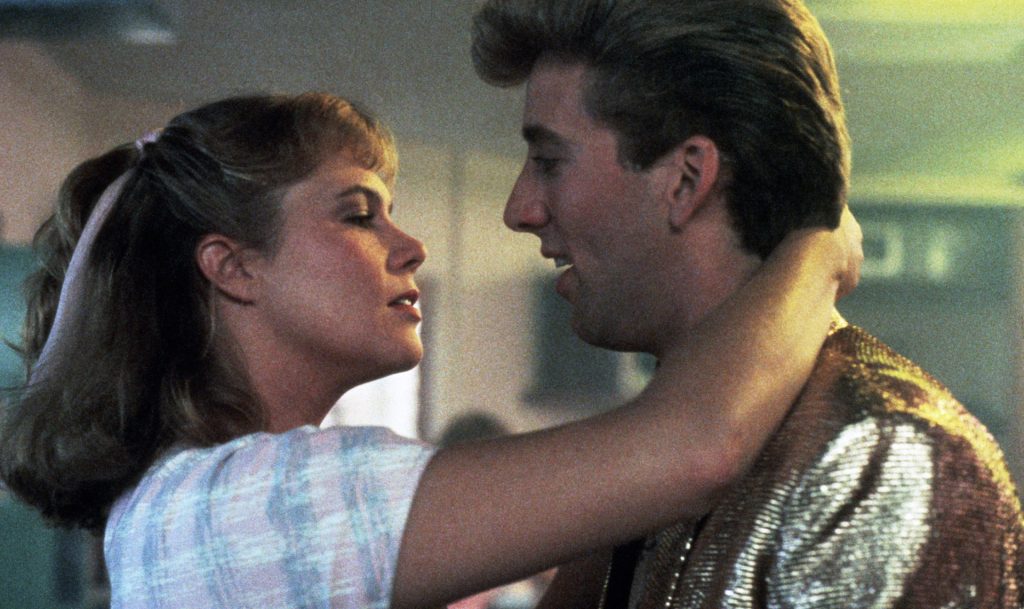
John Barry’s achingly lovely score is poured generously over the proceedings, and even the silliest scenes are suffused with a melancholy longing. There’s a feeling of loss in this movie that’s tough to shake. Coppola has said he was shooting for something akin to Our Town, and Roger Ebert wrote that the movie felt like “visiting a cemetery where all of the people are still alive.” Determined to do things right this time around, Peggy Sue goes for a motorcycle ride with the class beatnik (Kevin J. O’Connor) and seeks counsel about her metaphysical quandary from the school’s ostracized nerd, who only she knows will grow up to be a billionaire. (He’s played by Barry Miller, the doomed Saturday Night Fever sidekick whose girlfriend liked the taste of communion wafers.)
Yet Peggy Sue can’t seem to pull herself away from Charlie, notoriously played by Cage as a pompadoured tsunami of hormones and adolescent anxiety. Much to his leading lady’s horror, the actor based Charlie’s voice on that of Gumby’s pal Pokey and wears an oversized dental prosthetic throughout the picture. It’s one of Cage’s great gonzo turns, exhaling his lines in an adenoidal whine – my friends and I spent the next few years imitating the way he says “my whaaang” – yet I would argue that the overwhelming and ultimately endearing oddness of the portrayal externalizes the middle-aged Peggy Sue’s initial repulsion and ultimate surrender to the man she was destined to spend her life with, for better and worse. Charlie grows on us, and since few actors fall more convincingly in love than Nicolas Cage, we can see how his ardor wins her over, time and again.
This was not an opinion shared by the studio, and Tri-Star studio head Ray Stark wanted to personally fire Cage himself until Coppola intervened. (Probably not a good idea to try and whack the Don’s nephew, though it saddens me to note that Cage and his Uncle Francis never worked together again.) Turner still has plenty to say about the shoot — most of it hilarious — and was successfully sued by Cage for libel after claiming in her memoir Send Yourself Roses that he’d been arrested for drunkenly stealing someone’s chihuahua. The allegation was excerpted in a Daily Mail piece, amusingly titled “Why I Detest Burt Reynolds and Nicolas Cage by Kathleen Turner,” and the actress was forced to publicly apologize, as well as make “a substantial donation” to the National Adult Protective Services Foundation, a charity for victims of elder abuse.
Given the similarity of their loglines, Peggy Sue Got Married couldn’t help but be overshadowed by Back to the Future, the previous year’s biggest box office blockbuster. While I don’t think anyone would argue that Coppola’s is a more entertaining movie than Robert Zemeckis’ clockwork crowd-pleaser, it’s nonetheless wiser and more mature. In one film a trip back in time helps a character solve all his problems, while in the other it helps Peggy Sue learn how to live with hers.
“Peggy Sue Got Married” is streaming on Tubi.