Zach Vasquez
It’s fitting that Christopher Nolan’s new blockbuster version of The Odyssey should find itself the latest battleground for our inexhaustible culture wars. While not quite on the level of the mythic Trojan War that inspired Homer’s epic poem, these seemingly never-ending squabbles over onscreen historical accuracy, racial representation, and political ideology have grown increasingly virulent and deranged.
They’re also mostly made in bad faith, as none of the people pushing outrage towards Nolan’s film had actually seen it prior to release. Not that that matters: one of the funnier twists of this whole saga is the vaunting, amongst right-wingers, of Troy, Wolfgang Petersen’s thoroughly mediocre Iliad adaptation from 2004 as a counterexample.
What makes all of this even more pathetic is that, if The Odyssey’s detractors were serious in their demands for a more verisimilitudinous movie about the Trojan War and its aftermath, there is a far better example than Troy sitting right there for them: 1971’s The Trojan Women.
Adapted from Euripides’s tragic drama (written and performed circa 415 BCE), The Trojan Women takes place the morning after the Sack of Troy. The city’s men have all been slain, its children abducted, leaving only a throng of bereft, traumatized royal women behind. They are led by Hecuba (Katherine Hepburn), queen of the city, whose husband Priam and sons Hector and Paris have all perished.
Over the course of the drama that unfolds, she reunites with her daughter Cassandra (Geneviève Bujold); daughters-in-law Andromanche (Vanessa Redgrave) and Helen (Irene Papas), and her young grandson Astyanax (Alberto Sanz), all of whom come to learn their terrible fates via the Greek herald Talthybius (Brian Blessed): some will become slaves, others concubines (which is just sexual slavery), and others still will be killed.
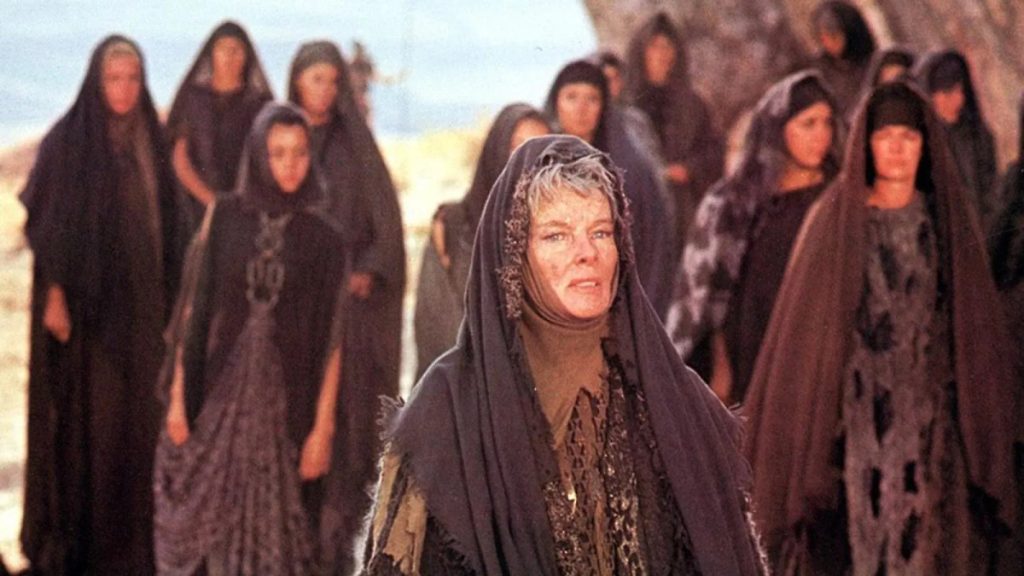
Helmed by Greco-British filmmaker and stage director Michael Cacoyannis, The Trojan Women is the type of austere, entirely sincere classical drama that we simply do not get anymore. A mostly direct adaptation of classicist Edith Hamilton’s 1937 translation—like Troy, this film jettisons the appearance of the Gods from the original text, keeping its focus entirely mortal—it is set outside of the smoking ruins of Troy, on the hardscrabble hillsides overlooking the Aegean Sea. Hecuba, along with the chorus of women that follow her everywhere, are clad in black robes, so that they appear as walking spirits rather than living beings. Unlike Cacoyannis’s black-and-white 1962 adaptation of another of Euripides’ tragedies Electra (with Papas in the title role), this film is ostensibly in color, even as the desolation of its setting and costuming renders everything ashen gray. There is no mistaking the intent: this is a post-apocalyptic horror story.
In contrast to the muted and constrained visuals—the open landscape (the Spanish village of Atienza stands in for Troy) keeps things from feeling too stagey, even as it holds the action to a small radius—the performances are combustible. Hepburn, discarding as best she can her famous Mid-Atlantic accent and leaning into her age, is a coiled fuse burning down to its last embers; she clings to her fury even as she fades into cold acquiescence. Redgrave, proud and handsome, puts on a brave face until she is told her child must die (on the orders of the unseen Odysseus, whose evil presence haunts the story), at which point she flies into hysterics before going catatonic. Papas plays Helen as a sneering, haughty manipulator, her physical beauty merely one facet of her masterful survival instincts. Bujold, meanwhile, young and unbelievably beautiful, steals the picture with her spasmodic performance, one befitting of the shaman she portrays. More than anything, her turn reminded me of Isabelle Adjani in Andrzej Zulawski’s Possession (in fact, there are lots of stylistic similarities between this and another of Zulawski’s titles, the mythopoetic sci-fi epic On the Silver Globe). Giving some love over to the film’s male contingency, Blessed is at his swarthy, robust best here, mixing angry bravado with moral turmoil.
The Trojan Women was a return to form for Cacoyannis following his critical and commercial flop of four years earlier, the nuclear armageddon comedy The Day the Fish Came Out. Before that, he’d been riding high thanks to the success of first Electra, which was nominated for a Best Foreign Film Oscar, and then his adaptation of Nikos Kazantzakis’s tragicomic novel Zorba the Greek (1964), which earned six Academy Awards (including Best Picture and Best Director) and won three (for costuming, cinematography, and art direction).
Which isn’t to say The Trojan Women was a by-the-numbers project for him. Cacoyannis—who’d staged the play throughout the preceding decade in Italy, Paris, and New York—felt a deep resonance with the message of the text, which was written by Euripides while his home state of Athens was engaged in the Peloponnesian War. Speaking to The New York Times, Cacoyannis described The Trojan Woman as “an anti-war play and an angry one. It’s a cry from the heart, a torment. And as Euripides shows, it is the victors who lose.” Indeed, he even ends his film with this scroll of text: “We who have made this film dedicate it to all those who fearlessly oppose the oppression of man by man.”

Earlier, I wrote that The Trojan Women is a post-apocalyptic tale, which is true. But even more than that, it is the story of a genocide, one that deals specifically with the war crimes inflicted by men upon women and children. No doubt that Cacoyannis was thinking of the various wars and conflicts of his day—World War II and the Greek Civil War were only a few decades behind him, while Vietnam was currently raging—but it’s impossible to watch the film in 2026 without thinking of Palestine, particularly the atrocities committed against its youngest, most vulnerable citizens. (Interestingly, Cacoyannis’s partner in the years directly preceding The Trojan Women was Israeli writer, soldier, and future politician Yael Dayan).
Which brings us back to modern day. It is interesting, though hardly surprising given their lack of curiosity and knowledge, that the reactionaries so ferociously opposed to Nolan’s intentionally modern (if not modernized) version of The Odyssey haven’t discovered and proselytized The Trojan Women, considering it is, on paper, exactly what they’ve been clamoring for: a traditionally classic and faithful adaptation of a related work of antiquity made by an actual Greek person. Granted, the cast is international—Papas is Greek, yes, but Hepburn is American, Redgrave and Blessed are British, and Bujold is French—but hey, they’re all white, which is the only thing these chuds care about (see: blonde-haired Missouri boy Brad Pitt as Achilles in their beloved Troy).
Of course, for them to hold up The Trojan Women as a counterexample would require them to actually watch the movie. Besides the fact that these so-called classicists have zero interest in classic cinema, if they did do that, they would find not a vainglorious celebration of masculine heroics, but a ferocious denouncement of it. Never mind that it comes straight from the source, the same of which is true of the other great works of Greek antiquity, The Odyssey included—all of which criticize the mercilessness of Grecian militarism and the human cost of battlefield glory.
But for those who do get the Ilion itch in the wake of all this Odyssey fever, The Trojan Women makes for a heady and hypnotic, if brutally bitter, chaser.
“The Trojan Women” is streaming on Kanopy.