Kayleigh Donaldson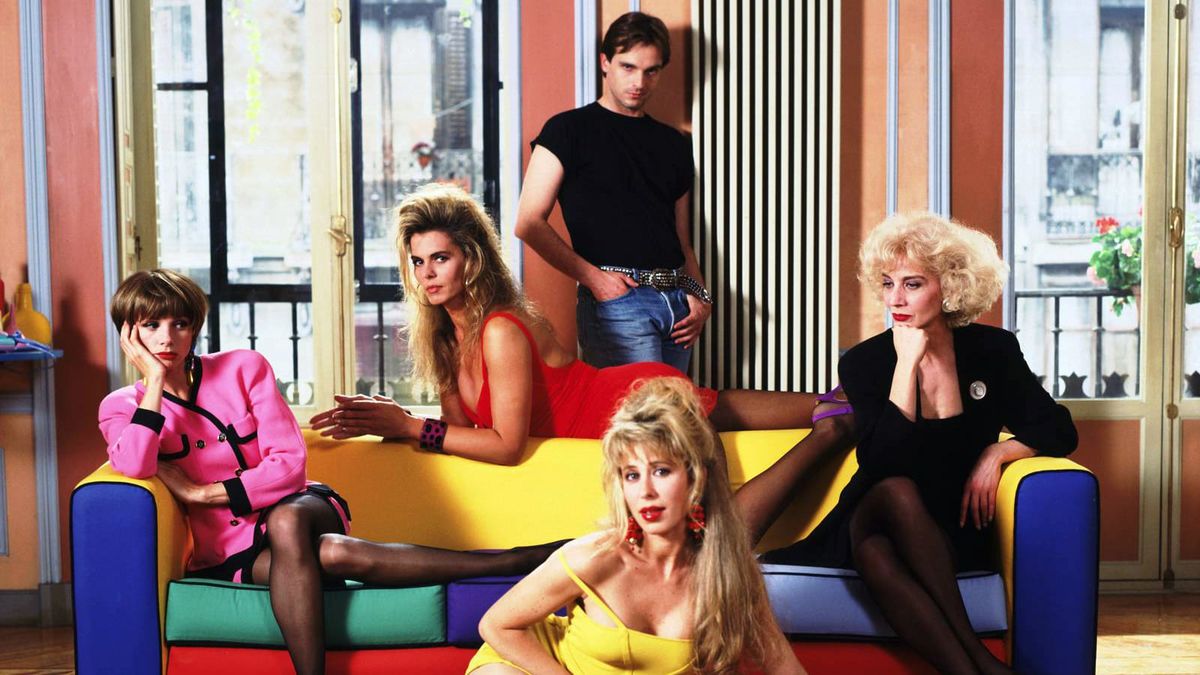
Pedro Almodóvar has made no secret of his love of golden age Hollywood melodrama. He has frequently taken inspiration from the women’s pictures of George Cukor and the dominant performances of the likes of Joan Crawford and Barbara Stanwyck, typically blended with a more candid and transgressive scope. If Stella Dallas, Imitation of Life, and Mildred Pierce were their era’s responses to contemporary social fears, Almodóvar’s queer remixes are the brazen updates that don’t have to worry about production codes. While most of his films contain at least some influence from classic melodrama, 1991’s High Heels (or Tacones Lejanos in Spanish) might be his most direct reimagining of the genre.
Rebecca (Victoria Abril) is a newsreader who forever lives in the shadow of her mother, the legendary singer Becky del Paramo (Marisa Parades.) Their relationship is awkward, a semi-estranged bond exacerbated by Becky’s choice to commit to her career over parenthood, and Rebeca marrying Manuel (Feodor Atkine), her boss and Becky’s former lover. Rebeca gets on far better with Femme Letal, a drag performer who impersonates her mother. Just ignore the Freudian damage they inspire. And that’s before we get to the murder.
Mildred Pierce’s fingerprints are all over High Heels. Both films are stories of fraught mother-daughter relationships exacerbated by ill-suited lovers, familial guilt, and death; the second half of Almodovar’s melodrama is explicit in its parallels with Joan Crawford’s magnum opus. It also makes a direct connection to Ingmar Bergman’s Autumn Sonata, another mother-daughter drama, which Rebeca compares to her and Becky’s situation. It’s a risky move to reference so many masterpieces in your own deliberately messy homage, especially when you’re not on your A-Game yourself. Certainly, High Heels is decidedly mid-tier Almodóvar, a step below his most potent and tightly plotted takes on melodrama through his transgressive lens. But even a minor effort from a master can provide insight.
Through the women’s pictures he so loves, Almodóvar explores the performativity of gender. Becky is an obsessed-over torch singer (the mere notion of which could only have come from an Almodóvar film) who performs lavish odes to lost loves of yore. Femme Letal, the drag artist who performs exclusively as Becky, is complimented by her for their method-like commitment to replicating the real thing. That makes things all the more awkward when Rebeca goes backstage to help Letal undress and the pair have unexpectedly acrobatic sex. Another layer is added when Letal’s identity is revealed.
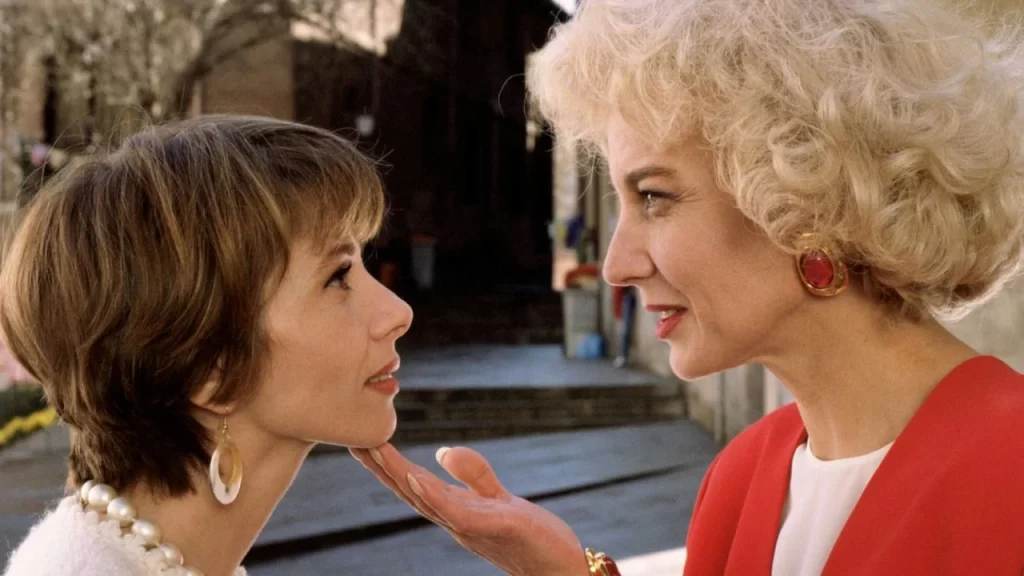
As High Heels turns into a murder mystery, the authorities turn up to investigate, and the magistrate, Judge Domínguez, is clearly Letal in a shoddy-looking fake beard. Perhaps the reveal was more of a surprise to audiences in pre-high-definition viewings, but it feels so obvious from the get-go on modern viewings that every character’s cluelessness reads as a big joke. The “Hugo” performance, of an authoritative man working overtime to crack the case, feels far less lived-in and fleshed-out than the “Letal” one (and the make-up’s way better too.) The irrationality of this set-up is the point, even if the suspension of disbelief from character and viewer alike can be tough to maintain. What holds it all together is Almodóvar’s strident rejection of irony. His films reject the opportunity to puncture their own ludicrousness or let the audience get ahead of the joke. You laugh with the characters, not at them or their Sirk-esque troubles. The viewer must embrace the madness as eagerly as the director does and on his terms.
While High Heels is obviously a melodrama with big soap opera moments (including an unexpected musical set-piece in a women’s prison that feels like a lesbian homage to Elvis’s Jailhouse Rock), it’s also more melancholy in tone than, say, the frenetic Women on the Verge of a Nervous Breakdown. Becky and Rebeca’s relationship is full of love but spiked with malaise and the undeniable bitterness of a scorned daughter who felt she came second to adoring fans and album sales. While the Letal/Hugo subplot is one of impish amusement, the mother-daughter relationship is played as seriously as anything in the films it was inspired by, full of the contradictions and love/hate push-pull fury that defined the women’s picture for a generation.
For as campy as much of the film is–it’s still Almodóvar, after all–High Heels sees the director on the precipice of his “prestige” era. While it is an erratic effort on its own, as a transitional title in the director’s canon, it’s pivotal, a stepping stone between his punky arthouse years and eventual status as an institution of Spanish cinema. Throughout it all, his influences and fascination with women remain at the forefront. The surrounding drama might be outlandish, but the relationship at its core is intense in its realism. Like Becky’s most beloved performances, it’s a torch song to a lost love, one of parental bonds gone astray.
“High Heels” is available for digital rental or purchase.