Jason Bailey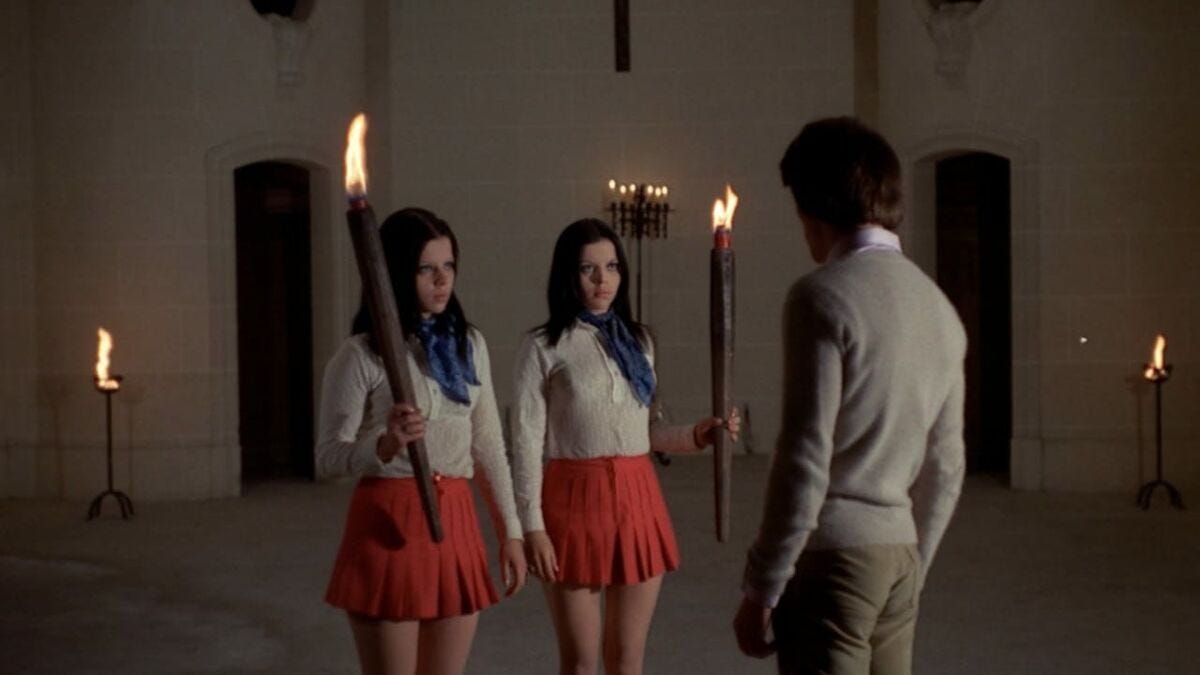
Jean Rollin’s films open up a door into a rich, unusual fantasy life stocked with female vampires, ancient castles and mysterious transformations. When he began working in the late ‘60s, France didn’t have much of a contemporary horror tradition. Although Mario Bava and Jess Franco were his peers, his work is grounded in places that meant something to him. Via jump cuts, his characters suddenly appear, as if by magic, at a beach in the town of Diebe. Rather than shooting in the streets of Paris, he headed to the countryside, where history and its hierarchies remained visible. His characters might as well have been abandoned in a forest. Rarely explicitly political, his low-budget films still come across as the work of an outsider. His career didn’t come easily. Unable to get financing for more horror films, he turned to hardcore porn in 1973 to earn a living.
Requiem for a Vampire, The Nude Vampire, The Shiver of the Vampires, Fascination, Lips Of Blood, The Grapes of Death and The Living Dead Girl, all streaming on Shudder, are disreputable and pulpy yet quiet and poetic. They defy the boundaries that are supposed to keep these qualities distinct. While not far removed from Jacques Rivette, they’re infused with a throbbing libido, obsessed with bi female vampires. Although his direction often exemplifies the male gaze, these films’ interest in women goes well beyond sex. Men rarely lie at their heart. If they sometimes leer at queer women, they refuse moralistic binaries, even when these women commit violence. Rollin always held a dimension of empathy for people seen as monstrous.
His first feature, Le viol du vampire, was released in the midst of France’s student uprising of May 1968, which prevented it from finding an audience. This rebellion forms the background of The Nude Vampire. Made in 1970, it serves up a story of generational revolt. Pierre Radamante (Olivier Rollin), a wealthy young man, discovers that his father (poet and avant-garde filmmaker Maurice Lemaitre) hosts secret parties in which women are kidnapped. Sneaking into one, he witnesses an odd spectacle, as a woman shoots herself in the head. His father has created a suicide cult to exploit the potential immortality of vampires and utilize it himself. The Nude Vampire works as a precursor to other films about the dangerous behavior of the ultra-wealthy, like Eyes Wide Shut and Martyrs, even as it looks back to the mysterious organizations of Louis Feuillade’s silent serials.
Among all the intrigue, it works best as an evocation of loneliness. Rollin frames long shots in an enormous, mostly empty castle. People are dwarfed by their surroundings. Two men speak about key plot points as they wander to the edge of the screen. The Nude Vampire establishes the isolation of being Othered; rather than being a dangerous beast to be feared, its captive woman has been exploited. The final line of dialogue is a manifesto of rebellion against such conditions.
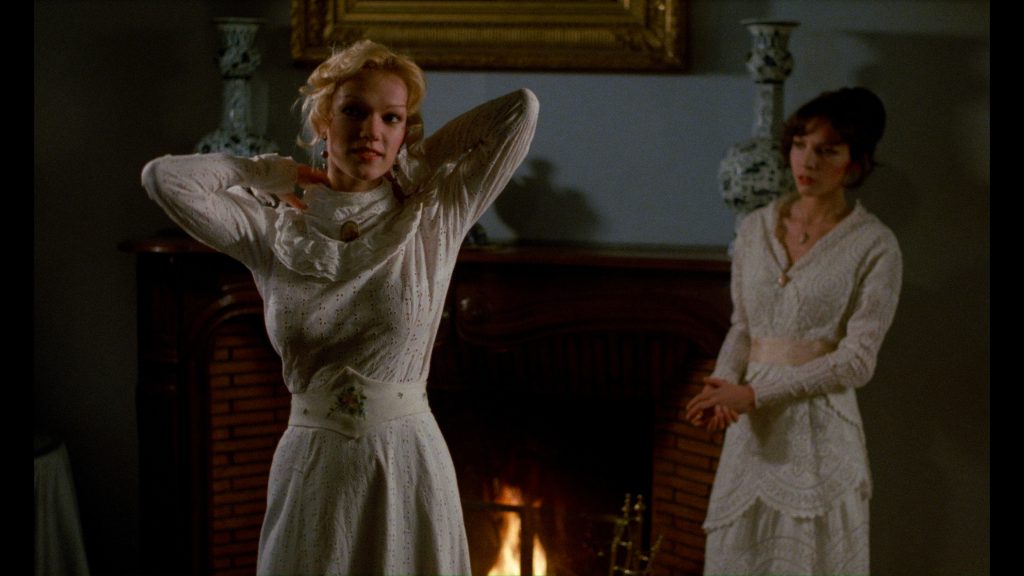
The countercultural air of Shiver Of The Vampires, made in 1971, is more calculated. The director set out to capture the spirit of the moment; all but one of the male characters sports long hair, while Acanthus composed and performed a Pink Floyd-influenced rock score. Rollin’s direction picks up ideas from both the Americana avant-garde and Nouvelle Vague, as he disregards the 180-degree eyeline rule and narrative logic, bypassing continuity. The supernatural becomes an excuse for experimentation, exuding a delight in the stylistic tools at his disposal. The sets glow under blazing red lights, making vampiric lust visible. Exteriors cloud over with fog, as wind and distant animals howl. Untethered from prior horror traditions, it plays more as a stoned reverie on the vampire mythos.
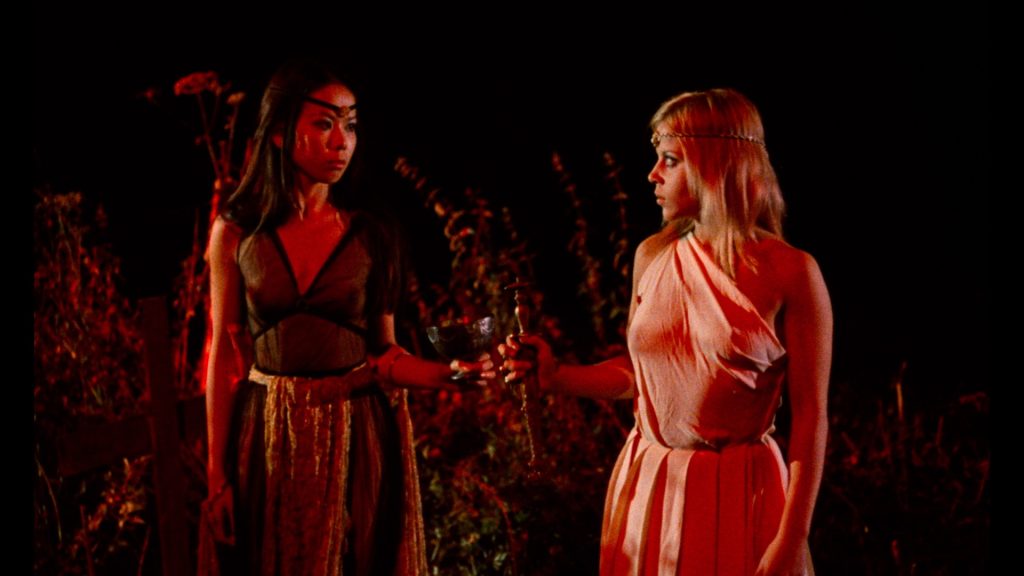
After their wedding, Isle (Sandra Julien) and Antoine (Jean-Marie Durand) head to a castle to spend their honeymoon with relatives. After being informed of the deaths of their cousins, Isle feels exhausted with grief, so she decides to sleep alone. Isobel emerges from a grandfather clock and seduces her. As Isle gives in to her new desires, Antoine seeks to save her. The cousins turn out to be alive, but they’ve turned from vampire hunters to the undead.
Anyone expecting tonal consistency from Shiver Of The Vampires will be sorely disappointed. As Vampire #1 and 2, Michel Delahaye and Jacques Robiolles give campy, mannered performances. (Their characters seem coded as a couple.) They speak to the camera during 360-degreee pans as it swirls around them. Isobel carries herself as though she were the queen of Carnaby Street or the Haight-Ashbury. Despite implications of sexual assault, the vampires promise a freer world for Isle than the one she’s entered through marriage. They view themselves as rebels, guarding a pagan faith that they’ve protected against Christianity since the Middle Ages. Although Isle wouldn’t have chosen to become a vampire herself, her new life offers the possibility of escaping heterosexual life and living as a queer woman.
Moving to 1979, Fascination establishes a hypnotic atmosphere from its very first shot: a pan downwards from a painting towards burning candles and a bound book. Without any narrative context, these images alone take on an air of European aristocracy and a ritual about to take place. With a swift cut, the mood changes completely, moving to a slaughterhouse. Marc (Jean-Marc Lemaire), a thief, hides out in a chateau owned by two rich women, Eva (Brigitte Lahaie) and Elizabeth (Franca Mai). Having double-crossed a group of crooks, he kidnaps a woman belonging to them. Eva and Elizabeth act flirtatiously, despite his expectation that they should fear him.
Turning towards softcore erotica (and the casting of adult film star Lahaie), Fascination reflects Rollin’s work in porn. Despite appearances, its women are never in real danger. In fact, they’re the ones who carry out sexualized violence —one stabs a man during sex, her knife protruding from his stomach as he moans. If they’re not treated as heroes, Mark is viewed less sympathetically.
Watching several Rollin films in close succession reveals their return to the same stock of images. The beach’s constant reappearance turns into his equivalent of Proust’s madeleine. Despite its quota of nudity and violence, his work is gentler than Bava and Argento’s.
Although Rollin never quite established a place in the French film industry, after the early ‘80s, he became even more marginal. Perhaps this status has contributed to his long-term reputation. Against a far more respectable horror landscape in 2026, he stands out by doggedly pursuing his vision with no regard for careerism or fitting in. These films still look as delightfully odd and unique as when they premiered.