Sean Burns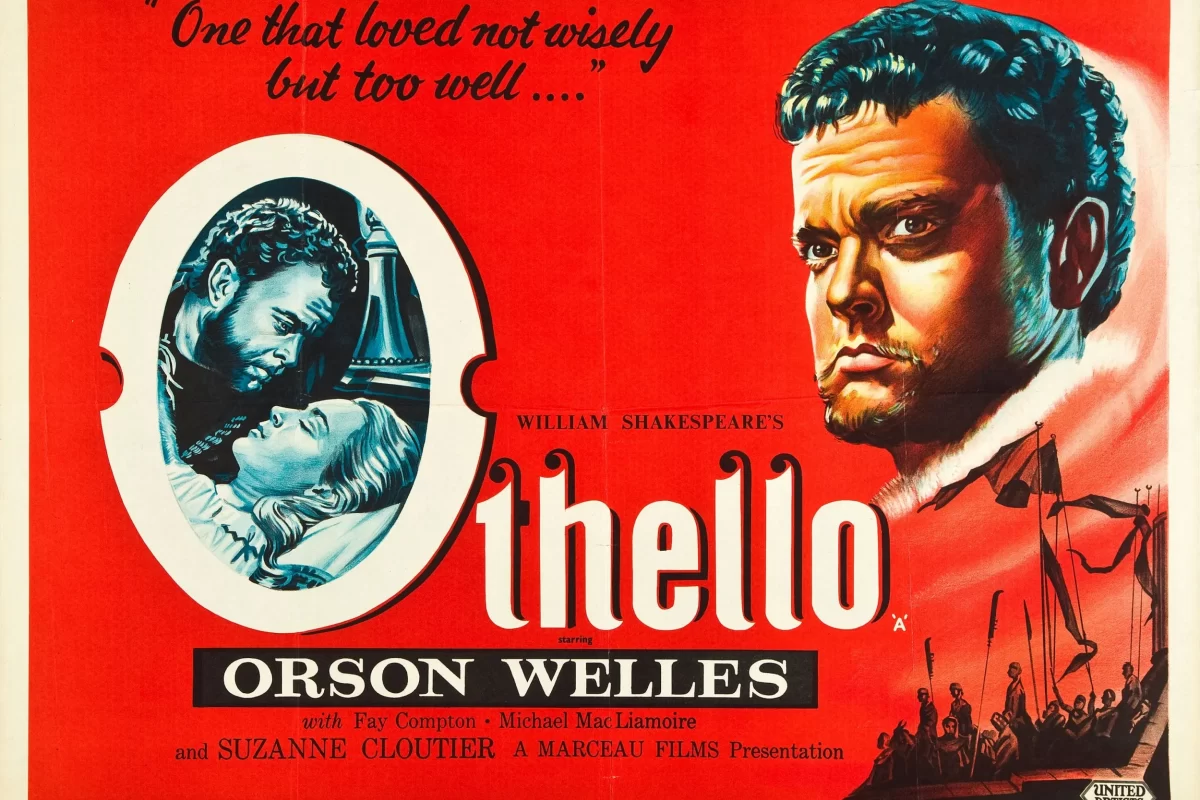
One of the most chaotic productions in cinema history — even by the standards of Orson Welles movies — the auteur’s adaptation of William Shakespeare’s Othello was filmed over the course of three years in multiple countries, with shooting stopping and starting again in new locales depending on how much money the director could rustle up from foreign financiers and assorted acting gigs to keep the cameras rolling.
The picture’s pedigree was so scattered around the globe that it was the first film selected for the Cannes Film Festival without an official country designation, eventually settling on Morocco out of both convenience and something of an inside joke. (Welles was playing the Moor of Venice, after all.) The filmmaker learned early that Othello had won the Grand Prize when someone from the festival approached him asking what Morocco’s national anthem was so that, as per tradition, the orchestra could play it at the awards ceremony. Welles confessed that he hadn’t the slightest idea, so they settled on a vaguely Middle Eastern-sounding operetta and nobody seemed to notice.
It’s a dazzling, patchwork quilt of a movie, with scenes stitched together from snippets shot on separate continents, spanning years sometimes between the filming of line and its retort. Previous Welles triumphs like Citizen Kane and The Magnificent Ambersons were renowned for their fluidly theatrical long takes, in which the actors and the camera were elegantly choreographed so that characters stepped in and out of their closeups. Kane was comprised of something like 560 individual shots, and Ambersons around 300. Othello has more than 2,000. The original idea had been to shoot entire scenes in those flowing, continuous takes, but after one of the backers went bankrupt a few days into shooting — stranding the cast and crew on location — Welles was forced to improvise.
His quick fixes and ingenious solutions are the stuff of cinema legend, with old theatre tricks and slight-of-hand coming into play. When elaborate costumes that the producers couldn’t pay for never arrived, Welles moved the murder of Roderigo to a Turkish bath, so they all could just be wearing towels. The scene wasn’t shot in a bathhouse, either, but rather a fish market that the production filled with “steam” by burning a whole lot of incense. Sentries seen from a distance wore armor made from hammered out sardine cans, and after a mink-lined coat that Welles wore while acting in the 1950 film The Black Rose went missing, costume designers later spotted him wearing it turned inside-out in Othello. The movie’s Iago, Micheál MacLiammóir, wrote a hilarious memoir of the shoot called Put Money in Thy Purse, and the delightful 1979 documentary Filming Othello finds him reminiscing with Welles and co-star Hilton Edwards.
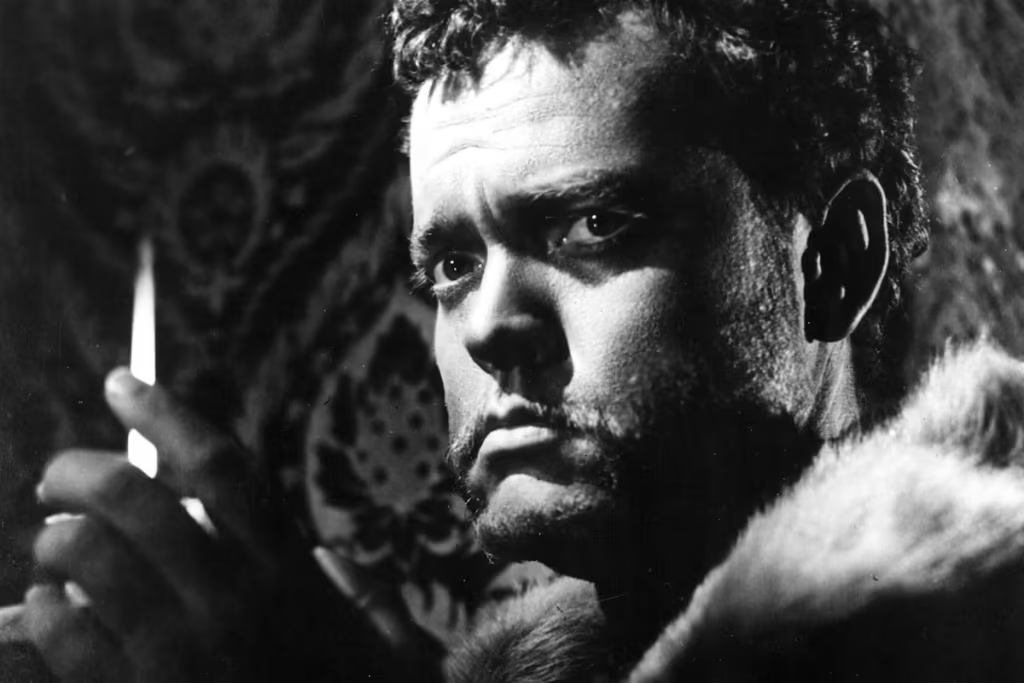
MacLiammóir wasn’t even the film’s first Iago. It was supposed to be Everett Sloane, the Mercury Player you remember as the fiercely loyal Mr. Bernstein in Citizen Kane. Sloane abandoned Othello due to the endless production delays, and Welles never forgave him, making disparaging comments even after the actor’s suicide in 1965. (The filmmaker was peerless at many things, especially talking shit.) Desdemona was to be played by Welles’ then-girlfriend Lea Padovani, who soon had to be recast after she broke his heart. She was replaced by Suzanne Cloutier, whom Welles praised for her “Renaissance face.” Cloutier’s performance was later entirely re-dubbed by actress Gudrun Ure, who played the role in Welles’ 1951 stage production of the play.
All these missing puzzle pieces and moveable parts are hardly seamless. I first saw Othello when a new restoration made the theatrical rounds in 1992, and what I remember most vividly about watching it at 17 years old was that I couldn’t believe how bad the sound was. (It’s pretty rough. Welles dubbed a lot of the voices himself in post-production.) But the fragmented quality becomes key to the movie’s nightmarish effect. Othello’s world is falling apart around him, and at times it feels like the film is as well. Welles conveys the Moor’s psychological collapse in entirely visual terms. We see Iago lead him down, down, down into a byzantine maze of columns, canals and liminal spaces as the green-eyed monster takes hold.
There are aspects of Othello that look like a trial run for The Trial, Welles’s 1962 Kafka adaptation in which Anthony Perkins’s Josef K is swallowed up by his sinister, expressionistic surroundings. Watch his elaborate use of the sets’ iron bars and lattice work, the shadows of which become elongated cages around Othello, matching the one in which Iago is imprisoned during the film’s opening flash-forward. Look at how he uses his hefty figure, already becoming prominent at the age of 34. As the character becomes more unhinged, he increasingly takes up more and more of the frame, eventually looming large over the camera — until the murder of Desdemona, after which he’s instantly diminished, as if spent. It ends with our towering war hero a tiny, pathetic figure, dwarfed by his iron and stone surroundings.
“Othello” is streaming on several ad-supported streamers.