Jason Bailey
The 64th New York Film Festival officially launches today, with the Opening Night selection of James Gray’s Paper Tiger, and I’ll have thoughts on that film and several of the fest’s other showpiece titles (including Behemoth!, 14th, Fatherland, and The Debut) in a report following the festival’s wrap-up on October 11th.
Those will all unspool during the festival proper, for both audiences and press. But one of the nice things about being a New York-based film critic is that NYFF spends nearly two weeks leading up to the fest holding all-day press screenings of the rest of the slate, and if you’re dedicated enough, you can see nearly everything they have to offer. I am not dedicated (or uncommitted) enough to do all of that, but I did pop in and check out a few titles of note.
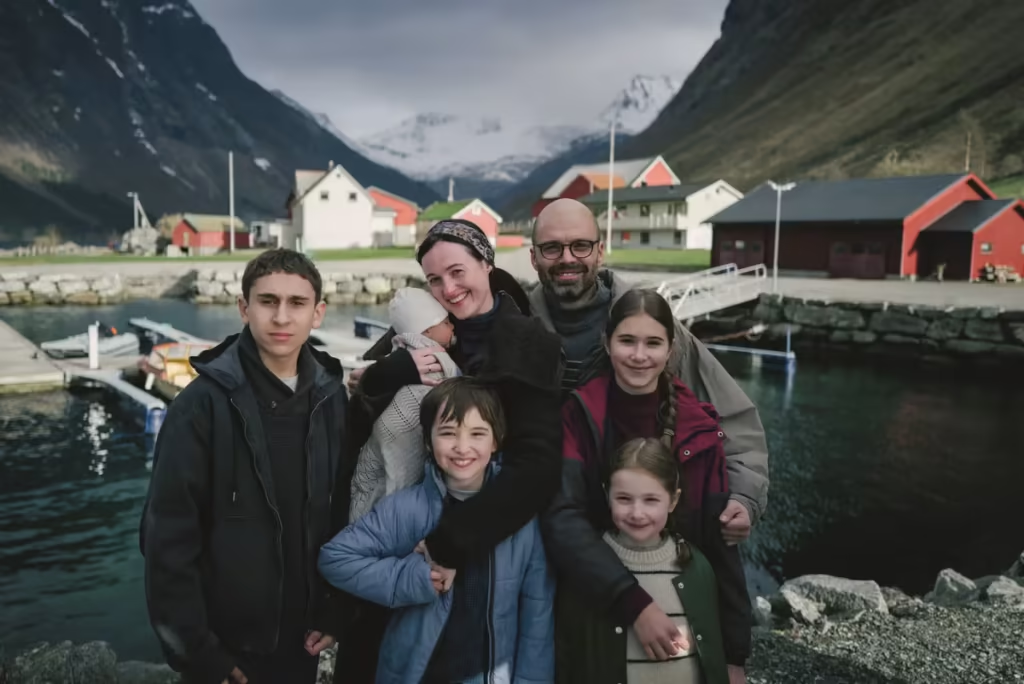
The great Cristian Mungiu’s new Palme d’Or winner Fjord opens with a plaintive piano rendition of “Amazing Grace,” and boy does that turn out to be A Choice. He’s telling the story of a family of five, headed by Sebastian Stan and Renate Reinsve, who move to Norway from Bucharest; they’re overtly religious, sometimes uncomfortably so, and the tension between them and their neighbors sets it up firmly as a “waiting for something bad to happen” movie, and eventually something does.
There are allegations of physical abuse, which the parents fiercely dispute (“I love my children and I have never hurt them,” he insists), which goes from a battle with Child Protection to a media firestorm that’s taken up by culture warriors. It’s provocative set-up, and a check of biases and empathy, to which Mungiu — who’s explored similar waters in pointed dramas like 4 Months, 3 Weeks and 2 Days and Graduation — brings his usual moral complexity. This is not a simple good vs. evil or even citizens vs. government question; there is a lot to not like about this couple, and how they live their lives, but as he asks, “Why would this freedom only apply to certain values?” The Stan performance is borderline inscrutable (complimentary), while Reinsve’s comparative vulnerability makes a fine counterpoint.
That one’s going to attract some discourse over the fall, but it feels like the most controversial film of the festival is likely NAZA, which has put its directors Yuval Abraham and Rachel Szor into the sights of Benjamin Netanyahu. And as their film proves, that’s a dangerous place to be. The title comes from the term Israeli intelligence uses for “collateral damage — the number of civilians who will be killed in a strike.” It’s a purposefully dehumanizing term; apparently one can sleep better at night if casualties are phrased as “15 NAZA” not “15 people,” or, yes, “15 children.”
If you find that horrifying, oh, just wait. Abraham and Szor, both Israeli, interviewed two dozen of their countrymen who are involved in the surveillance, planning, and execution of deadly strikes in Gaza. Their subjects, who have had their faces and voices obscured, break down the technology and the interface that allows them to, essentially, murder on demand. (“It’s like a video game,” one shrugs.) The filmmaking is infected by a haunted melancholy; the interviews are all conducted on rooftops at night, with the inky, dark cinematography and moody music making their chilling confessions feel all the more sinister. (Significantly, there are no images from inside Gaza until the final scene, and the effect is shattering.) “I trust the system and do my job as part of the system,” one of the soldiers explains. In other words, they’re just following orders.
Rose doesn’t present itself as a contemporary commentary — this is a period international drama, shot in stark, striking black-and-white — though perhaps others will pick up where it’s going sooner than I did. We meet its title character, played by the always impenetrable yet compelling Sandra Hüller, as a survivor of a long and brutal war, which she fought in the guise of a man; she is now masquerading as a friend killed in battle, making a claim to his inheritance of a long-abandoned farmhouse and its adjoining land. Rose makes an unlikely success of the farm, and is then expected to take a wife, which leads to some dryly comic complications.
But this is ultimately serious business, and around the scene of their neighbors and employees demanding to examine Rose’s manhood, the timeliness became crystal clear. Significantly, it’s here, for the first time, that Huller’s ice-cool demeanor cracks, and it’s impossible to look upon her determined visage, in these black and white scenes of judgment, without thinking of The Passion of Joan of Arc. (“There is more freedom in trousers. And they are just a bit of cloth. So I put on trousers.”) Rose draws you in and demands your attention; it’s solemn and austere, until it’s explosive.
Angela Schanelec’s My Wife Cries delivers the first half of that description, but not the second; it’s such an unhurried, often oblique piece of work that it wasn’t hard to understand why so many others in the press screening either left early or stayed put to snort through it. Schanelec is in no hurry to make things too clear, and then she drops everything into your lap at once, her characters speaking in such torrents of words that all kind of monologue at each other, which can be both enlightening and off-putting, sometimes within the same scene.
She alternates these long scenes of talking — sometimes from such a distance as to create audience alienation— with long scenes of contemplation (and, at one point, some singing and dancing). It’s all extremely German, though she seems equally influenced by the existential interrogations of Bergman and other Swedes. But she displays a keen understanding of how small slights foster and warp in a serious relationship, and of how these words, when delivered unfiltered and received unguarded, can do more damage than daggers.
Similar resentments brew at the center of Sompot Chidgasornpongse’s 9 Temples to Heaven, in which an elderly Thai grandmother and her extended family attempt to visit all nine of the nearby Buddhist temples in a single day, to “make merit” — donate an offering of food and supplies, a kind of tithing to assure her imminent entrance into heaven. While in transit between them, they initially engage in thoughtful, searching conversations on big and important subjects: life and death, faith and Buddha, obligations and enlightenment, what we do when we’re here and what we leave behind.
But they’re already discussing the improbability of getting it all done in a day by stop three, and the big ideas of the early scenes soon degenerate into bickering over logistics and propositions of possible shortcuts, a fine metaphor for attempting to live a life of faith and service if I’ve ever seen one. (There’s also a light, welcome dose of cynicism about the kitsch and materialism of where they’re going and what they’re doing.) The filmmaking is mostly straightforward, though there are some gorgeous, potent close-ups and a dreamlike passage with a darkening sky, all on the way to an elegant ending that really sneaks up on you.
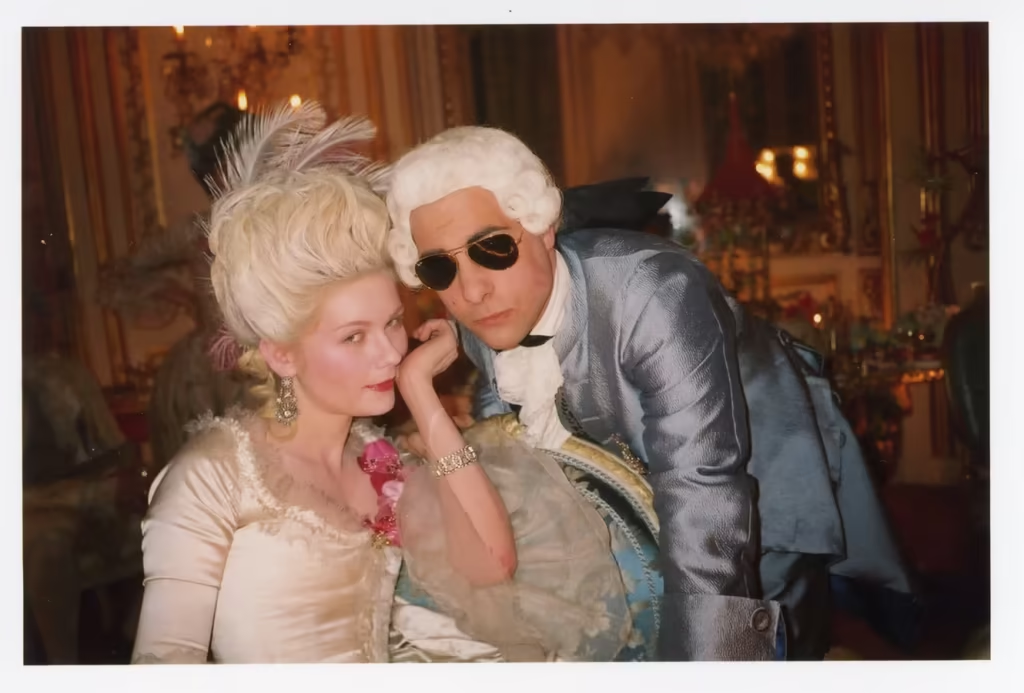
In 2005, Eleanor Coppola shot almost 80 hours of video footage on the set of her daughter Sofia’s film Marie Antoinette, put it aside, and finally started putting it together as a lockdown project with Sofia, who finished it off after Eleanor’s passing in 2024. The resultant documentary, Making Marie Antoinette, will inevitably be compared to Hearts of Darkness, her chronicle of the making of husband Francis’s Apocalypse Now, perhaps the greatest of all making-of movies. But the discrepancy between Sofia’s personality and Francis’s separates the films immediately; he’s boisterous and gregarious, a grandiose talker, where she is more quiet and interior, which makes for a less dramatic and operatic dispatch, beyond the (comparatively) sane circumstances of her shoot.
But what Making captures instead is the everyday stress and overwhelming exhaustion of a typical film production (as opposed to the extraordinary challenges of something like Apocalypse). This was a high-stakes production — a $40 million budget with 57 days of location shooting (including, for the first time, within and outside the walls of Versailles) — but for the Coppolas, making movies is a family business. Sofia directs, Francis produces (and hangs out), their son Roman directs 2nd unit and shoots second camera, and Eleanor documents, her well-honed documentarian’s eye catching casually artful compositions and quiet, private moments. And since its ostensible central figure is such an unassuming one, Making Marie Antoinette ends up being as much a love letter to her late mother as a production diary. And it’s quite delightful on those terms.
Mike Leigh has indicated that Tender Loving Care will likely be his last feature film, and from the first scene — establishing a tone of equal parts desperately bleak and painfully funny — there’s not a moment of doubt that it belongs to anyone else. His primary focus is on Rosie (Alice Bailey Johnson) and Amy (Kate O’Flynn), a pair of social workers and longtime friends. Amy is moving back in with Rosie following a failed relationship, so they spend a lot of time drinking wine and trying a little too hard to be breezy. Their scenes echo other Leigh films (most notably Career Girls), but you can tell Leigh is getting older, because he gives about as much screen time to Amy’s aging parents, Birdie (Marion Bailey) and Geoff (Paul Jesson), especially once Geoff starts displaying symptoms of dementia.
It must be noted, at least in passing, that there’s an undeniable clunkiness to Leigh’s more recent works; the scenes feel less organic, the structures more schematic. But his eye for performances and ear for dialogue are both still fully intact, and there’s one scene (only slightly connected to the main narrative) with an alcoholic mother in her cluttered kitchen that’s the kind of thing he’s always done so well — no clear good/bad dichotomies, just complicated people struggling. Near the end, there’s a patient moment in which his camera slowly dollies out of a middle-class bedroom, and it feels indicative of his entire career; these are the quiet lives he’s spent all this time observing, and that move feels like the quiet closing of an especially satisfying boo
Like Leigh, Radu Jude has become one of the mainstays of the NYFF, both because he hits so many of the programming sweet spots (international, provocative, potentially alienating) and because he’s so wildly prolific. Last year he had two features on the slate, and now he’s back with his own take on Octave Mirbeau’s 1900 novel The Diary of a Chambermaid, previously adapted for the screen by (among others) Luis Buñuel. The line of succession from Buñuel to Jude is pretty direct, but anyone who saw his Dracula last year knows that the last thing Jude is interested in making is a straight adaptation.
So he updates Mirbeau’s story, making his heroine, Gianina (Ana Dumitrașcu, excellent) a Romanian immigrant working as a nanny, cook, and maid for a wealthy family in contemporary Bordeaux. (He also adapts it to his interests; he finds capitalism far more insidious than sexual debasement, so the father condescends to her, and uses her as a prop in a dinner party political argument, rather than harass her.) She spends her evenings acting in an amateur black box theater production of a far more faithful adaptation of the book, because there are few things Jude likes more than multiple levels of meta-textual commentary. It’s all funny and odd and pointed, as we expect from Jude (though there’s some hyper-local land development material that doesn’t come across at all), and a bit of honest pathos at the end that’s surprising, but earned.
Chambermaid is not the most provocative picture to play at NYFF this year, however; that honor would fall to the long-awaited, fully restored version of Ken Russell’s 1971 freakshow The Devils. And if it’s hard to imagine a time when a major studio would finance and release what is, essentially, an explicitly sexual and overtly blasphemous high-class nunsploitation movie, credit where due: that same studio is releasing this restoration, via its new “Warner Bros. Clockwork” specialty label. (I have an educated guess as to what will happen to that shingle, and its mission, under the seemingly inevitable new ownership.) Any way you slice it, Devils feels like the polar opposite of your typical safe, vanilla 2026 studio release; it’s sweaty, grimy, bloody, rotting.
Russell is, to put it mildly, not a subtle filmmaker. He smashes his raw images of faith, death, and sex together with the brute force of a sledgehammer, and then rubs your nose in them. (“Oh, is this what you want?” he seems to sneer. “You like sex and violence?”) Many of his images and juxtapositions still have the power to shock; he’s lighting dynamite sticks, deliberately and gleefully, and the results are brutal, bold, and darkly funny. By the time he reaches his out-of-control (complimentary) climax, an orgy of writing, screeching, humping, bondage, and general feral behavior, it feels genuinely dangerous, and when his story’s panel of judges deem his protagonist “guilty of obscenity, blasphemy, and sacrilege,” it’s like he’s passing judgment on his own movie, and doing so unapologetically.