Max Borg
The question of whether one can, or should, separate the art from the artist has become an increasingly thorny one. It resurfaced during the San Sebastián International Film Festival, specifically in the context of the retrospective focusing on the French writer-director José Giovanni. In between screenings, I would chat with Ariel Schweitzer, a critic for Les Cahiers du Cinéma, who told me such a program would not be feasible in France nowadays, despite the fact Giovanni – unlike other filmmakers with a criminal record – has been dead for two decades.
It would also be tricky to separate art and artist since Giovanni’s nefarious past is what informed his entire writing career: born in 1923, the young Joseph Damiani – his real name, which he later carefully concealed – joined a Nazi-affiliated organization during the Occupation in 1944, and was sentenced to death in 1948 for a triple premeditated murder. The sentence was subsequently commuted to hard labor for life, and it was merely one of several punishments he received for various different crimes – a separate charge earned him the permanent deprivation of all civil rights, similar to other French citizens who had collaborated with the German invaders.
Damiani was eventually released in 1956, at which point he adopted his pen name and wrote his first novel, The Break (Le trou), based on his real-life escape attempt with four other inmates. His prose, vividly fueled by his personal experiences, had two majors consequences: firstly, it made him one of the poster boys for the Série noire, the crime fiction imprint of the major French publisher Gallimard (and the supposed inspiration for the term film noir, first coined by French critic Frank Nino in 1946); secondly, the 1960 cinematic adaptation of the book, which Giovanni himself worked on alongside the film’s director Jacques Becker, made him an in-demand screenwriter, often adapting his own novels for filmmakers such as Claude Sautet and Jean-Pierre Melville.
It was a universe populated by gangsters and bagnards (jailbirds), one that major French stars gravitated towards on more than one occasion. Most curious, perhaps, was the case of Giovanni’s novel L’Excommunié, published in 1958. In 1961, it served as the basis for Jean Becker’s A Man Named Rocca, starring Jean-Paul Belmondo. Ten years later, Belmondo himself approached Giovanni, who by then had become a director in his own right, about making a second adaptation, since the actor felt he had reached the right age to do his role justice. Giovanni readily agreed, as he also had issues with the previous version, where many stronger scenes had been excised for the purpose of appealing to a wider audience.
He was also keen to make La Scoumoune, as the new adaptation came to be known, as a career-saving strategy, since his first two directorial efforts had done poorly at the box office. In fact, as the retrospective curators explained at the San Sebastián screenings, 1971’s Where Did Tom Go? was such a huge flop, it basically vanished from circulation for decades: never broadcast on French television nor released on physical media, it remained unseen until StudioCanal recently restored it.
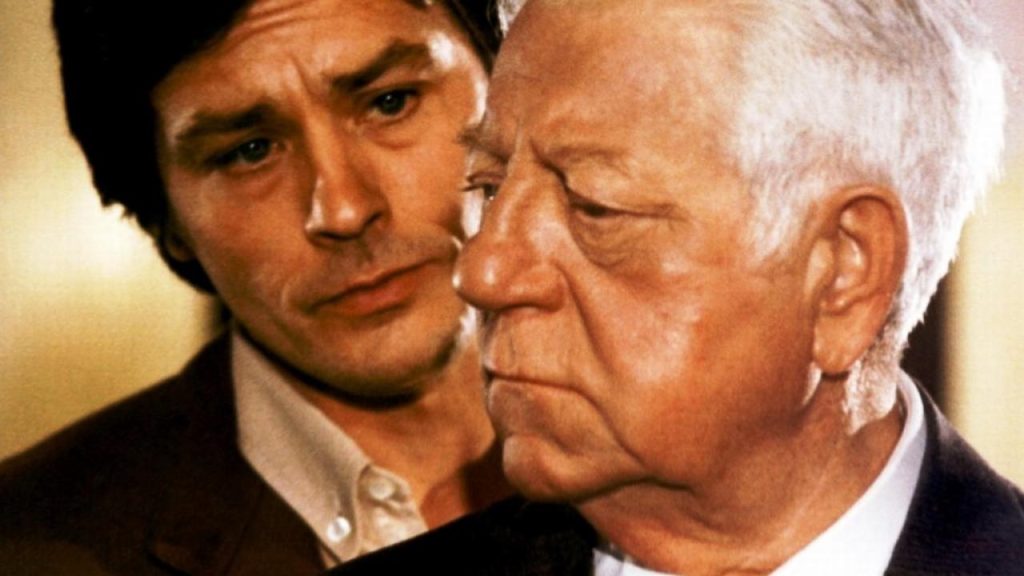
Blistered by that experience, Giovanni went on to very carefully choose projects that, while undoubtedly the product of his distinctive vision, would also have commercial appeal. Never was this more evident than in the case of what many regard as his most important work, 1973’s Two Men in Town. Although his political leanings were quite conservative, Giovanni was a staunch opponent of the death penalty, and decided to contribute to the ongoing debate – capital punishment was still in use in France at that point – by injecting the topic into a loose modern retelling of Victor Hugo’s Les Misérables, starring Alain Delon as the reformed criminal and Jean Gabin as his prison advisor (Lino Ventura, who was the first choice for the latter role, turned it down because, being even more right-wing than Giovanni, he refused to appear in a film where the de facto villain was a cop).
As the genre mutated into something different (the 1980s made it more and more difficult to pitch crime movies where the crooks were the sympathetic figures), Giovanni’s career began to slow down, although he still produced some interesting work, often in spite of budgetary constraints. The San Sebastián program included one of his rare non-crime works, the political action movie Among Wolves (1985) — basically The Dirty Dozen done on a shoestring budget, in the style of Sam Fuller (one of the director’s role models). And while the financial limitations are obvious, Giovanni also made sure the sequences for which he did have the money actually stood out. (I’m still thinking about a mountain-climbing stunt that gives Tom Cruise’s Mission: Impossible II antics a run for their money.)
Throughout all this, Giovanni never made a secret of his past – after all, it was a feature, not a bug. That said, he did omit the exact nature of the crimes that had led to his death sentence in the ‘40s, and going by a different name kept him largely isolated from any investigations into the full extent of his underworld background. He also had his civil rights restored in 1984, although his criminal record remained unaltered.
Then, in 1993, when he was largely retired, two major French-language newspapers in Switzerland – Giovanni’s primary residence since the late 1960s – published an article detailing his Nazi-adjacent activities and his real name. It didn’t kill his career outright (he continued writing books and making films, albeit at a slower pace, until death in 2004), but it damaged his reputation to the extent mentioned earlier, making it virtually impossible to organize a retrospective like the San Sebastián one in his home country. Which is ironic, given a large chunk of his work from the 1970s onwards dealt with the idea of second chances and rehabilitation.