Craig J. Clark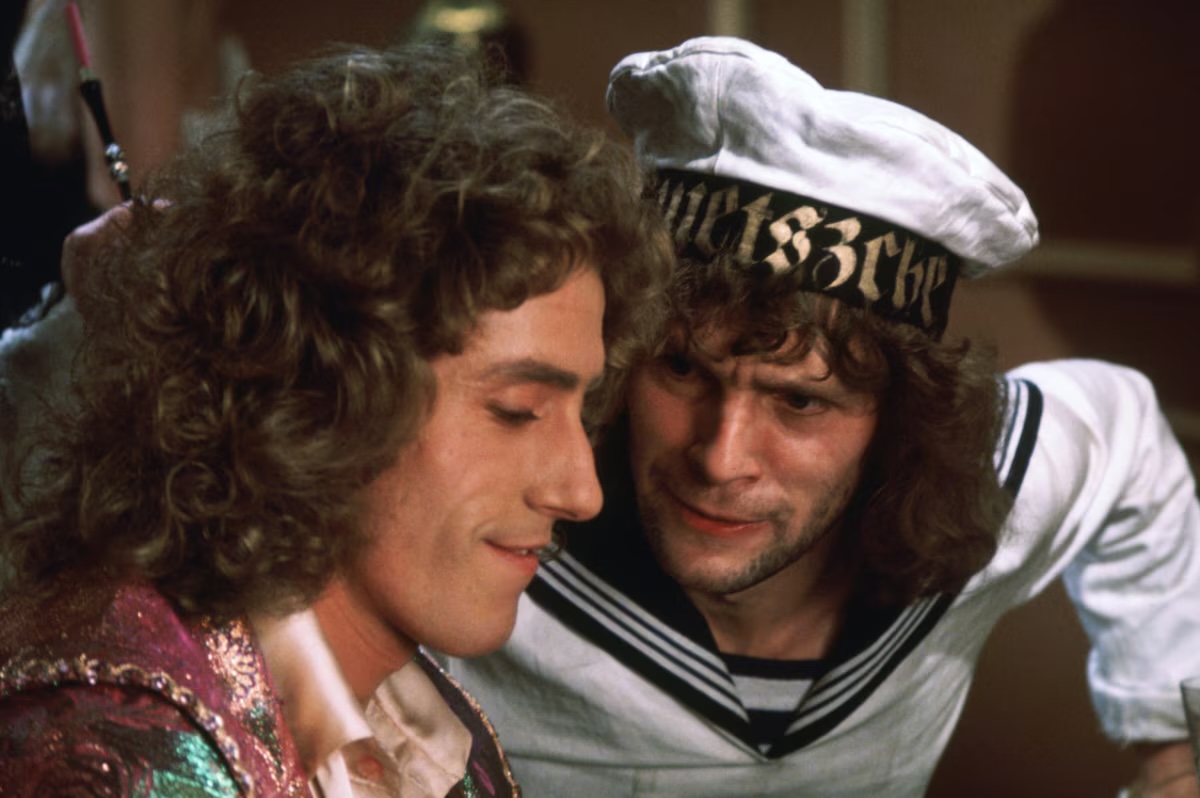
In response to the recent crop of musician biopics that flatten out their subjects’ lives and flatter them in the process, the Criterion Channel has programmed “Rock Biopics That Don’t Suck.” Along with the expected likes of The Buddy Holly Story, The Doors (coming in September), and The Runaways are a few titles that stretch the definition of “rock,” though. While Milos Forman’s Amadeus inspired the Falco hit “Rock Me Amadeus,” it doesn’t exactly rock itself, but no qualifiers are necessary to justify the inclusion of Ken Russell’s Lisztomania. Not only did he get progressive rocker Rick Wakeman to do the soundtrack, he cast The Who’s lead singer Roger Daltrey – fresh off playing the lead in Tommy – as Franz Liszt. How better to convey his rock-star swagger and the cultish adoration of his fans?
Lisztomania was the culmination of a decade-plus of increasingly daring and flamboyant composer biopics, which Russell started making for the BBC’s arts programs Monitor and Omnibus. Ever the mold-breaker, he was keen to free himself of the strictures of the television documentary form when he advanced the notion of filming actors portraying Edward Elgar and others for Elgar: Portrait of a Composer in 1962. Where the previous year’s Prokofiev: Portrait of a Soviet Composer relied on stock footage and producer Huw Wheldon’s narration to tell the story of his life, Russell married shots of his actors communing with nature to the composer’s stirring music. They just weren’t allowed to speak.
The same prohibition was in place for 1964’s Bela Bartok, but concessions were gained by the time Russell embarked on The Debussy Film the next year. Devised with Melvyn Bragg, who’s credited with the dialogue, The Debussy Film: Impressions of the French Composer takes the form of a film about the making of a film about Claude Debussy. This is signaled by the opening sequence of a BBC crew arriving on location to shoot a scene and the director (Vladek Sheybal, late of From Russia with Love) talking to a young actor. The line the boy is given to deliver (“It seems he was a musician”) is the first of many assumptions made about Debussy before they’re through.
Largely eschewing traditional narration, Russell and Bragg have Sheybal fill the audience in on the contours on Debussy’s bumpy life at the same time he briefs the actors, chief among them Oliver Reed (beginning a long and fruitful association with Russell), who gets so into character there are times he doesn’t seem to be performing. Further clouding the issue is the way Sheybal also plays Pierre Louÿs, a photographer who had a complicated relationship with the composer. “What he really liked to do was manipulate people, a kind of Svengali,” Sheybal says of Louÿs, adding “Debussy was good material for him.” In one speech, he collapses the divisions between his character, his role as their filmmaker, and Russell’s as the master manipulator behind the scenes.
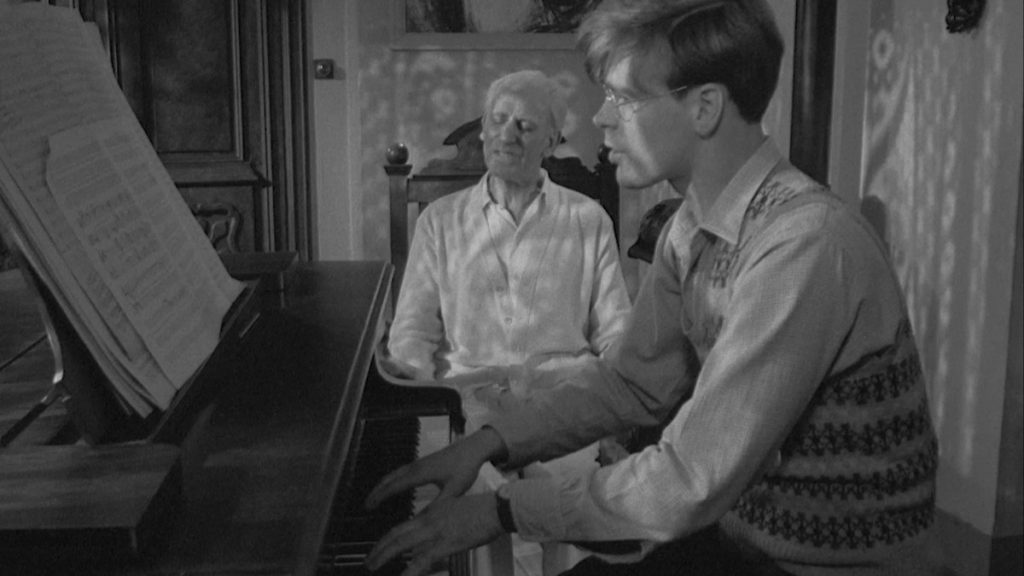
With the precedent set, Russell had a freer hand with 1968’s Song of Summer, which charts the difficult relationship between Frederick Delius and his amanuenses Eric Fenby, who spent years helping the blind and paralyzed composer complete several unfinished works. Restrained as Song of Summer is, its polar opposite is 1970’s Dance of the Seven Veils, which was Russell’s final film for Omnibus. A “comic strip in 7 episodes on the life of Richard Strauss,” that would be a hard act for anyone to follow, and the Strauss family was so scandalized they withdrew the music rights, which has kept it out of circulation.
Russell’s move to features came as censorship loosened up enough for him to go places that weren’t possible on the telly. (Alan Bates and Oliver Reed’s nude wrestling match in Women in Love was but a warmup.) He didn’t abandon his beloved composers, though, jumping straight into The Music Lovers, a film about Pyotr Ilyich Tchaikovsky that makes no bones about which way he swung. Introduced romping in the snow with a male friend who’s unmistakably more than just a friend, Richard Chamberlain’s Tchaikovsky is bursting with exuberance, as is Russell, who establishes the relationships of most of the major players in a dynamic, dialogue-free sequence, the first of many such lyrical passages set to Tchaikovsky’s glorious music.
A common theme in Russell’s biopics is how his subjects were often misunderstood or underappreciated at the time they were producing their most famous work. (In the scene where Tchaikovsky premieres his “Piano Concerto No. 1,” Russell repeatedly cuts to his mentor shaking his head.) Another problem that frequently crops up is how they support themselves. The most pragmatic solution is to attract the right patron, or failing that, go on tour conducting their own work. Tchaikovsky tries both with varying success, and Gustav Mahler, the subject of 1974’s Mahler, travels to Vienna by train to take up the baton himself, a journey Russell intersperses with flashbacks to his turbulent life and career.
Structurally speaking, Mahler is one of Russell’s more conventional biopics. In terms of content, though, it’s as outrageous as any, skirting the boundaries of good taste with gleeful abandon. To depict Mahler’s childhood as a musical prodigy in a large Jewish family, Russell plays up the stereotypes. He also indulges in baroque fantasies whenever the ailing composer dozes off. In one, he imagines himself trapped in a coffin that’s placed in a crematorium, but that’s a doddle compared to Russell’s vision of his conversion to Catholicism to appease Cosima Wagner, widow of Richard, who is a raging anti-Semite. Set to “The Ride of the Valkyries,” it’s presented as a slapstick silent short replete with Nazi imagery, to which Russell returned with a vengeance the very next year.
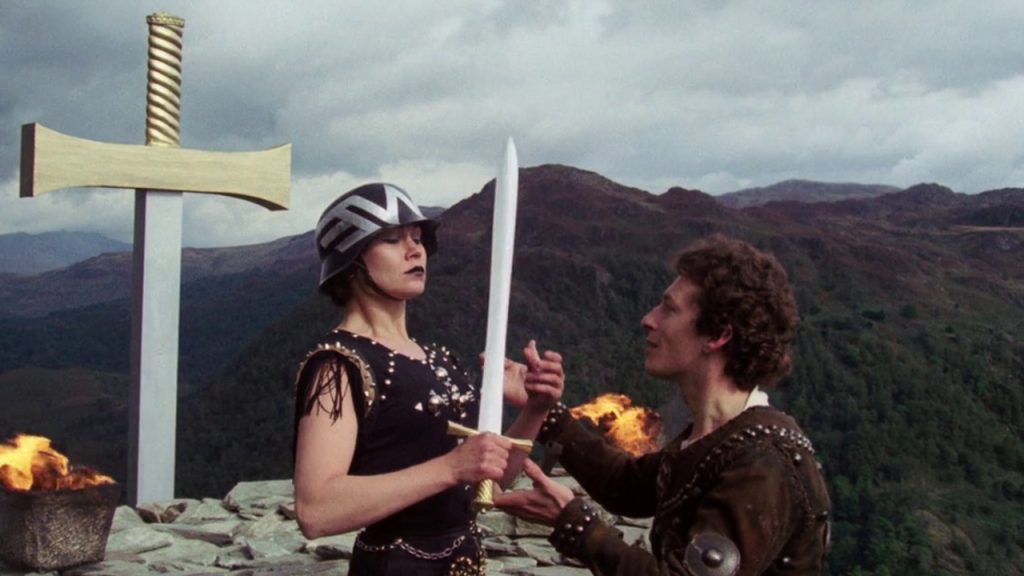
Much like Mahler opens with the hut where he did his composing going up in flames, Lisztomania starts off with a bang. Caught in bed with the wife of a jealous count, Liszt imagines the two of them being trapped inside a grand piano and placed in the path of an oncoming train, which obliterates them on impact. This turns out to be a dream he has right before a concert, which is attended by such luminaries as Chopin, Strauss, Rossini, and Mendelsohn, as well as a young Richard Wagner, who is humiliated by the dismissive way Liszt performs his music. (Think of the scene in Amadeus where Mozart plays a piece in the style of various composers and makes a lifelong enemy of Salieri, only multiply his fury tenfold.)
With Lisztomania, Russell let his imagination run riot, but while he conjures up indelible imagery – you’re unlikely to forget the sight of Roger Daltrey riding a giant phallus – it quickly becomes apparent he’s pushed the form about as far as it can be pushed. Between depicting Wagner as a literal vampire, putting him and his followers in Superman uniforms, and reviving him as a Frankenstein/Hitler monster who mows down Hassidic Jews with a machine gun, one might be inclined to agree with Liszt’s sentiment when he says, “I think we should put him out of his misery. He’s giving music a bad name.” Still, where else are you going to see Rick Wakeman as Thor and Ringo Starr as the Pope?
When Lisztomania stiffed at the box office, and Russell’s follow-up Valentino did likewise, he was effectively barred from the biopic business, at least as far as movies were concerned. He still had an outlet on television thanks to the patronage of Melvyn Bragg, though, and spent the next quarter century producing programs about Holst’s The Planets, Ralph Vaughan Williams, Anton Bruckner, and Arnold Bax. (He even starred in the last one.) Russell came full circle, though, with 2002’s Elgar: Fantasy on a Composer on a Bicycle, made 40 years after his first Elgar film, and one he narrated himself. Whatever his budget, he always knew the right pieces of music to marry to his inventive visuals – and when to let them speak for themselves.
Those susceptible to “Lisztomania” can catch it on the Criterion Channel. Mahlerholics may find his biopic there as well.