Zach Vasquez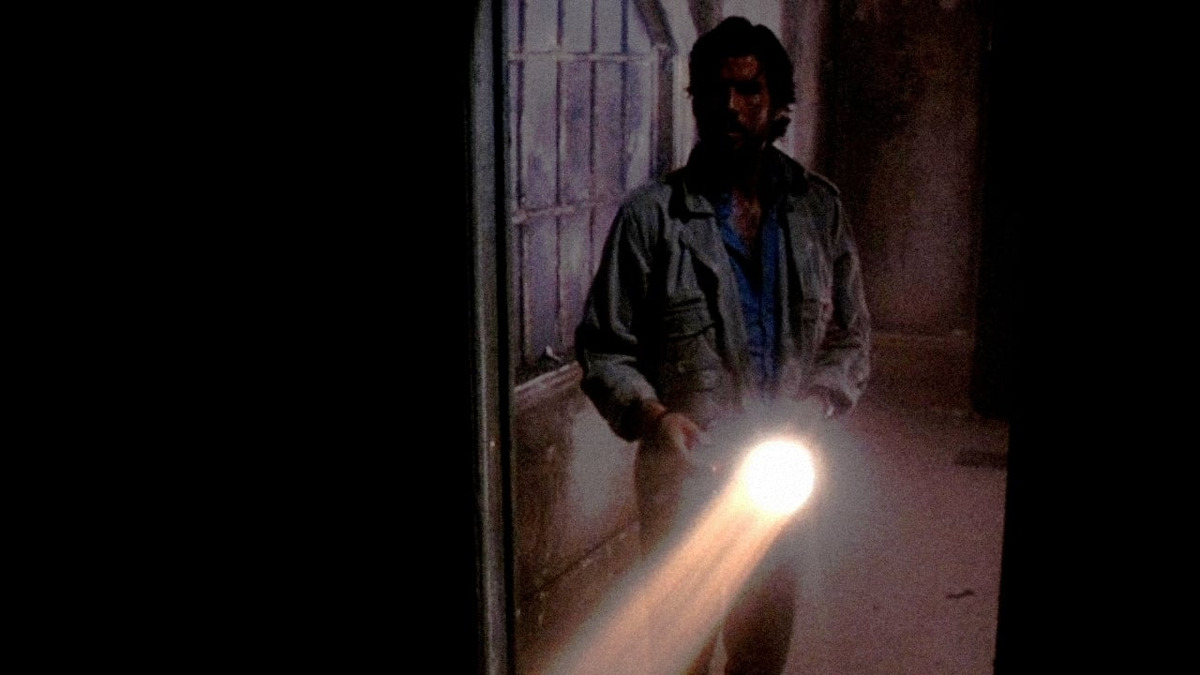
Who wants to live forever? This was the question that was on several filmmakers’ minds 40 years ago this March. The answer: only monsters and punks.
March 7th saw the American release of the forgotten horror-fantasy Nomads, as well as the action-fantasy blockbuster Highlander. Across the pond, the U.K. horror-fantasy Rawhead Rex hit theaters (there is conflicting data about the exact date of its release, but several sources have it as March 17, 1986). While all different from one another in tone and plot, they share a number of thematic and stylistic crossover – particularly in their depiction of ancient, immortal evil as looking quite a bit like a certain youthful subculture of the day.
Adapted from Chelsea Quinn Yarbro’s 1984 novel of the same name, Nomads follows Dr. Eileen Flax (Leslie Anne Dowd), a recent transplant to Los Angeles from the East Coast (although she has a clear British accent that goes unremarked upon). One night while working in the ER, a frenzied and badly beaten Frenchman is brought into the hospital. He quickly succumbs to his wounds, but just before dying, whispers something into her ear. Almost immediately, Dowd grows deathly ill, before wandering off into the mean streets of L.A. while simultaneously living out the last week of her patient’s life.
Said patient turns out to be French anthropologist Jean-Charles Pommier (Pierce Brosnan), another recent Los Angeles transplant (along with his wife) after years spent amongst indigenous tribes all over the globe. The first night in their new home, they are harassed by a group of leather-clad punks in a van, who seem to have some attachment to the home (which we come to learn was the site of a grisly murder). Intrigued by this band of modern-day urban nomads, Pommier begins following them, eventually discovering that they are in fact a collective of ghosts known as the Innuat—demonic trickster spirits that wander amongst the living wrecking havoc and bloodshed (this is all very much a bastardization of actual Iniut mythology and language).
If that synopsis reads as convoluted to the point of incoherence, well, that’s Nomads. In his 2 ½ star review, Roger Ebert called it a “very confused movie,” made all the more confusing by its structure, which constantly shifts perspective from Dowd and Brosnan’s characters, sometimes within the same shot. Some of this is intentional, but much of it is not; this is not a work of pure, unmitigated dream logic horror, like, say Eraserhead or Possession.
(The overriding sense of discombobulation is furthered by Brosnan’s sweaty performance and ridiculous French accent, which makes some of his line readings—including the hilarious “ZEEZ PEOPLE LIVE IN PARKING LOTZ!”—unintentionally hilarious.)
And yet, while there is no arguing that Nomads is a mess of a movie, it is a gorgeous mess, more imaginative and evocative than any of the elevated horror offerings we get today (one slow boiling set piece atop a skyscraper rooftop is particularly memorable). Director John McTiernan proves himself a born filmmaker, every frame of the movie evoking the shadowy, neon menace of a Michael Mann joint. It’s no surprise that, even as Nomads failed at the box office, it catapulted McTiernan onto the A-list, with Arnold Schwarzenegger tapping him to direct Predator based on how impressed he was with what he achieved on a budget of only $1 million. (Brosnan didn’t do too badly for himself either, and indeed, he and McTiernan would reconnect in 1999 for The Thomas Crown Affair.)
The demonic entities in Nomads are meant to invoke an updated version of the Manson Family, having traded in their hippy digs for leather, lace, and metal. Gyrating on the roofs of cars, tearing ass on Harley Davidsons, fighting and fornicating in back alleys, and just generally slacking around at the beach, they are indistinguishable from the young punks and rockers that populated the debaucherous music videos of the day, or who haunted the actual streets of Los Angeles’s Sunset Strip (where much of the movie was shot). As Ebert notes in his review, Nomad’s final frame is a sly joke about how these spirits fit right at home in “loony” California.
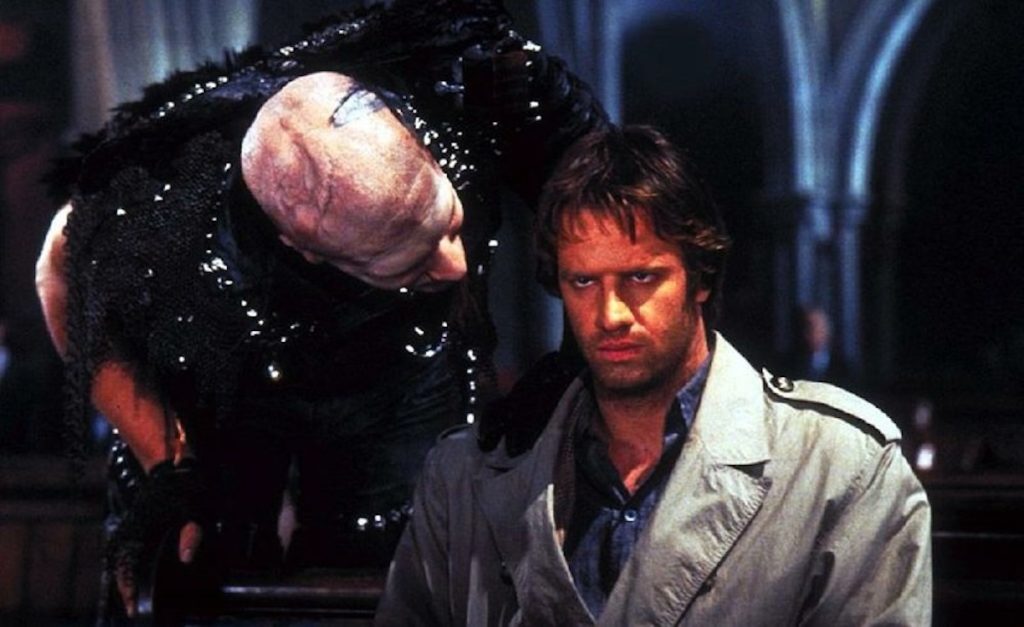
The same cosmic joke appears in Highlander, a high-concept hybrid of urban action and sword-and-sandals fantasy. One of the more respectable titles to come from ‘80s schlockmeisters Cannon, it charts the centuries-long battle between a group of immortal warriors who must wage war against one another (“There can be only one!”). The hero is Scottish-born Conor McCloud (French actor Christopher Lambert, who manages to outdo Brosnan in the wacky accent department), currently living as a wealthy antique dealer in New York City. His mortal enemy is the sadistic Kurgan (Clancy Brown), an even older Immortal originally hailing from a savage tribe of Russian barbarians (said to have pitted toddlers against wolves for sport).
While not initially a huge hit, Highlander eventually became one on home video, spawning four sequels, a six-season television show, and a short-lived animated series (a new reboot, starring Henry Cavill, Russell Crowe, and Dave Bautista began filming at the start of this year). Like Nomads, it is a mess of a movie that features a number of (enjoyably) cheesy performances, but it is, similarly, a visual knockout. Australian director Russell Mulcahy, who had cut his teeth as an in-demand music video director (and who previously made the wonderfully psychotropic creature feature Razorback), brings all of that MTV excess and glamour to bear here, resulting in a film that punches way above its budget. At the time, many a critic and snooty moviegoer dismissed this as style over substance, but compared to the gray digital landscape of today’s offerings, it plays like Lawrence of Arabia.
One part of Highlander that needs no comparison to defend it is Brown’s performance as The Kurgan. Arguably the greatest of all ‘80s bad guy actors, Brown—with his towering, beefy frame, lupine features, and deep, resonant voice—is an imposing figure all on his own, but here is outright monstrous. Swapping out his barbarian skins for ratty leather, chains, and studs, he looks like a cross between a Hells Angels biker and Skid Row punk rocker. Like the Innuat in Nomads, the gag is that, even as he scares those around him, he manages to totally blend in with his skeezy urban surroundings. When not lopping off his fellow Immortals’ heads, he spends his time partying—tearing ass down the city streets in his muscle car, sleeping with call girls, and freaking out the squares at church services. It’s like he gleefully preaches to a horrified man of the cloth: “It’s better to burn out than to fade away!”
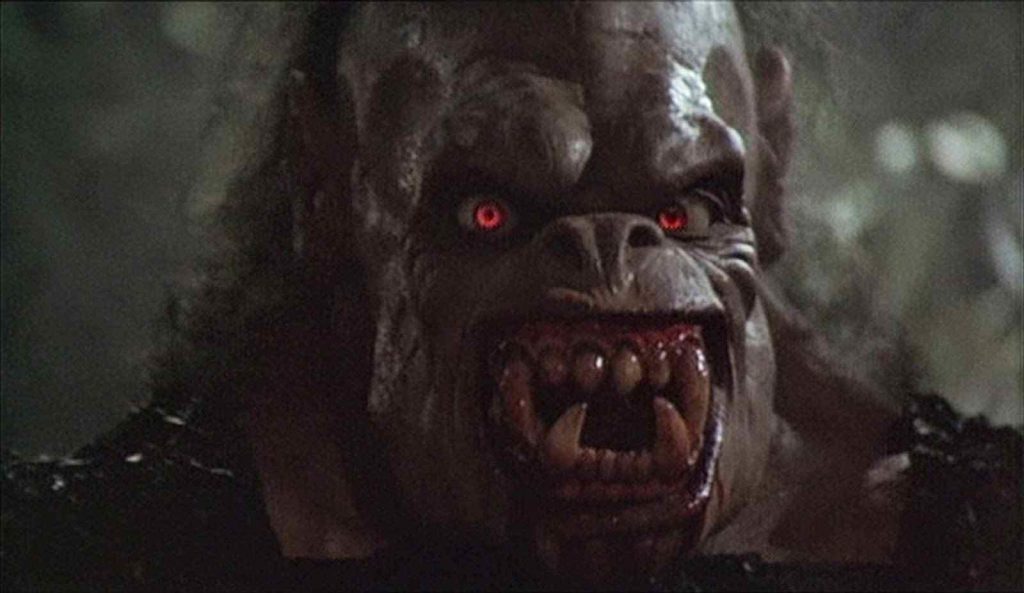
Only slightly more monstrous than The Kurgan is the demon king at the center of Rawhead Rex, British director George Pavlou’s gory chiller, adapted from a short story by legendary horror author and filmmaker Clive Barker (this was that pair’s second film together, following the even more obscure Underworld [a.k.a. Transmutations] from the year prior). Moving the action of the story from a seaside community in Southeast England to a small village in rural Ireland, Pavlou’s film follows the bloody rampage wrought by its titular beast, a giant demon who used to rule as king over the area’s pagan tribes in ancient times, after the magical rune imprisoning him in the earth is moved by some unwitting farmers.
Rawhead Rex is yet another ungainly film. ridiculously campy one moment, genuinely transgressive the next. Largely faithful to Barker’s original story, it keeps in the most shocking elements, including the unexpected death of a character that breaks a certain horror movie taboo, as well as a jaw-dropper of a scene in which the local church verger, having fallen under the unholy sway of Rawhead, undergoes a baptism by piss. But these moments are few and far between, with most of the plot given over to the standard slasher template of set-up, kill, set-up, kill. Barker himself would say the problem with the movie is a lack of “directorial oomph,” and while Pavlou’s direction is by no means bad, it’s hard to argue with this.
And then there is Rawhead himself. Described in the story as looking like a walking phalllus (hence the name), here he comes off as a mix of bad Boris Karloff Frankensteins and an angry warthog. One has to assume the filmmakers were going for something similar to the ferocious beast of the 1957 British folk horror classic Night of the Demon (1957), but they didn’t quite hit the mark. The creature effects, courtesy of Max Headroom designer Peter Litten, would make for an impressive Halloween costume—indeed, several shots that see Rawhead stumbling around look like a guy wearing a big, ungainly mask—but that doesn’t quite translate to film. Which isn’t to say it doesn’t make for an enjoyable experience; the plasticity of it all, combined with some wonky additions (such as his whirling red eyes), are fun to look at. Once again, compared to sinewy CGI creatures that currently clog our screens, give me this any day.
Costume-wise, Rawhead’s pagan getup is indistinguishable from the glammy biker-punk look sported by the spirits in Nomads and The Kurgan in Highlander. Given Barker’s penchant for imbuing horror with S&M aesthetics (see: Hellraiser), and taking into consideration those aforementioned elements of kink, it’s impossible not to view Rawhead Rex as the story of an ultra virile gay god scouring the repressive countryside of the British Isles in order to return it to its pre-Christian pagan glory. Even if this is a stretch, Rawhead Rex deserves reclamation and greater acknowledgment as a work of queer horror.
Taken together, Nomads, Highlander, and Rawhead Rex reveal a prevalent sense of dread surrounding the youth movements of their day. The figure of the leather-clad street punk made for an easy villain in countless films from that time, playing off tropes regarding the savage Other that predate cinema. But in these three schlocky but surprisingly artful genre gems, we find them imbued with a deeper and more mythic resonance than ever before.